What Happens When You Talk in Your Sleep?
People can mumble, laugh, shout, or form complete sentences while still asleep. Here is what the brain is doing—and why those words are not hidden confessions.
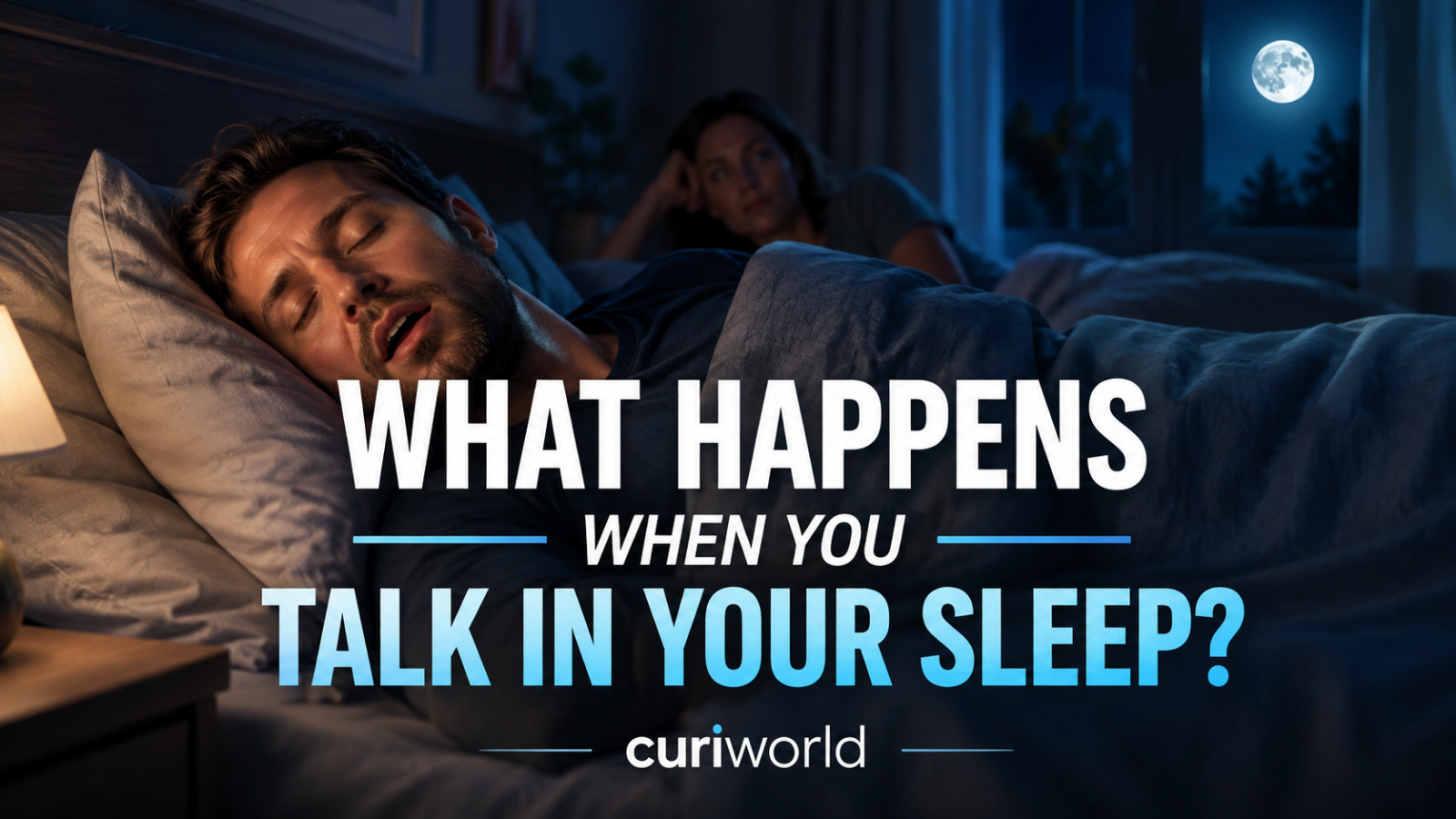
Someone beside you suddenly says your name at 2:17 a.m.
You answer.
There is a pause.
Then comes a sentence that makes absolutely no sense.
By morning, the person who said it remembers nothing.
This is sleep talking, also known as somniloquy. It can range from a quiet mumble to surprisingly clear sentences, laughter, shouting, or fragments of what sounds like a conversation. In most cases, the person speaking remains asleep and has no idea it happened.
The strange part is that the sleeping brain is not simply switched off. Some systems remain active enough to produce language-like vocalizations even while normal conscious awareness is greatly reduced.
And no, sleep talking is not a reliable way to discover someone’s secrets.
What Is Sleep Talking?
Sleep talking is exactly what the name suggests: vocal speech produced while a person is asleep.
The American Academy of Sleep Medicine classifies sleep talking, or somniloquy, among isolated symptoms and normal variants associated with sleep. It can occur on its own or alongside other sleep behaviors.
A sleep-talking episode might consist of one word, a few seconds of mumbling, an emotional outburst, or a more structured sentence.
Some speech is completely unintelligible. Other episodes can sound surprisingly normal.
The person speaking is usually unaware of what is happening and often learns about it only because a partner, family member, roommate, or sleep recording captures the episode.
What Is Happening in Your Brain When You Talk in Your Sleep?
Sleep is not a single, uniform state.
During the night, the brain cycles through different stages, including non-rapid eye movement (NREM) sleep and rapid eye movement (REM) sleep.
Sleep talking can happen during both REM and NREM sleep.
That matters because it means there is no single sleep stage responsible for every episode.
Researchers still do not fully understand exactly how sleep talking is generated. Scientific research suggests that language-processing and motor systems can sometimes become active enough to produce vocalizations without the person reaching normal waking consciousness.
In simple terms, parts of the sleeping brain can become active enough to generate speech without fully waking you up.
Sleep contains many examples of this blurry boundary between sleeping and waking. Curiworld’s explanation of why we sometimes wake up just before an alarm goes off explores another fascinating example of how much timing and biological activity continue beneath conscious awareness.
Are You Dreaming When You Talk in Your Sleep?
Sometimes there may be a connection, but it is not safe to assume that every spoken sentence is a direct narration of a dream.
Dreaming is especially vivid during REM sleep, but dreams and other forms of mental activity can occur during different stages of sleep.
Because sleep talking can happen during both REM and NREM sleep, a spoken phrase cannot automatically be interpreted as someone describing a dream.
A person might suddenly say:
“Get the blue suitcase!”
That does not necessarily mean there was a blue suitcase in the dream.
The phrase could be connected to ongoing mental activity, a fragmented memory, or a temporary burst of language production that does not correspond to a coherent dream at all.
Most sleep talkers also have no memory of the statement after waking.
Does Sleep Talking Reveal What Someone Really Thinks?
This is one of the biggest myths surrounding sleep talking.
Movies and jokes sometimes treat sleeping people as human truth machines: ask them a question while they are asleep and supposedly their deepest secrets will come out.
There is no good scientific basis for that idea.
The American Academy of Sleep Medicine notes that the content of sleep talking has not been shown to reliably reflect previous waking behavior or memories.
Sleep speech can contain recognizable grammar, emotions, names, and meaningful words. But that does not make it a truthful transcript of someone’s conscious thoughts.
If your partner says something strange while asleep, it should not be treated as evidence of a hidden opinion, intention, memory, or secret.
The sleeping brain is operating in a very different state from the waking brain having a deliberate conversation.
Can You Have a Real Conversation With a Sleep Talker?
It may sometimes seem that way.
A sleeping person might respond after someone else speaks. Their timing can even make the exchange sound intentional.
But apparent responsiveness does not necessarily mean the person is awake in the normal sense.
You might ask:
“Where did you put the keys?”
And receive the answer:
“They’re behind the green train.”
That does not mean you have discovered a mysterious nighttime memory-retrieval system.
The answer might be partially connected to something happening in the sleeping brain—or it might be completely unrelated.
Sleep talkers are generally not participating in conscious conversation in the way an awake person would.
Why Don’t Sleep Talkers Remember What They Said?
Because producing speech does not necessarily require fully waking up.
The brain systems involved in creating sounds or words can become temporarily active without the broader level of awareness needed to form a normal waking memory.
This creates one of the strangest parts of sleep talking.
One person may remember hearing an entire nighttime speech.
The person who delivered it remembers absolutely nothing.
Memory gaps are not unique to sleep talking. Sleep-wake transitions can produce many unusual sensations and movements.
For example, Curiworld’s guide to strange things your body does and the science behind them explains hypnic jerks—the sudden involuntary movements that can happen just as you begin falling asleep.
How Common Is Sleep Talking?
Sleep talking appears to be surprisingly common.
Research summarized by the American Academy of Sleep Medicine suggests that around two-thirds of people may experience sleep talking at least once during their lives.
That does not mean most people regularly hold nighttime conversations.
For many people, it happens only occasionally.
The exact frequency is also difficult to measure because people who sleep alone may never know they talk in their sleep.
Unless a partner hears you, someone records you, or the episode wakes you up, the behavior can easily go unnoticed.
So some people may have talked in their sleep without ever discovering it.
Why Do Some People Talk in Their Sleep More Than Others?
There is no single cause that explains every episode.
Sleep talking can appear on its own, but several factors may make unusual nighttime behavior more noticeable.
Sleep disruption, irregular sleep schedules, stress, sleep deprivation, illness, and other sleep disorders may sometimes occur alongside episodes of sleep talking.
Children also appear to experience sleep talking relatively often.
However, hearing someone occasionally mumble during the night does not automatically mean that stress or illness is responsible.
For many people, sleep talking is simply part of normal variation in sleep behavior.
Does Sleep Talking Mean Something Is Wrong?
Usually, isolated sleep talking is considered harmless.
An occasional word, sentence, laugh, or nighttime mumble generally does not indicate that someone has a neurological or psychiatric disorder.
That distinction matters because sleep talking is often discussed alongside parasomnias, a group of unusual behaviors or experiences that occur during sleep.
Some parasomnias are minor.
Others can involve more significant movements or safety concerns.
Sleep talking can also occur alongside conditions such as sleepwalking, disorders of arousal, or REM sleep behavior disorder.
The important factor is therefore not simply whether someone speaks during sleep, but what else happens during the episode.
When Should Sleep Talking Be Checked by a Doctor?
Occasional sleep talking without other symptoms usually does not require treatment.
It is worth discussing nighttime behavior with a healthcare professional or sleep specialist when the vocalizations occur together with other concerning behaviors, such as:
- violent kicking or punching;
- physically acting out dreams;
- repeated sleepwalking;
- intense confusion or agitation during the night;
- choking, gasping, or unusual breathing sounds;
- injuries to the sleeper or someone nearby;
- frequent episodes that seriously disrupt sleep;
- a sudden and unexplained major change in nighttime behavior.
Those signs do not automatically mean that a serious disorder is present.
They simply make it more important to distinguish ordinary sleep talking from another sleep-related condition.
Can Sleep Talking Wake You Up?
Yes, although many people sleep straight through it.
A person can speak, mumble, laugh, or shout while remaining asleep.
In some cases, vocalization can occur around a brief arousal and the person may partially or completely wake afterward.
More often, the person who becomes fully awake is the partner lying beside them.
That is why sleep talking can sometimes disturb another person’s sleep more than the sleep of the person actually talking.
Why Can Sleep Speech Sound So Normal?
Producing language is incredibly complicated.
Even an ordinary sentence requires the brain to coordinate vocabulary, grammar, breathing, vocal muscles, timing, and sound production.
Yet some of those systems can apparently remain organized enough during sleep to produce recognizable speech.
Researchers studying sleep talking have found that nighttime speech can preserve elements of normal linguistic structure.
Some statements follow grammatical patterns.
Some contain emotional expression.
Others are fragmented or impossible to understand.
That makes sleep talking scientifically interesting because it offers researchers a rare opportunity to observe what the brain can do when conscious awareness is dramatically altered.
Can People Swear or Shout While Talking in Their Sleep?
Yes.
Sleep speech is not always quiet or polite.
Some episodes involve shouting, emotional statements, laughter, or profanity.
That can make sleep talking particularly memorable for the person listening.
But dramatic content does not necessarily make the statement more meaningful.
A loud or emotional sentence should still not be treated as a reliable window into the person’s hidden thoughts.
Sleep speech can be unusual precisely because normal conscious control is reduced.
Can You Stop Yourself From Talking in Your Sleep?
There is usually no reason to try if episodes are occasional and harmless.
Because the person is asleep and generally unaware of the behavior, consciously deciding not to talk is obviously difficult.
If episodes seem connected with poor sleep, maintaining more regular sleep habits may be useful for overall sleep quality.
That includes getting adequate sleep, maintaining a reasonably consistent sleep schedule, and addressing persistent sleep disruption.
But there is no universal trick that guarantees someone will stop sleep talking.
If the episodes are severe or occur alongside other unusual nighttime behaviors, the underlying sleep problem matters more than the talking itself.
Should You Wake Someone Who Is Talking in Their Sleep?
Usually, there is no need.
If the person is peacefully mumbling and appears physically safe, allowing them to continue sleeping is generally reasonable.
Waking someone abruptly can sometimes leave them confused or disoriented, particularly if the episode is connected with another type of parasomnia.
Safety becomes more important if the person is moving around, behaving violently, appearing unable to breathe normally, or placing themselves or someone else at risk.
In those circumstances, the unusual behavior—not simply the speech—is what deserves attention.
The Sleeping Brain Is Quieter, Not Inactive
Sleep talking reveals something much bigger than a few strange nighttime sentences.
Going to sleep does not mean the brain shuts down until morning.
It continues cycling through different states, regulating the body, processing information, generating dreams, organizing memories, responding to the environment, and sometimes producing behavior that crosses the boundary between sleeping and waking.
Sleep talking is one audible example of that hidden activity.
For most people, an occasional nighttime sentence is simply a harmless curiosity.
And whatever bizarre declaration someone makes at 3 a.m. probably belongs where it came from: somewhere in the strange territory between sleep and waking—not in a courtroom, relationship argument, or interrogation about hidden secrets.
Sources
American Academy of Sleep Medicine — International Classification of Sleep Disorders, Third Edition, Text Revision: Parasomnias / Sleep Talking
View the American Academy of Sleep Medicine source
Alfonsi, V., D’Atri, A., Scarpelli, S., Mangiaruga, A. & De Gennaro, L. — Sleep Talking: A Viable Access to Mental Processes During Sleep — Sleep Medicine Reviews






Join the discussion