12 Strange Things Your Body Does—and the Science Behind Them
Your body sneezes at sunlight, wrinkles its fingertips, moves your eyes while you stare, and sometimes jolts you awake. Here is the science behind 12 strange body reactions.
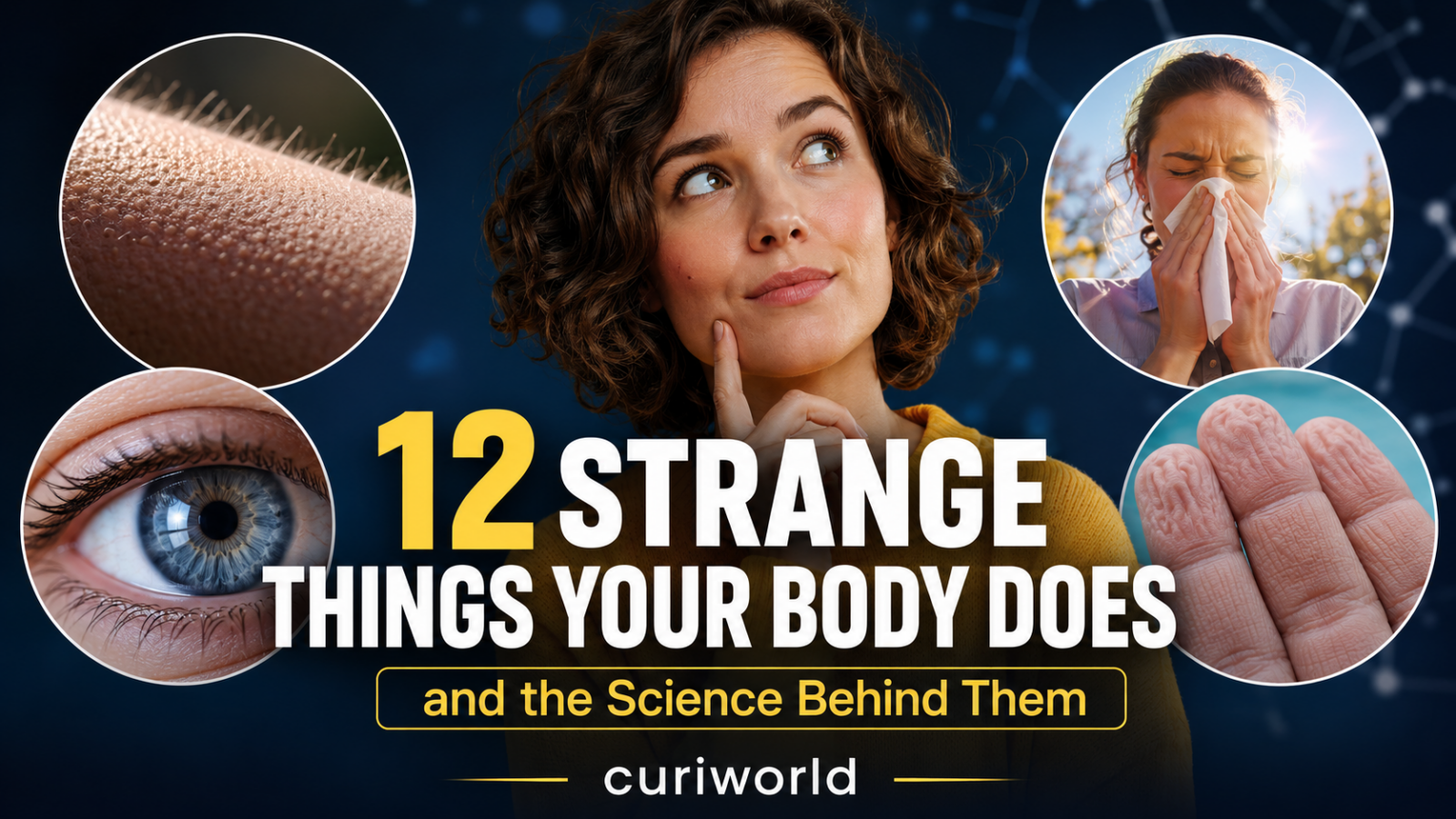
Your body spends much of the day doing things you never consciously request. It raises tiny hairs when a song hits the right note, switches airflow between your nostrils, moves your eyes while you are trying to hold them still, and occasionally jolts you awake just as sleep begins.
Many strange body reactions are automatic responses controlled by the nervous system, muscles, blood vessels or sensory pathways. Scientists understand some of them very well, while the purpose of others—such as yawning and hypnic jerks—remains surprisingly uncertain. Here are 12 everyday examples and what the evidence actually tells us about them.
Why Does the Human Body Do So Many Strange Things?
Most “weird” body reactions are not random glitches.
They are usually automatic responses controlled by the nervous system, muscles, blood vessels, reflex circuits or sensory pathways.
Some have clear functions. Others appear to be side effects of systems that evolved for broader purposes. And a few—such as yawning or hypnic jerks—are familiar enough to experience every day even though scientists still debate exactly why they happen.
The important distinction is between:
- how a reaction happens,
- what triggers it,
- and why evolution preserved it.
Science often understands the first two better than the third.
1. You Get Goosebumps from Cold, Fear—and Sometimes Music
Goosebumps have a technical name: piloerection.
Each hair follicle is connected to a tiny arrector pili muscle. When sympathetic nerves activate those muscles, they contract and pull the hairs upward, producing the little bumps that appear across the skin.
For fur-covered mammals, raising the hair can help trap insulating air. Humans have far less body hair, so that warming effect is much less useful. Yet the same circuitry can still respond to cold and intense emotional stimuli.
The system may be more biologically interesting than a simple evolutionary leftover. Research has found that sympathetic nerves and arrector pili muscles are closely connected with hair-follicle stem cells. In animal studies, cold-induced sympathetic activity influenced those stem cells as well as producing piloerection.
That does not mean getting goosebumps makes human hair grow. It does show that the familiar bumps on your arms belong to a much more sophisticated skin-and-nerve system than they appear to.
Music can trigger a surprisingly physical response too. Curiworld explores this in why some songs give you chills and goosebumps.
2. Bright Sunlight Can Make Some People Sneeze

Walk out of a dark building into strong sunshine and, for some people, a sneeze arrives almost immediately.
This is known as the photic sneeze reflex.
Ordinary sneezing begins when sensory pathways detect irritation in the nose. Photic sneezing is stranger because the trigger is a sudden increase in light rather than something entering the nasal passages.
The exact neural mechanism is still unresolved. One possibility is that signals associated with intense visual stimulation interact with nearby pathways involving the trigeminal nerve and the sneeze reflex.
Genetics appears to matter. Large genetic studies have identified variants associated with susceptibility to the reflex, supporting the idea that it can run in families.
So if stepping into sunlight makes you sneeze, you are not imagining the connection—and you are far from alone.
3. A Hiccup Is a Tiny Respiratory Chain Reaction
That abrupt hic is not simply your diaphragm twitching.
A hiccup, medically called singultus, begins with an involuntary contraction involving the diaphragm and often the intercostal muscles between the ribs. That is followed by rapid closure of the glottis, producing the characteristic sound.
Researchers describe a hiccup reflex arc involving the vagus and phrenic nerves, sympathetic pathways, the central nervous system, and the muscles involved in breathing.
What is less certain is why humans retain the reflex at all.
For ordinary hiccups, that mystery does not matter much: most episodes disappear on their own. Clinically, duration makes a difference. Hiccups continuing beyond 48 hours are considered persistent rather than a routine brief episode and may warrant medical assessment.
4. “Brain Freeze” Is Real Enough to Have a Medical Classification
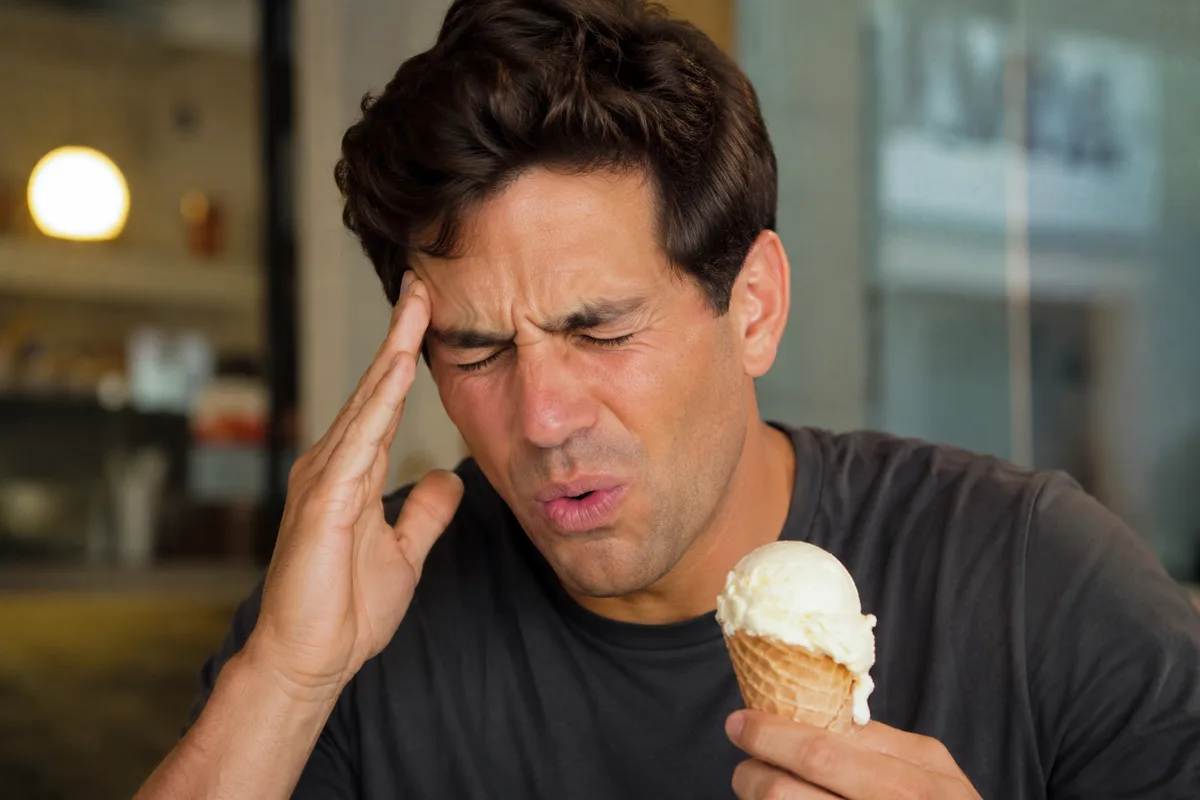
The sudden forehead pain after a large mouthful of ice cream sounds almost comically informal, but “brain freeze” has a formal place in headache medicine.
The International Classification of Headache Disorders recognizes it as a headache triggered by the ingestion or inhalation of a cold stimulus. It typically appears soon after something very cold contacts the palate or back of the throat and resolves quickly after the stimulus disappears.
What is happening inside the nervous system is less settled.
Researchers have reported different vascular findings, which is one reason it is misleading to reduce brain freeze to a simple story about blood vessels suddenly expanding or contracting.
The pain is real. The complete mechanism is still being worked out.
5. Your Body May Jolt Just as You Fall Asleep
You are almost asleep when a leg kicks, an arm jerks, or your entire body suddenly jumps.
These movements are called hypnic jerks, hypnagogic jerks, or sleep starts. They are abrupt involuntary muscle contractions associated with the transition from wakefulness into sleep and are widely reported in otherwise healthy people.
They can also arrive with the sensation that you are falling.
That has produced a popular explanation: your muscles relax, your brain mistakenly thinks you are falling, and it fires a movement to save you.
It is a memorable story, but it is not an established scientific explanation.
Researchers have proposed several mechanisms, including activity arising from brainstem systems during the unstable transition between wakefulness and sleep. Stress, fatigue, sleep deprivation, and stimulants such as caffeine may make hypnic jerks more noticeable.
Scientists therefore understand the phenomenon better than they understand its ultimate cause.
6. Your Fingers Do Not Wrinkle in Water Simply Because They “Soak It Up”
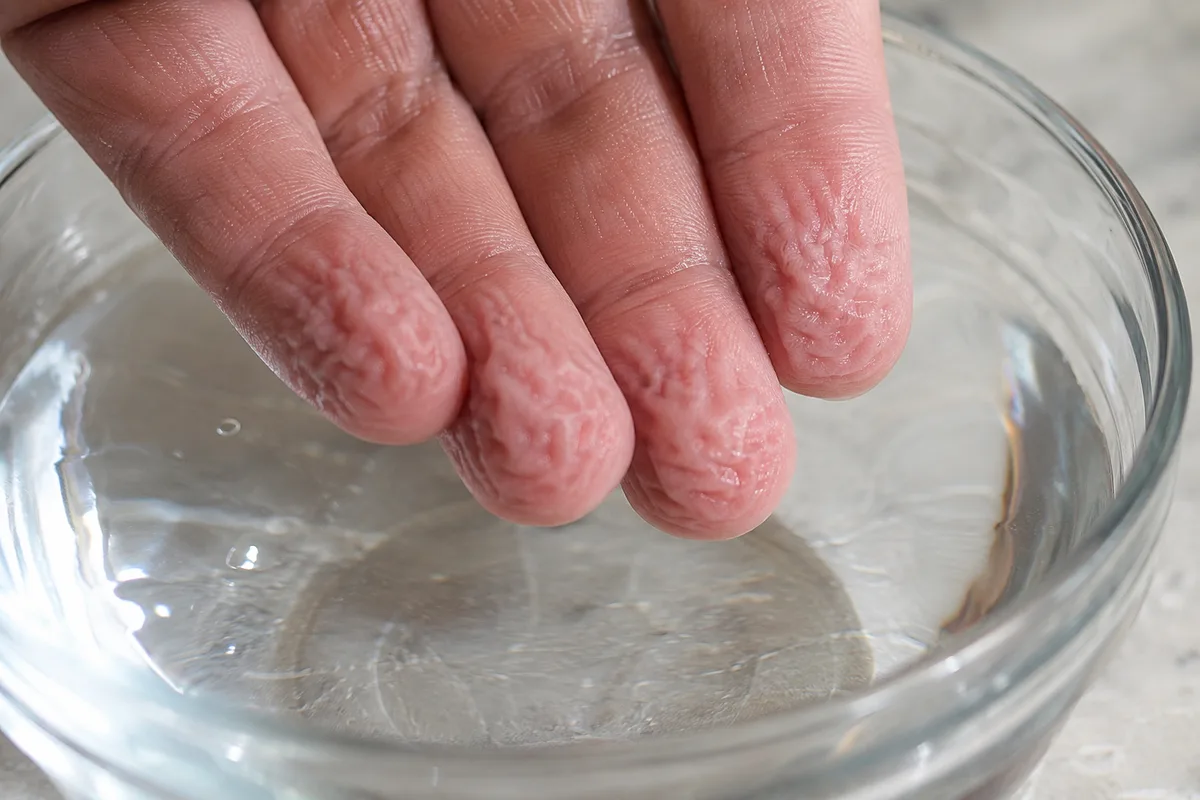
The prune-like fingertips you get after a long swim were once explained mainly as water swelling the outer skin.
The actual process is more active.
Experiments have shown that water-induced wrinkling is associated with sympathetic nerve activity and constriction of blood vessels in the fingers. Reduced volume beneath the skin helps create the characteristic ridges and valleys.
Why this response evolved is less certain. One proposed explanation is that wrinkled fingertips improve grip on wet objects, but experimental results have been mixed. The nerve-controlled mechanism of wrinkling is therefore better established than its proposed evolutionary advantage.
7. One Nostril Is Usually Doing More Work Than the Other
Try breathing through your nose and paying close attention. One side may feel noticeably more open.
A few hours later, the advantage may switch.
This is the nasal cycle, a normal pattern in which tissues inside the nasal passages alternately become more and less congested. As resistance increases on one side, airflow tends to become greater through the other.
Most people never notice because total nasal airflow can remain comfortable.
The pattern is influenced by the autonomic nervous system, sleep, body position, and other factors. Research in healthy adults has shown that the cycle can change between waking and sleeping and that lying on one side may alter airflow between the two nostrils.
Your nose, in other words, is not necessarily blocked just because one nostril feels quieter. It may simply be taking its turn.
8. Your Eyelid Can Start Twitching Without Your Permission
A tiny eyelid twitch can feel enormous to the person experiencing it even when nobody else can see it.
The common phenomenon is called eyelid myokymia. It usually consists of fine, spontaneous contractions of the orbicularis oculi muscle around the eye and commonly affects the lower eyelid.
The precise cause is not fully understood. Fatigue, stress, and caffeine are frequently associated with episodes, and most isolated cases are temporary and benign.
One useful distinction is that ordinary eyelid myokymia usually remains localized. Twitching that persists, spreads into other facial muscles, forces the eye shut, or appears with other neurological symptoms is not the same everyday phenomenon and deserves professional evaluation.
For the typical occasional twitch, however, your eyelid is essentially producing tiny involuntary bursts of muscle activity without waiting for conscious instructions.
9. Why Does Your Stomach Growl Even When You Are Not Hungry?
A loud abdominal rumble in a silent room feels like your stomach publicly announcing that it needs food.
That interpretation is only partly right.
The sounds—often called borborygmi—come from movement of gas and fluid through the gastrointestinal tract. They occur during digestion, but some particularly noticeable sounds happen during fasting.
Between meals, the stomach and small intestine undergo recurring waves of electrical and muscular activity known as the migrating motor complex. These cycles help move leftover material through the digestive tract during fasting periods.
That means a rumbling abdomen can accompany the gut’s normal housekeeping movements even if you do not consciously feel hungry.
The noise is not your stomach asking for lunch in words. It is the sound of a muscular transport system at work.
10. Why Do Your Eyes Keep Moving Even When You Stare at Something?
Fix your gaze on a single letter on this page.
It feels as though your eyes have stopped moving.
They have not.
Even during visual fixation, the eyes make tiny movements that include drift, tremor, and rapid movements called microsaccades.
These movements are connected with visual attention and processing. Researchers have found relationships between microsaccade patterns and shifts in both external and internally directed attention.
Scientists continue to study exactly how different fixational eye movements contribute to functions such as maintaining clear vision and stabilizing what we see.
The broader lesson is simpler: seeing is an active process. Even when you think your eyes are perfectly still, the visual system is constantly making microscopic adjustments.
11. Why Does Your Body Shiver When You Are Cold?
Shivering may feel like your body is malfunctioning in the cold. Physiologically, it is almost the opposite.
Cold-sensitive pathways send information toward thermoregulatory systems in the brain. When maintaining body temperature requires more heat production, skeletal muscles begin involuntary contractions.
Those contractions consume metabolic fuel and generate heat.
In cold-exposed adults, shivering thermogenesis can become one of the body’s major sources of additional heat production. The response works alongside measures that reduce heat loss, particularly constriction of blood vessels near the skin.
The precise muscles recruited and the mixture of carbohydrates and fats used as fuel vary considerably between people.
Yet the basic strategy is elegantly simple: if the environment is pulling heat away faster than you want, make the body’s biggest heat-producing tissue—skeletal muscle—start working without waiting for a voluntary workout.
12. Why Do We Yawn—and Why Is Yawning Contagious?
Yawning looks simple: the mouth opens, a deep inhalation occurs, muscles around the jaw and airway stretch, and the movement ends with a shorter exhalation.
Explaining why it happens has proved much harder.
Yawning is strongly associated with transitions in arousal, including periods around waking and sleep. Researchers have proposed roles involving arousal regulation, brain temperature, social communication, and airway mechanics.
None has become a universally accepted single explanation.
Recent scientific reviews continue to describe yawning as a complex muscular movement while emphasizing that there is still no consensus on its primary function.
That uncertainty is itself one of the most interesting facts on this list. A behavior performed by humans every day—and observed across many vertebrate species—still does not have one definitive scientific explanation.
Are These Strange Body Reactions Usually Normal?
Most of the reactions in this list are common parts of normal human physiology.
Occasional hiccups, goosebumps, yawning, hypnic jerks, wrinkled fingers after water exposure or sneezing in bright light are not usually signs that something is wrong.
Context matters, however.
A familiar body reaction deserves more attention when it becomes unusually frequent, severe, painful, persistent or appears alongside other new symptoms.
The point of understanding these reactions is not to diagnose every twitch or sneeze.
It is to recognize that many surprisingly strange things the body does are ordinary consequences of complex systems working automatically.
Your Body Is Less Automatic Than It Looks—and More Automatic Than It Feels
These reactions may feel like biological glitches, but most involve coordinated nervous, muscular, vascular or sensory systems working automatically beneath conscious awareness. Science can often explain how a reaction happens even when its evolutionary purpose remains uncertain.
That is what makes everyday human biology so interesting: goosebumps, hiccups, wrinkled fingers and microsaccades can be described in remarkable detail, while familiar behaviors such as yawning and hypnic jerks still leave scientists with unanswered questions.
Sources
Shwartz, Y. et al. — “Cell Types Promoting Goosebumps Form a Niche to Regulate Hair Follicle Stem Cells” — Cell / PubMed
View source
Wang, M. et al. — “A Genome-Wide Association Study on Photic Sneeze Reflex in the Chinese Population” — Scientific Reports
View source






Join the discussion