Why Do We Remember Things That Never Happened? The Science of False Memories
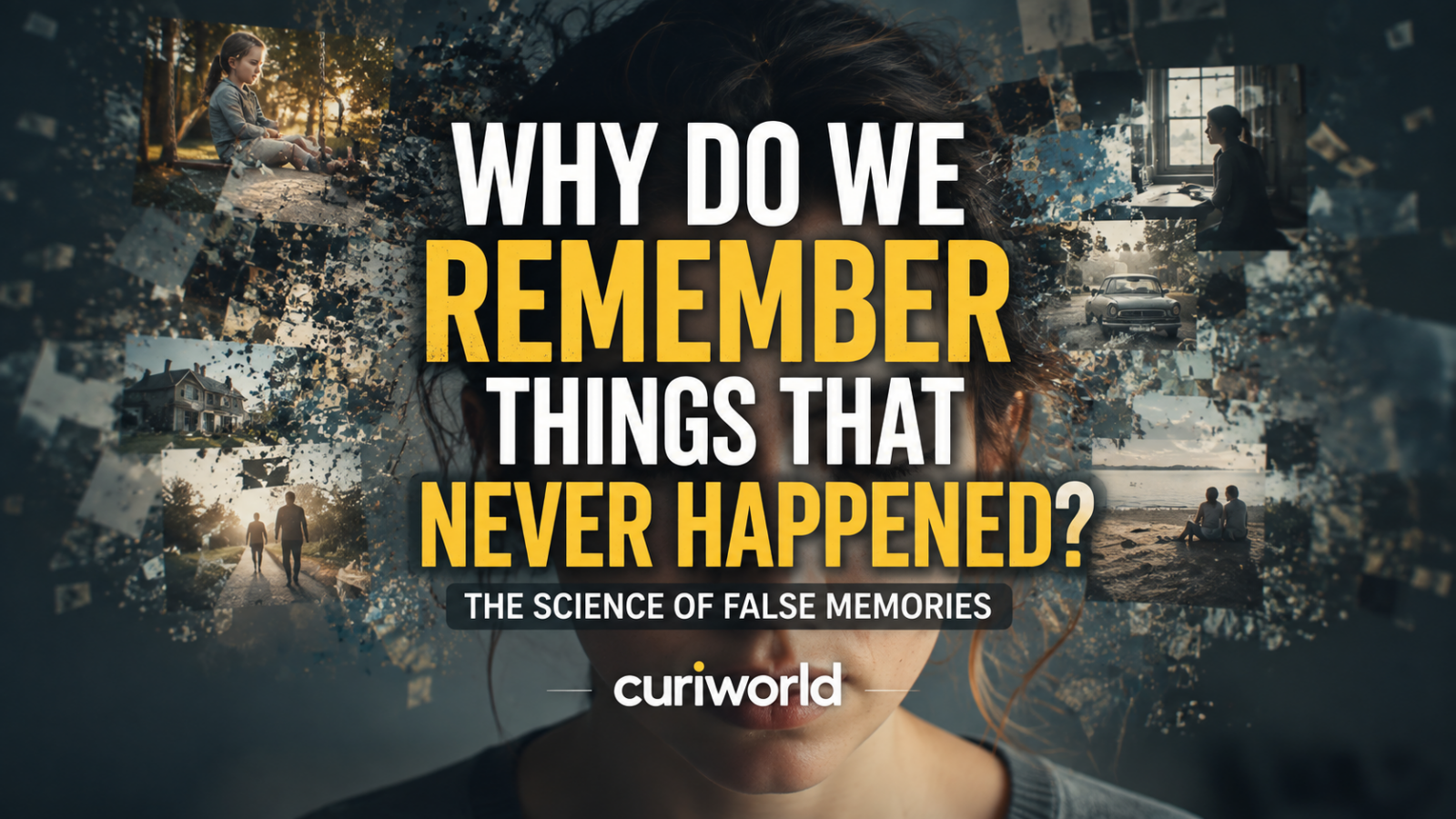
Memory is not a perfect recording of the past. The brain reconstructs experiences from stored details, expectations and later information, which means false memories can feel just as convincing as real ones.
You remember leaving your keys on the kitchen counter.
You can picture them there.
You may even remember walking past them before leaving the house.
Then someone finds the keys inside your coat pocket.
The strange part is not simply that you were wrong. It is how convincingly right the memory felt.
False memories can range from small everyday errors—remembering a word that was never said or confusing where you learned something—to much more elaborate recollections. They happen because human memory does not work like a camera that stores perfect recordings of experience.
Remembering is an act of reconstruction.
Each time the brain retrieves an event, it rebuilds that event from stored details, context, expectations, later information and the general meaning of what happened. Usually this system works remarkably well.
Sometimes, however, the reconstruction includes something that was never actually there.
The Short Answer: Memory Rebuilds the Past Rather Than Replaying It

A false memory is a recollection of something that did not happen as remembered—or, in some cases, did not happen at all.
That does not mean the person is lying.
Lying involves knowingly saying something believed to be untrue.
A person experiencing a false memory can sincerely believe the memory is accurate.
Research on memory distortion has shown that what people remember can be influenced by information encountered after an event, confusion about where a detail came from, expectations about what probably happened and the way related information is organized in memory.
One of the most studied examples is the misinformation effect: after people experience an event, misleading information introduced later can sometimes become incorporated into their recollection of the original event.
A 2024 systematic review in Psychonomic Bulletin & Review describes this effect as a consequence of the reconstructive nature of episodic memory and notes that people vary in how susceptible they are to it.
The unsettling lesson is simple:
A memory can feel real without being a perfect record of reality.
Your Brain Does Not Store an Entire Experience in One File
Think about what happens during an ordinary dinner.
You hear several conversations.
You notice what people are wearing.
You taste the food.
You look at your phone.
Someone tells a story.
Music is playing somewhere in the background.
You probably will not store every detail of that evening with equal precision.
Instead, different aspects of the experience are encoded and later connected into a meaningful episode.
Days afterward, if someone asks what happened, your brain reconstructs the dinner using the details that remain available.
It may accurately retrieve that your friend arrived late.
But perhaps you no longer remember whether they were wearing a blue or black jacket.
That gap does not necessarily remain visibly blank.
Memory often uses context, expectations and related knowledge to create a coherent reconstruction.
Most of the time, the result is close enough to be useful.
Sometimes the brain fills in the wrong detail.
False Memories Often Begin With Something That Really Happened
A false memory does not have to be completely invented.
Many memory errors involve genuine pieces of information arranged incorrectly.
You really saw a red car—but not at the accident you are remembering.
Someone really mentioned a broken window—but you heard about it afterward rather than seeing it yourself.
Your friend really told that funny story—but perhaps you gradually started remembering yourself as being present when it happened.
This matters because the brain has to remember not only information, but also its source.
Where did this detail come from?
Did I see it?
Did someone tell me?
Did I imagine it?
Did I read it?
Did I dream it?
Psychologists refer to the processes involved in making these distinctions as source monitoring.
False memories can arise when the content of a memory feels familiar but its source is incorrectly identified.
Familiarity Can Be Mistaken for Recollection
You have probably experienced a milder version of this problem.
A person’s face looks familiar, but you cannot remember where you know them from.
A sentence feels as though you have heard it before, but you cannot place it.
A location seems strangely recognizable even though you are certain you have never visited it.
Familiarity and detailed recollection are related, but they are not identical.
That distinction is also important for understanding what déjà vu is and why it happens. Déjà vu can involve a strong feeling of familiarity appearing without a convincing memory explaining its source.
False memory can involve the opposite problem: familiarity or remembered details become attached to the wrong event or source.
The brain is not simply asking:
“Do I know this?”
It is also trying to answer:
“Why do I know this?”
Sometimes the second answer is wrong.
What Is the Misinformation Effect?
The misinformation effect is one of the clearest demonstrations that later information can influence memory for an earlier event.
Imagine that you witness a minor traffic accident.
Later, someone tells you:
“The blue car ran the red light.”
But the car was actually green.
When you are questioned days later, you may remember seeing a blue car—even though the blue detail entered the story only afterward.
This does not happen to everyone every time.
But decades of research have shown that post-event information can distort recollection under certain conditions.
The 2024 systematic review by Maryanne Brassil, Cian O’Mahony and Ciara Greene examined research on adults’ susceptibility to eyewitness misinformation. The authors found evidence that several cognitive abilities—including aspects of memory, perception and reasoning—can influence susceptibility, while emphasizing that no single trait appears to make someone completely immune.
In other words, false memory is not simply something that happens to “gullible people.”
Memory distortion reflects processes that are part of ordinary human cognition.
The Brain Remembers Meaning Better Than Every Tiny Detail
Another clue comes from the way memory handles meaning.
Suppose you hear these words:
bed
pillow
night
dream
tired
blanket
Later, someone asks whether the word sleep appeared in the list.
It did not.
Yet “sleep” fits the theme so perfectly that it may feel familiar.
Laboratory research on false memories has repeatedly shown that people can remember related information that was never actually presented.
Why?
Because memory does more than preserve individual details.
It also extracts gist—the general meaning, pattern or theme connecting them.
This is enormously useful.
If someone tells you a ten-minute story, you do not need to remember every word to understand what happened.
You preserve the important relationships.
The trade-off is that a strongly related detail can sometimes feel as though it belonged to the original experience.
Memory prioritizes meaning.
Perfect transcription is not its main job.
Expectations Can Quietly Fill in Missing Details
Your existing knowledge about the world also shapes what feels plausible in memory.
Imagine remembering a birthday party.
You might confidently picture:
a cake;
candles;
wrapped presents;
people singing.
Perhaps all of those things really happened.
But suppose there were no candles.
Because candles fit your mental model of a birthday celebration so naturally, they can become easy to imagine—and eventually difficult to distinguish from something you actually saw.
Psychologists often call organized knowledge structures like these schemas.
Schemas make thinking efficient.
You do not have to relearn what a restaurant, airport or classroom is every time you enter one.
But expectations can also influence reconstruction when details are incomplete.
Sometimes the brain remembers what normally happens rather than precisely what happened this time.
Repetition Can Make an Incorrect Detail Feel Familiar
Another complication is that memories are not retrieved only once.
We tell stories about them.
We think about them.
Other people mention them.
We look at photographs.
We hear different versions of what happened.
Each encounter gives the brain another opportunity to process information associated with the original event.
If an inaccurate detail is repeated, it can become increasingly familiar.
And familiarity itself can later be mistaken for evidence that the detail came from the original experience.
That does not mean hearing something twice automatically creates a false memory.
Human memory is far more complicated than that.
But repeated exposure can make the question of where a detail originated increasingly difficult to answer.
Why Can a False Memory Feel So Vivid?
This is one of the most important misconceptions.
People often assume:
If I remember it clearly, it must have happened that way.
Unfortunately, vividness and accuracy are not the same thing.
A memory can contain visual detail, emotion and a strong feeling of certainty while still containing errors.
Curiworld’s explanation of why certain smells bring back powerful memories makes the same important distinction. A scent can produce an extraordinarily vivid feeling of returning to the past without guaranteeing that every reconstructed detail is historically accurate.
The emotion can be real.
The familiarity can be real.
The confidence can be real.
That does not turn memory into video footage.
False Memories Are Not the Same as Forgetting
Forgetting and false remembering can produce very different experiences.
When you forget something, information may simply be difficult or impossible to retrieve.
You know there is a gap.
False memory can be more deceptive because the gap does not feel empty.
Something occupies it.
That difference becomes clearer when compared with everyday retrieval failures such as forgetting why you walked into a room.
In the doorway example, the original intention may become temporarily harder to access after the brain updates its representation of the current situation.
With a false memory, the problem can instead involve reconstructing or attributing information incorrectly.
One is:
“I can’t remember.”
The other can feel like:
“I remember exactly what happened.”
The second may actually be harder to recognize as an error.
Does This Mean We Cannot Trust Our Memories?
No.
The existence of memory errors does not mean human memory is useless.
That would be like saying vision cannot be trusted because optical illusions exist.
Memory usually performs an extraordinarily difficult job: preserving useful information about a constantly changing world while allowing new knowledge to update old information.
A rigid recording system might actually be less useful.
Imagine remembering every irrelevant detail of every experience with equal strength—the exact position of every cup, every sentence spoken nearby, every license plate you passed and every shadow on every wall.
Useful memory has to select, organize, connect and generalize.
Those abilities allow us to learn.
They also create opportunities for distortion.
False memories can therefore be understood partly as a cost of having a memory system designed for meaning and flexibility rather than flawless recording.
Can Two People Remember the Same Event Differently?
Very easily.
Two people standing in the same room do not necessarily experience the same event in identical ways.
They may look in different directions.
Pay attention to different details.
Interpret the same conversation differently.
Know different things beforehand.
Feel different emotions.
Later, they may also discuss the event with each other.
Their memories can therefore diverge without either person deliberately lying.
This is especially important whenever people say:
“But I remember it completely differently.”
That statement alone does not establish which memory is accurate.
Both people may correctly remember some details, misremember others and interpret still others differently.
Human disagreement is sometimes partly a disagreement between reconstructions.
Why Photos Do Not Always Settle the Question
Photographs can be valuable memory cues.
But once we see a photograph repeatedly, the photograph itself becomes part of our memory history.
You may eventually remember an event partly from experiencing it and partly from seeing images of it afterward.
Childhood memories provide a familiar example.
Do you genuinely remember standing beside that birthday cake at age three?
Or have you seen the photograph so many times that you can now imagine the scene effortlessly?
Sometimes there is no simple way to separate the two.
That does not make the memory meaningless.
It simply means that autobiographical memory can be assembled from several sources.
A False Memory Does Not Mean Something Is Wrong With You
Everyday memory errors are part of normal cognition.
Remembering a conversation slightly differently, confusing who told you something or inserting an expected detail into an old story does not by itself indicate a neurological or psychiatric problem.
At the same time, ordinary research on false memory should not be misused to claim that every uncertain, disputed or emotionally intense memory must therefore be false.
Memory accuracy has to be considered case by case.
The scientifically useful lesson is more modest:
human recollection is fallible, and subjective certainty alone cannot guarantee historical accuracy.
Can We Make Memories Less Vulnerable to Distortion?
We cannot turn human memory into a perfect recording system.
But several habits can help preserve the distinction between what happened and what was learned later.
If accuracy matters, record important details relatively soon after the event.
Separate what you personally observed from what someone else later told you.
Be cautious with leading questions such as:
“What color was the jacket?”
when it has not yet been established that there was a jacket.
A more neutral question would be:
“What do you remember the person wearing?”
And when new information appears, mentally label its source:
“I learned that afterward.”
That source distinction can matter.
The 2024 systematic review notes that stronger encoding, recognizing discrepancies and better source monitoring are among the mechanisms researchers are investigating as possible protections against misinformation effects.
None provides perfect immunity.
They can simply make reconstruction more careful.
Memory’s Imperfection Is Part of What Makes It Useful
False memories initially seem like evidence of a badly designed brain.
Look more closely, however, and they reveal something fundamental about why memory works the way it does.
Memory has to preserve the past while remaining flexible enough to incorporate new information.
It has to extract meaning rather than store every detail.
It has to connect related experiences.
It has to decide which information belongs together and where that information came from.
Most of the time, those processes give us a coherent and useful personal history.
Occasionally, they build something that feels like a memory even though part of the event never happened.
That is the unsettling—and fascinating—truth about false memories.
The past we remember is not simply retrieved.
Each time we remember it, the brain has to reconstruct it.
Sources
Brassil, Maryanne; O’Mahony, Cian; Greene, Ciara M. — “Do Cognitive Abilities Reduce Eyewitness Susceptibility to the Misinformation Effect? A Systematic Review” — Psychonomic Bulletin & Review (2024)
Read the peer-reviewed systematic review
Lentoor, Antonio G. — “Cognitive and Neural Mechanisms Underlying False Memories: Misinformation, Distortion or Erroneous Configuration?” — AIMS Neuroscience (2023)
Read the open-access review







Join the discussion