Why Do We Forget Why We Walked Into a Room?
Walking into a room and forgetting your purpose is more than a quirky lapse. Research on event boundaries reveals why it happens—and why doorways are not always to blame.
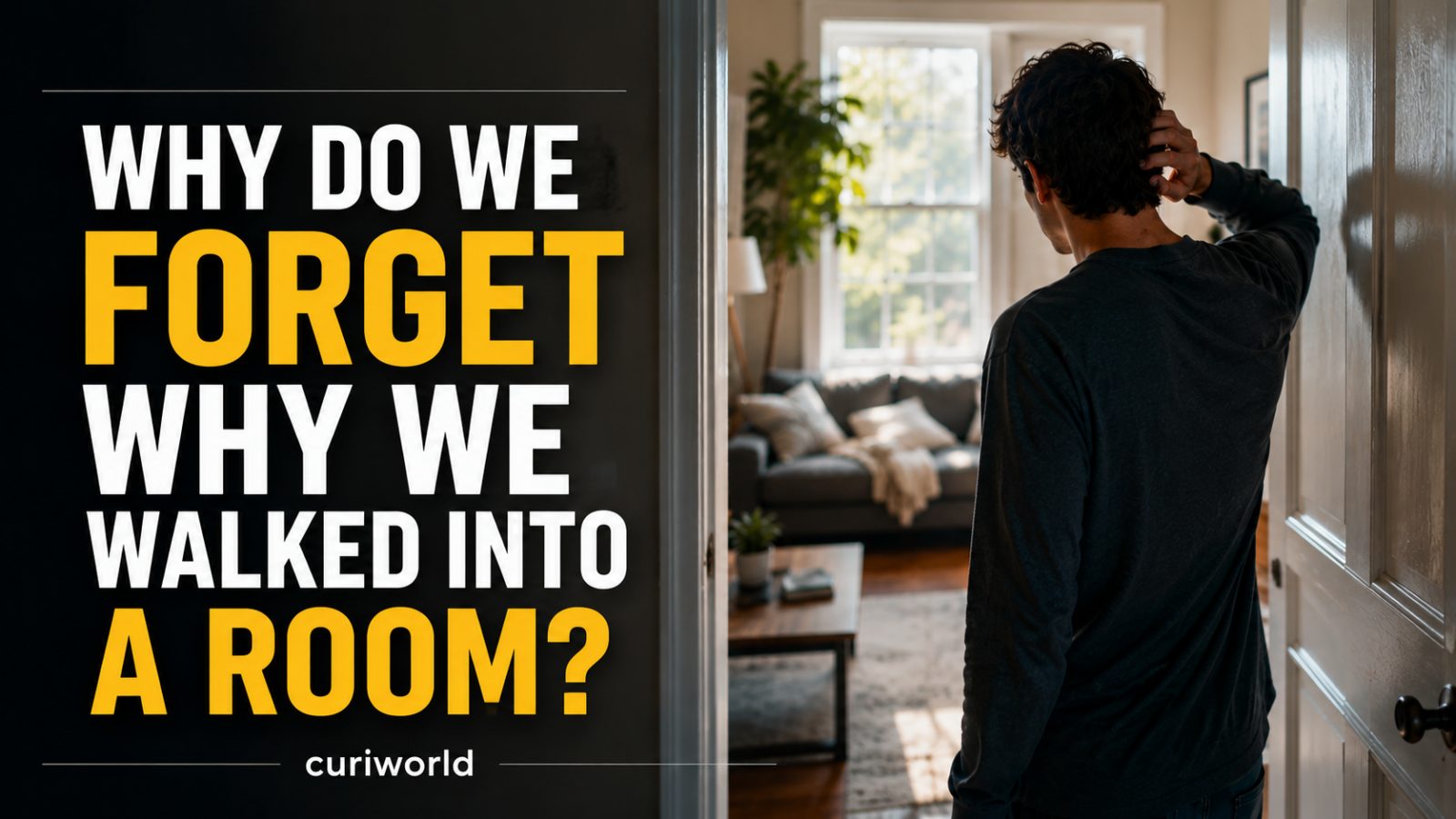
You stand up to get something, cross the hall, step into another room—and the reason for the trip suddenly disappears. Cognitive psychologists have a name for this familiar lapse: the doorway effect, sometimes called the location-updating effect.
The basic idea is not that a doorway erases a memory. Instead, moving into a new space can act as an event boundary, making the thought that belonged to the previous moment temporarily harder to retrieve.
That distinction matters. Research does support the idea that spatial boundaries can change what information is easiest to access, but the effect is not a guaranteed “brain reset.” Some experiments have found clear memory disruption after room changes, while others have found weak or no effect unless working memory was already under strain.
The Doorway Effect Is Really an Event-Boundary Effect
Daily life feels continuous, but the brain does not necessarily treat it as one unbroken stream. It organizes experience into meaningful episodes: making coffee, answering a message, leaving the house, beginning a meeting.
Changes in location, goals, people, or activity can signal that one event has ended and another has begun.
A doorway is an especially obvious boundary because it can bring several changes at once. The visual scene changes. The objects around you change. Your movement reaches a new destination. The goal that was active in one room may suddenly have to compete with information in the next.
Researchers studying event segmentation describe these transitions as moments when the brain updates its representation of the situation currently unfolding.
In a classic 2006 experiment, psychologists Gabriel Radvansky and David Copeland had participants move through virtual rooms while carrying and setting down objects. Information about recently encountered objects became less accessible after participants moved into another room.
The researchers interpreted the result through the idea of situation models—mental representations of what is happening in the current environment.
Your Brain Did Not Delete the Thought
The everyday experience can feel strangely absolute: one second you know exactly why you are walking toward the kitchen, and the next you have nothing.
But “forgotten” does not necessarily mean erased.
A more accurate description is that the intention has become less accessible.
While you are carrying out a simple goal—“get my glasses,” “charge the phone,” or “bring the scissors”—that goal has to remain sufficiently active to guide your next action. Crossing an event boundary may prompt the brain to update its model of the current situation.
Information associated with the previous event can then lose priority as the new room and its contents become more relevant.
This also helps explain why the missing thought may return seconds later. A cue can make the intention easier to retrieve again: noticing an empty coffee mug, looking toward the room you came from, or remembering what you were doing just before you stood up.
What changed may be access to the information rather than the existence of the memory itself.
A different memory effect explains why incomplete responsibilities can remain unusually persistent in your mind: why unfinished tasks stay in your head.
What the Studies Actually Show
The popular version of the doorway effect is simple: walk through a door, forget.
The research is more interesting than that.
The 2006 experiment that helped establish the effect found that moving into another virtual room made recently relevant information about objects harder to retrieve, even when researchers controlled aspects of the distance participants traveled.
A 2021 study published in BMC Psychology tried to reproduce doorway-related forgetting across four experiments using immersive virtual reality, passive video, and real-life movement.
The researchers found no significant doorway-related forgetting effect across the experiments overall.
One important exception appeared when participants were also performing a task that increased working-memory load. Under those conditions, recognition performance became more vulnerable to interference after crossing doorways.
A 2023 study pushed the idea in another direction. Participants viewed animations simulating movement through rooms. Their recognition memory was impaired not only after passing through a doorway, but also when they were tested just before reaching a doorway they were about to cross.
That suggested that anticipation of an upcoming event boundary may sometimes be enough to affect memory access.
More recent research has added another layer. In 2026, researchers reported a doorway effect in an immersive virtual-reality building when participants later had to remember the order and room context of objects they had encountered.
A demanding visuospatial distraction introduced in the middle of a room could also disrupt the organization of event memory.
That finding supports the idea that the underlying mechanism involves how experiences are divided into events rather than something uniquely powerful about physical doors.
Another 2026 study found that event boundaries can sometimes help organize information. Researchers studying word-list learning found limited evidence that splitting information across rooms could improve memory for material near the boundary, although the benefit was inconsistent and did not always persist across later room changes.
Event boundaries, then, are not simply bad for memory.
Their effects depend on what is being remembered, when memory is tested, how much attention is available, and how the experience is structured.
The fairest conclusion is more nuanced than the viral explanation: walking through a doorway does not automatically make everyone forget.
Why Distraction Can Make the Lapse Feel Worse
A doorway may be the moment when you notice the failure, but it is not always the only thing responsible for it.
Imagine deciding to get a charger, then checking a notification while walking, replying to a message, and entering the bedroom.
Your original intention is now competing with a new stream of information.
This matters because working memory has limited capacity. When attention is divided, a simple intention may become easier to lose.
The 2021 doorway study is particularly relevant here because its clearest doorway-related interference appeared when participants were already handling an additional working-memory demand.
That does not mean every phone glance causes the doorway effect, or that distraction is required for it to happen.
It does mean a fragile intention can be harder to maintain when attention is being pulled in several directions at once.
This is one reason the phenomenon can seem unpredictable.
On one trip across the house, the goal stays active without effort. On another, a conversation, notification, sound, interesting object, or second task becomes mentally prominent at exactly the wrong moment.
Can You Stop It From Happening?
There is no established “doorway effect cure,” but you can make an intention easier to retrieve before changing context.
A few simple strategies can help:
- Put the goal into words before moving. Saying “I’m going to the bedroom for my glasses” creates a stronger cue than silently holding the intention.
- Take a relevant cue with you. Carrying an empty mug toward the kitchen or a charging cable toward another room can keep the purpose of the trip visible.
- Avoid starting a second task during the trip when the first one matters.
- Use external memory aids for important tasks. Notes, reminders, checklists, and calendars are more reliable than expecting working memory to hold everything.
These strategies are not specific medical treatments for the doorway effect. They simply reduce how much you have to depend on a fleeting thought.
Does Forgetting at a Doorway Mean Something Is Wrong?
An isolated “why did I come in here?” moment is not a diagnostic test for a memory disorder.
Experimental research has observed doorway-related memory disruption in both younger and older adults, and ordinary forgetfulness can occur without indicating dementia.
What matters more from a health perspective is the broader pattern.
Memory changes deserve more attention when they become persistent, noticeably worsen, or interfere with daily life—for example, repeatedly getting lost in familiar places, becoming unusually confused, or struggling with tasks that were previously routine.
An occasional doorway lapse, by itself, cannot tell you whether anything is medically wrong.
A Doorway Is More Like Punctuation Than a Delete Key
The most useful way to understand this strange lapse is to look at what the brain is trying to accomplish.
Human memory has to keep track of a world that changes from moment to moment, and dividing experience into events is one way of keeping that information organized.
That system prevents an entire day from becoming one undifferentiated stream. It separates one episode from the next, directs attention toward what has changed, and helps structure memories around meaningful events.
The small cost is that a thought from the previous “chapter” can occasionally fall out of immediate reach.
So the next time you arrive in the kitchen with no idea why you are there, the doorway may have contributed to the moment—but it probably did not erase anything.
Your brain may simply have turned the page a little too efficiently.
Sources
Gabriel A. Radvansky & David E. Copeland — “Walking Through Doorways Causes Forgetting: Situation Models and Experienced Space” — Memory & Cognition (2006)
View the study at Springer Nature
Jessica McFadyen, Christopher Nolan, Ellen Pinocy, David Buteri & Oliver Baumann — “Doorways Do Not Always Cause Forgetting: A Multimodal Investigation” — BMC Psychology (2021)
View the open-access study







Join the discussion