Why Do You Think Your Phone Vibrated When It Didn’t? Phantom Vibration Explained
Feeling a phone vibration that never happened is surprisingly common. Phantom vibrations reveal how expectation and repeated phone habits can shape perception.
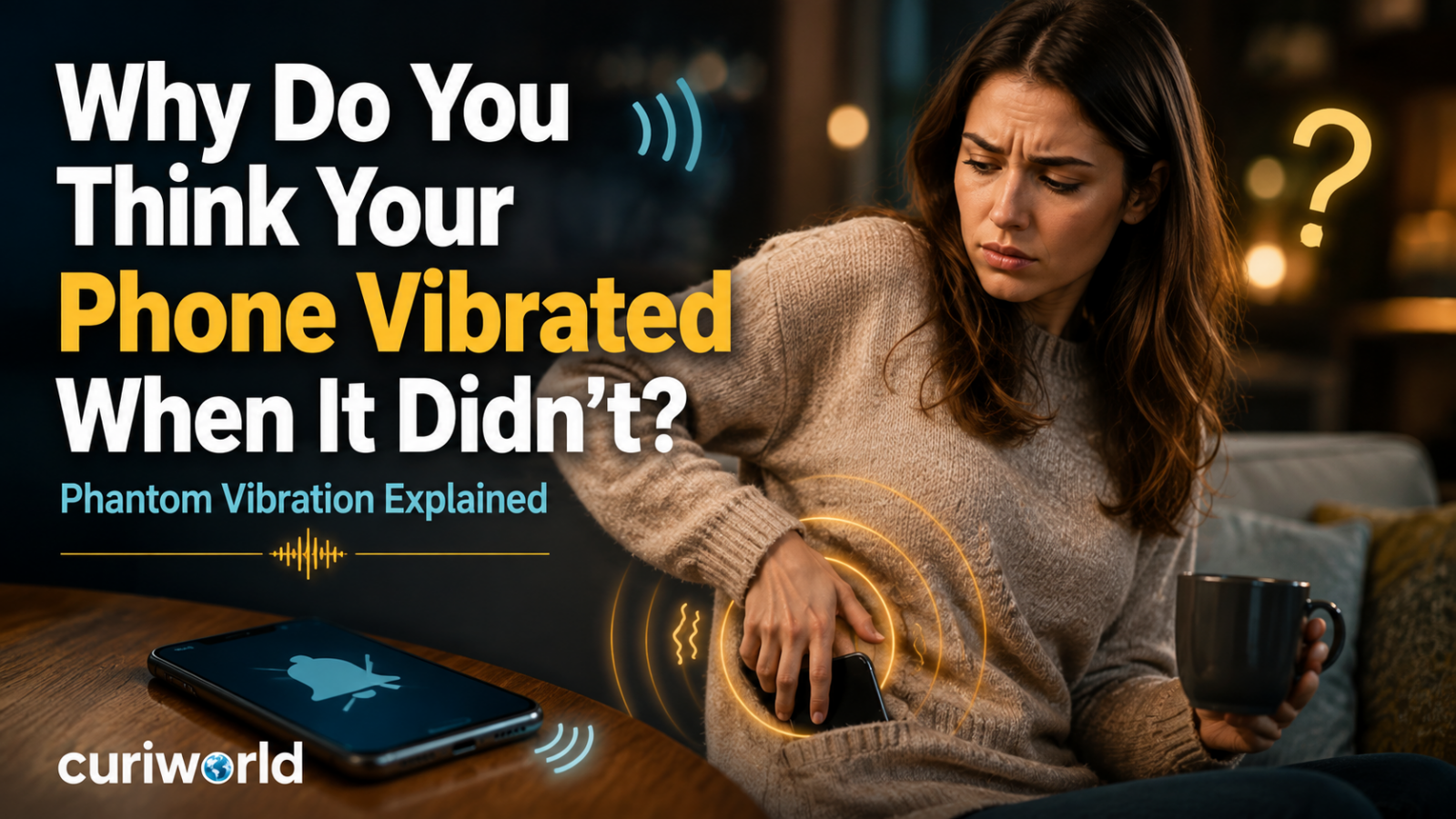
You are walking down the street when you suddenly feel it.
A quick buzz against your leg.
You reach into your pocket.
No message.
No call.
No notification.
Your phone did not vibrate at all.
A few minutes later, it happens again.
This surprisingly common experience is known as a phantom vibration: the sensation that your phone vibrated even though no vibration actually occurred.
It may sound strange, but research suggests phantom vibrations are common among frequent mobile-phone users. In one study of hospital staff, about 68% of participants reported experiencing them at least once.
The most likely explanation is not that your phone somehow vibrated invisibly.
It is that your brain has become very good at expecting a particular signal—and sometimes interprets an ordinary sensation as that familiar alert.
What Is Phantom Vibration Syndrome?
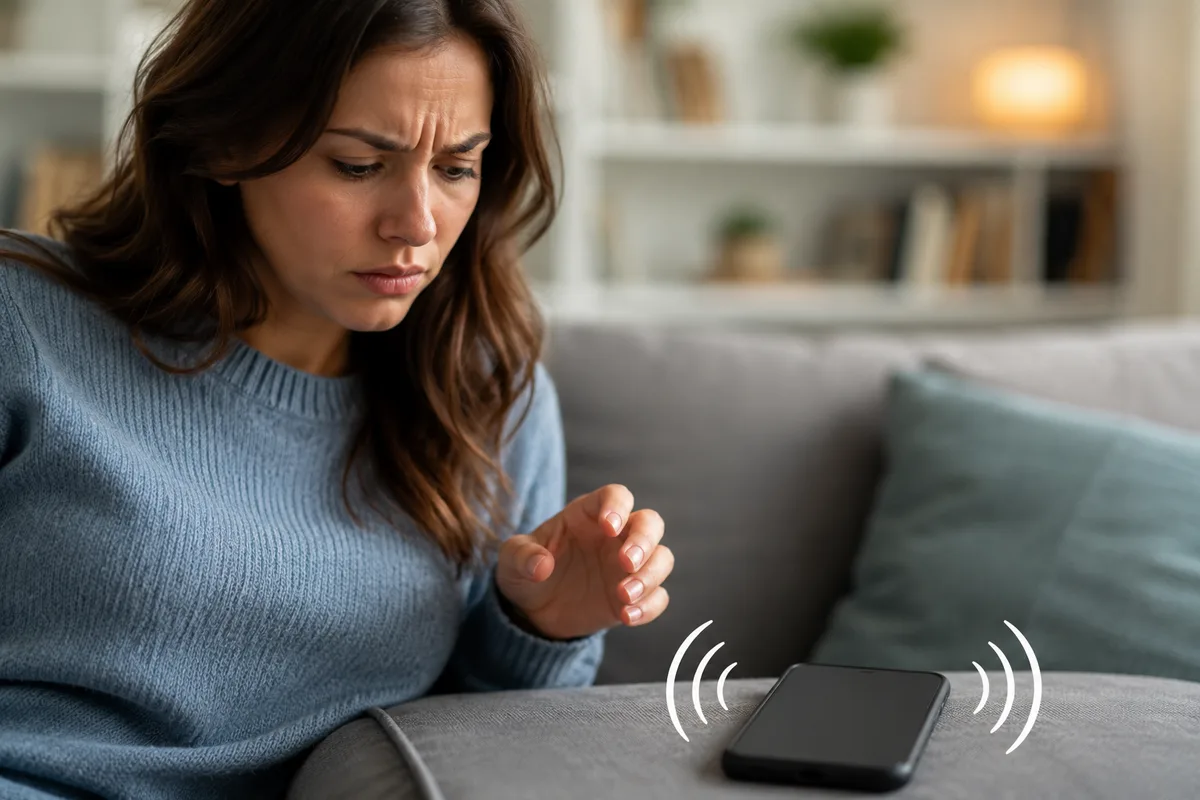
The term phantom vibration syndrome, often shortened to PVS, describes the false sensation that a mobile phone or similar device is vibrating when it is not.
A related phenomenon is phantom ringing, when someone believes they heard their phone ring even though no call or notification occurred.
A systematic review found that both experiences have been reported widely among mobile-phone users, although the research literature remains relatively limited and there is no universally accepted clinical diagnostic criterion for PVS.
That point matters.
Calling it a “syndrome” does not automatically mean it is a psychiatric disorder or medical disease.
For most people, it appears to be a benign perceptual error associated with frequent device use and expectation.
Your Brain Is Constantly Guessing What Sensations Mean
Your senses do not simply record the world like cameras and microphones.
The brain constantly interprets incoming information.
Imagine feeling a slight movement against your thigh.
The sensation could come from:
- fabric shifting,
- a muscle twitch,
- your keys moving,
- pressure from your pocket,
- the seam of your clothing,
- or your phone vibrating.
Your brain has to decide what caused it.
If you carry a phone in the same pocket every day and receive dozens of notifications there, one explanation becomes extremely familiar:
“That was my phone.”
Most of the time, that interpretation is correct.
Occasionally, it is not.
Expectation Changes What We Notice
Suppose you are waiting for an important message.
You know your phone may vibrate at any moment.
Your attention becomes more sensitive to sensations around the pocket where the device is sitting.
A tiny fabric movement that you would normally ignore may suddenly become meaningful.
Your brain asks:
“Was that it?”
And sometimes the answer feels like yes before you consciously verify it.
This fits a broader principle of perception:
what we expect can influence how ambiguous sensory information is interpreted.
The brain is not inventing sensation from absolutely nothing in every case.
Often there may be a real physical sensation—the mistake is in identifying its source.
It Is Similar to a False Alarm
A useful way to understand phantom vibration is through signal detection.
Imagine your brain is monitoring your body for one important signal:
phone vibration.
There are four possible outcomes:
- The phone vibrates and you notice it.
- The phone vibrates and you miss it.
- The phone does not vibrate and you correctly ignore everything.
- The phone does not vibrate but you think it did.
That last category is a false alarm.
If missing an important message feels costly, your brain may become more willing to respond to weak or ambiguous sensations.
In practical terms:
better to check unnecessarily than miss the call you were waiting for.
Repeated phone use may train that expectation even further.
Frequent Phone Use Seems to Matter
Research has repeatedly found associations between phantom sensations and how people use their devices.
In a study of medical staff, phantom vibrations were associated with factors including carrying the device for longer periods and using vibration mode more frequently.
Another study of medical interns found that phantom vibration was significantly associated with more frequent phone use and use of vibration mode.
A separate study of medical students found higher smartphone-use scores among those experiencing phantom vibration or ringing sensations.
These studies do not prove that phone use mechanically “damages” the brain.
A more reasonable interpretation is that repeated exposure may make the vibration signal highly familiar and expected.
Your Brain Learns the Exact Place Your Phone Lives
Think about where you normally carry your phone.
Perhaps:
- right front pocket,
- left back pocket,
- jacket pocket,
- waistband,
- handbag.
After thousands of notifications, your brain develops a very stable association:
sensation here = phone alert.
That location matters.
The hospital-staff study found that where a device was carried was associated with phantom vibration frequency.
This makes intuitive sense.
If your brain repeatedly receives the same vibration in the same patch of skin, it becomes highly practiced at detecting that pattern.
Eventually, ordinary sensations in that area may sometimes be misclassified.
Why Does Fabric Movement Feel So Much Like a Phone Vibration?
Phone vibrations are actually fairly simple sensory events.
They are brief mechanical movements applied through:
- clothing,
- a pocket,
- skin,
- and sometimes several layers of fabric.
That means the signal arriving at your nervous system is already somewhat noisy.
You are not touching the vibration motor directly.
You feel pressure and movement transmitted through materials.
Other things can create similar low-level sensations:
- jeans pulling while walking,
- a pocket seam shifting,
- keys moving,
- a muscle fasciculation,
- the phone itself sliding slightly,
- or fabric brushing against skin.
Your brain may recognize the pattern as “close enough.”
Why Does It Happen Even When the Phone Is Not in Your Pocket?
This is one of the strangest versions.
Someone leaves their phone on a desk and then feels a vibration in the usual pocket anyway.
That makes the experience feel almost supernatural.
But learned expectation does not disappear the moment the device moves.
If your phone normally stays in the same location for many hours every day, your brain can continue monitoring that area out of habit.
The same principle appears in many learned behaviors.
You may reach for a light switch in a room even after furniture has been rearranged.
You may check a watch that you forgot to put on.
You may instinctively reach toward the pocket where your phone normally lives.
The behavior continues briefly because the expectation remains active.
Is Phantom Vibration a Hallucination?
Research papers sometimes use terms such as tactile hallucination or hallucinatory experience when describing phantom vibrations.
But that language can sound more alarming than the phenomenon usually is.
A phantom vibration by itself is not equivalent to experiencing persistent hallucinations associated with neurological or psychiatric illness.
The systematic review found the phenomenon to be common among ordinary mobile-phone users, with relatively few people finding it seriously bothersome.
So context matters.
Feeling an occasional nonexistent phone buzz is quite different from experiencing frequent unexplained tactile sensations throughout the body.
How Common Are Phantom Vibrations?
Reported prevalence varies substantially between studies and populations.
For example:
- A study of hospital staff found 68% had experienced phantom vibrations.
- A longitudinal study of medical interns found a baseline prevalence of 78.1%, rising above 90% during parts of internship training before later decreasing.
- A 2022 study of medical students reported phantom vibration in 27.9%, with combined phantom vibration/ringing experiences in 44.9%.
- A 2026 university-student study reported phantom vibrations in 41.4% of respondents.
Those figures should not be combined into one universal prevalence estimate.
The studies use different populations, definitions and methods.
The useful conclusion is simpler:
phantom vibrations are not rare.
Does Stress Cause Phantom Vibrations?
Possibly in some circumstances, but the relationship is not simple.
One study of medical interns found phantom vibration and phantom ringing increased dramatically during internship while anxiety and depression scores also increased.
However, the researchers did not find a significant direct correlation between the phantom sensations and anxiety or depression scores.
Another study did find associations between phantom vibration and perceived stress among medical interns.
This mixed evidence means we should avoid the simplistic statement:
“Phantom vibration means you are anxious.”
A safer interpretation is that stress, attention, phone-use patterns and expectation may all influence the experience differently across people.
What About Smartphone Addiction?
Some studies have reported associations between higher problematic-smartphone-use scores and phantom vibration or ringing.
But again, association does not automatically prove causation.
Someone who uses a smartphone very frequently:
- receives more alerts,
- carries the phone longer,
- checks it more often,
- and develops stronger notification expectations.
Those same behaviors could increase the opportunity for phantom sensations.
So experiencing a phantom vibration does not, by itself, diagnose smartphone addiction.
Notifications Train Expectation
Modern phones are extraordinarily good at teaching us to respond to signals.
A vibration might mean:
- a message,
- a work email,
- a delivery update,
- a social-media reaction,
- a banking alert,
- a family call.
Some notifications are trivial.
Others may be important.
Because the meaning is unpredictable, people often check quickly.
Over time, this builds a powerful sequence:
vibration → attention shift → phone check → new information
The vibration becomes a cue.
Eventually the expectation may become strong enough that an ambiguous tactile sensation triggers the same response even without the original signal.
Curiworld’s article on what happens when you stop using social media for 30 days discusses a related pattern: repeated notifications and app cues can reinforce automatic checking behavior, and removing those cues can make the urge to check the phone more noticeable at first.
Why Do You Check the Phone Before Thinking?
Sometimes the sequence is extremely fast.
You feel something.
Your hand moves toward your pocket.
Only afterward do you think:
“Wait—did it actually vibrate?”
That is because frequently repeated actions can become highly automatic.
You do not consciously reason:
- detect tactile signal,
- compare against stored vibration pattern,
- estimate probability of notification,
- decide whether to inspect device.
You simply check.
The conscious explanation comes later.
Phantom Ringing Works in a Similar Way
Some people experience the auditory version.
They hear something that resembles their ringtone or notification sound.
They check the phone.
Nothing happened.
Common environmental sounds can contain features resembling familiar notification tones:
- distant music,
- appliances,
- another person’s phone,
- television audio,
- traffic sounds.
Once a ringtone becomes extremely familiar, your brain may occasionally detect that pattern in ambiguous sound.
This is analogous to hearing your name in a noisy room.
The brain is especially sensitive to signals that have become personally meaningful.
Why Does It Seem to Happen More When Waiting for Someone?
Expectation raises vigilance.
Imagine you sent an important message 20 minutes ago.
You are waiting for a response.
Now every small sensation around your pocket matters more.
Compare that with a day when your phone is on Do Not Disturb and you are not expecting anything.
The physical sensations against your leg may be almost identical.
But your brain assigns them different importance.
This is why phantom vibration is probably best understood as a combination of:
sensation + attention + expectation + learned association.
Can You Reduce Phantom Vibrations?
If they are occasional and do not bother you, there may be nothing you need to do.
But if they become annoying, changing the cues can help.
Practical experiments include:
- Keep the phone in a different pocket.
- Turn vibration off temporarily.
- Use a distinct vibration pattern.
- Reduce nonessential notifications.
- Leave the phone on a desk instead of carrying it constantly.
- Check messages at deliberate intervals instead of reacting to every possible buzz.
Interestingly, the hospital-staff study reported that some participants tried changing where they carried their device or switching vibration settings in response to phantom sensations.
The goal is not to “treat” the brain.
It is to weaken the repetitive cue pattern.
Does Putting the Phone Somewhere Else Help?
It may.
If the same patch of skin has become strongly associated with vibration alerts, moving the phone changes the sensory context.
For example:
front-right pocket → jacket pocket
Now ordinary fabric movements in the old location no longer predict real alerts.
This can reduce the learned association over time.
It is the same reason changing a habit’s environment can sometimes make an automatic behavior easier to notice.
Turning Off Vibration Can Be an Interesting Test
If you switch your phone to sound-only or completely silent notifications for several days and still occasionally feel phantom vibrations, that tells you something useful:
The sensation is not being generated by an unnoticed device vibration.
Your expectation has simply outlasted the signal.
Over time, if real vibration alerts stop occurring, the association may weaken.
Why Does the Experience Feel So Convincing?
Because perception is convincing by design.
When your brain concludes:
“Something touched me,”
you do not normally experience that conclusion as a hypothesis.
You experience it as reality.
Most perception works this way.
You do not consciously debate whether a chair exists before sitting down.
The nervous system rapidly converts incomplete sensory information into useful interpretations.
Usually those interpretations are correct.
Phantom vibration is interesting precisely because it exposes one of the rare moments when you can catch the prediction process making a small mistake.
Is Phantom Vibration Dangerous?
Occasional phantom vibration is generally described in research as common and usually not seriously bothersome.
The experience becomes more worth discussing with a clinician if:
- tactile sensations occur frequently when no device is involved,
- sensations spread beyond the usual phone location,
- they are accompanied by numbness, weakness or pain,
- other unusual sensory experiences are occurring,
- or the symptoms interfere with everyday life.
At that point, assuming everything is “just phantom phone vibration” would not be appropriate.
There are many unrelated neurological, musculoskeletal and sensory causes of unusual bodily sensations.
Does It Mean Technology Is Rewiring Your Brain?
That claim goes too far.
Learning changes the nervous system—that is true of almost every repeated human activity.
But an occasional phantom buzz does not demonstrate that smartphones have dangerously “rewired” the brain.
A better description is:
your brain has learned a frequently repeated sensory pattern and occasionally generates a false positive while looking for it.
That is far less dramatic, but scientifically much more useful.
Frequently Asked Questions
What is phantom vibration syndrome?
It is the sensation that your phone is vibrating even though no vibration actually occurred. Research suggests it is common among mobile-phone users.
Why do I feel my phone vibrate when it didn’t?
An ordinary sensation from clothing, movement or your body may resemble the familiar phone vibration. Expectation and repeated phone use can make your brain more likely to interpret that ambiguous sensation as an alert.
Is phantom vibration caused by anxiety?
Not necessarily. Some studies report relationships with stress or phone-use patterns, while others have not found a direct correlation with anxiety or depression.
Does phantom vibration mean I am addicted to my phone?
No. Some studies have found associations with higher problematic smartphone-use scores, but experiencing phantom vibration alone does not diagnose smartphone addiction.
How common is phantom vibration?
Reported rates vary widely by population and study design, but multiple studies have found the experience in a substantial proportion of smartphone users.
Can phantom vibrations stop?
They may become less noticeable when notification habits or phone-carrying patterns change. For occasional experiences, no specific treatment is usually necessary.
Final Thoughts
Your phone did not vibrate.
But your brain had good reason to think it might have.
After hundreds or thousands of real alerts, one particular sensation has become meaningful.
A small movement touches your leg.
The pattern looks familiar.
Your brain makes a rapid prediction:
phone notification.
Your hand reaches into your pocket.
Nothing is there.
That tiny mistake reveals something much larger about perception.
The brain does not merely wait for perfect sensory evidence.
It constantly combines what it feels with what it expects.
Most of the time, that makes perception faster and more useful.
Occasionally, it makes you check a completely silent phone.
Sources
PubMed — Phantom Vibration Syndrome Among Medical Staff
PubMed — Phantom Vibration and Phantom Ringing Among Mobile Phone Users: A Systematic Review








Join the discussion