Why Do Humans Find Symmetry Beautiful?
Symmetry appears in faces, flowers, architecture, and art. But why does the human brain so often interpret visual balance as beautiful?
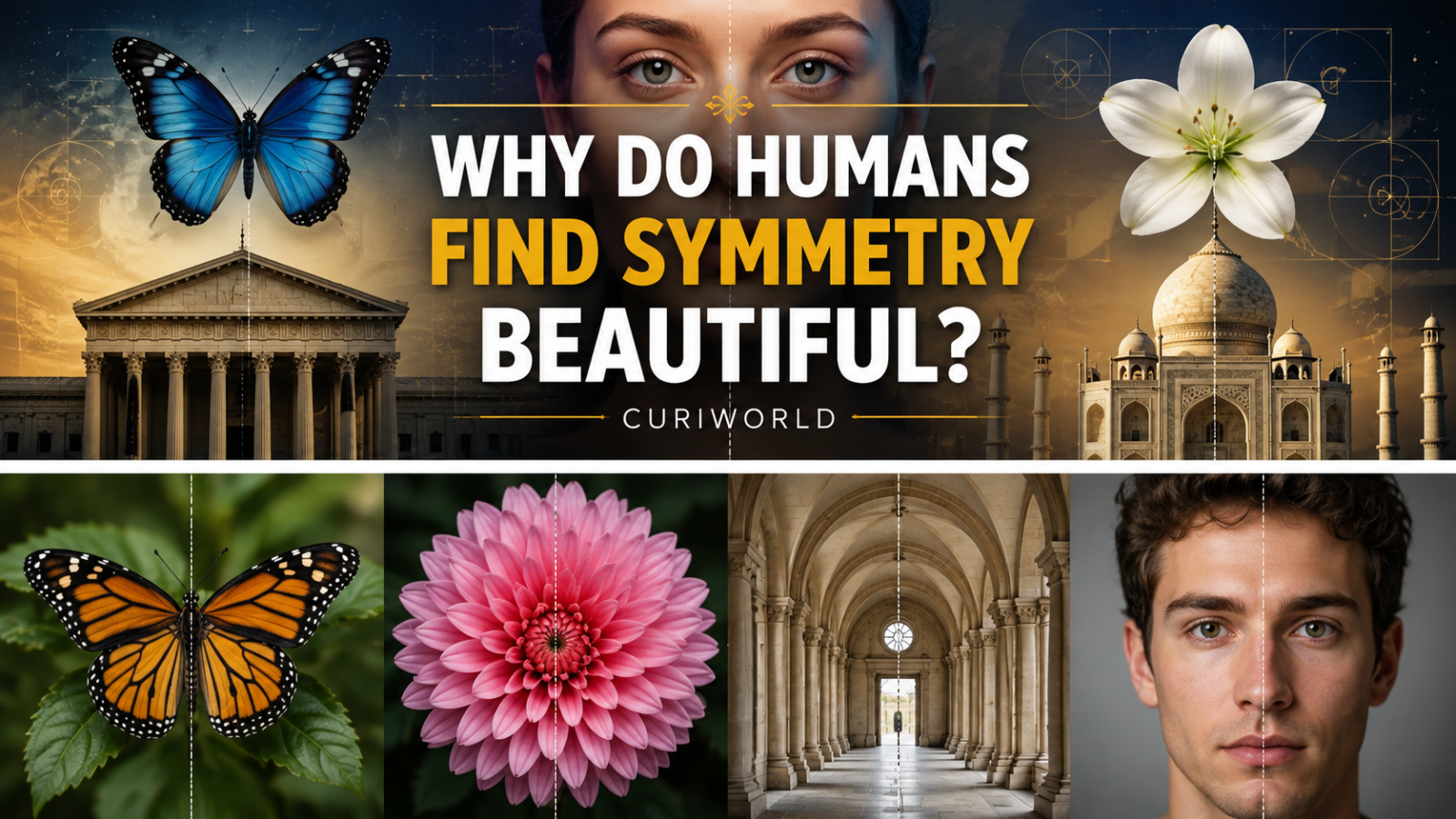
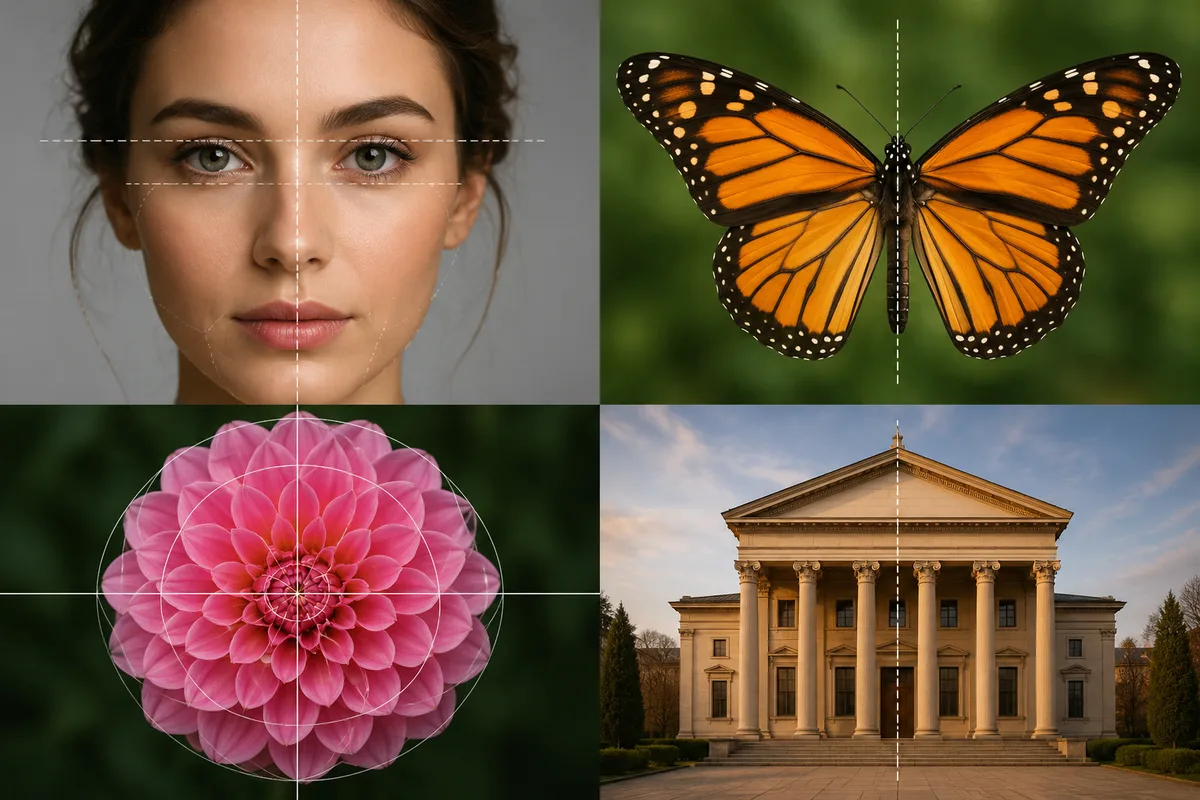
Split a butterfly down the middle and its two wings roughly mirror each other. Look at a flower, a human face, a cathedral façade, or a carefully designed logo and you may find the same basic pattern: one side corresponds, at least approximately, to the other.
Humans often respond positively to this kind of visual balance.
But symmetry is not a secret mathematical formula that automatically creates beauty. Perfectly symmetrical things can look dull, while asymmetrical paintings, buildings, landscapes, and faces can be strikingly beautiful.
So the more interesting question is not simply why symmetry is beautiful.
It is why the human visual system is so responsive to symmetry in the first place—and why that responsiveness can influence what we like.
Symmetry Is Easy for the Visual System to Detect
The brain receives an enormous amount of visual information every second.
Edges, colors, shadows, movement, depth, faces, objects, and spatial relationships all have to be organized rapidly enough for us to understand what we are looking at.
Regularity helps.
When one half of a pattern mirrors the other, the image contains a predictable relationship. Once part of the structure has been detected, the rest becomes easier to organize.
Psychologists sometimes discuss this in terms of processing fluency: some visual information is easier for the brain to process than other information.
A major review by psychologists Rolf Reber, Norbert Schwarz, and Piotr Winkielman proposed that greater processing fluency can contribute to positive aesthetic reactions. Symmetry is one of several visual properties that can make an image easier to process.
That does not mean the brain consciously thinks:
“This object requires less perceptual effort, therefore I find it attractive.”
The effect is much subtler.
A pattern can simply feel orderly, coherent, or satisfying.
The Brain Likes Patterns It Can Organize
Imagine looking at two abstract designs.
The first contains shapes arranged randomly in different directions.
The second contains the same number of shapes, but each element on the left has a matching counterpart on the right.
The symmetrical version provides the visual system with more structure.
Instead of processing every element as an unrelated piece of information, the brain can detect relationships among them.
This preference for organized visual information connects symmetry to a broader feature of human perception: we constantly search for structure in what we see.
Curiworld has explored how even very young children can become fascinated by movement, contrast, repetition, and simple visual patterns in ordinary objects such as ceiling fans and lights. The developing visual system is already busy learning how to organize the world around it.
Babies Love Ceiling Fans and Lights — Is That Normal?
Our attraction to orderly patterns later in life is far more sophisticated, but the underlying point remains useful: visual regularities are especially noticeable to the human brain.
Faces Make Symmetry Especially Interesting
Symmetry becomes more complicated when the object we are judging is another person.
Human faces are approximately bilaterally symmetrical. We have two eyes, two ears, two sides of the nose and a broadly mirrored facial structure.
They are not perfectly symmetrical.
Look closely at almost any face and you will find differences between the two sides: one eyebrow may sit slightly higher, one eye may be marginally larger, or the mouth may curve differently.
Research on facial attractiveness has nevertheless repeatedly found that symmetry can contribute to attractiveness judgments.
Psychologist Gillian Rhodes reviewed research on facial beauty and concluded that symmetry, averageness, and sexually dimorphic facial characteristics are among the features associated with attractiveness.
That last part matters.
Symmetry is only one component.
An attractive face is not simply a perfectly mirrored face.
Did Evolution Teach Us to Prefer Symmetry?
One influential explanation comes from evolutionary psychology.
Developing a symmetrical body requires an organism to grow according to a biological plan while dealing with disease, nutrition, environmental stress, genetic variation, injury, and other disruptions.
Researchers have therefore proposed that relatively stable bilateral symmetry might sometimes provide information about developmental stability.
If symmetry historically correlated—even imperfectly—with biological condition, sensitivity to it could potentially have influenced mate preferences over evolutionary time.
This hypothesis has helped generate decades of research on symmetry and attraction.
But it should not be turned into an oversimplified rule.
A symmetrical face is not proof that someone is healthier, genetically superior, more fertile, or a better partner. Human attractiveness is influenced by many interacting biological, psychological, social, and cultural factors.
Research on facial beauty itself reflects that complexity.
So “we evolved to prefer healthy symmetrical mates” is possible as part of the story, but it is much too simple to serve as the entire explanation.
Our Brains Are Exceptionally Sensitive to Faces
There is another reason facial symmetry may carry so much psychological weight.
Humans devote enormous perceptual attention to other humans.
Faces tell us who someone is, where they are looking, what they may be feeling, whether we recognize them, and whether their attention is directed toward us.
Curiworld has previously examined this sensitivity in its explanation of why we sometimes feel as though someone is watching us. Our perception is unusually responsive to faces, eyes, head direction, and gaze.
Why Do We Sometimes Feel Like Someone Is Watching Us?
Because faces are such important visual stimuli, even small changes in proportion, balance, and alignment can become noticeable.
Symmetry therefore matters differently in a face than it does in a wallpaper pattern.
The brain is not merely seeing geometry.
It is seeing another person.
Perfect Symmetry Can Actually Look Strange
If symmetry contributes to beauty, you might expect perfect symmetry to produce the most attractive possible face.
Reality is more complicated.
One way to create a perfectly symmetrical face is to take one half of a photograph, mirror it, and join the two identical halves.
The result can look surprisingly unnatural.
Why?
Because real biological faces contain small asymmetries. Perfect mirroring can duplicate distinctive features in ways that make the face seem artificial rather than naturally balanced.
This illustrates a larger point about aesthetics.
Beauty does not require mathematical perfection.
Human perception can appreciate order while also responding positively to complexity, novelty, individuality, contrast, and slight irregularity.
A perfectly uniform object may be easy to process but not especially interesting.
Symmetry Is Everywhere in Nature—but Nature Is Rarely Perfectly Symmetrical
Butterflies, leaves, flowers, starfish, animals, and human bodies provide familiar examples of biological symmetry.
Yet close inspection reveals imperfections almost everywhere.
A leaf may have insect damage.
One flower petal may grow differently from another.
A butterfly wing may be slightly worn.
A human smile may rise higher on one side.
Nature often follows an underlying symmetrical body plan while allowing small variations around it.
That combination may help explain why approximate symmetry often feels natural while sterile mathematical perfection can feel artificial.
We recognize the pattern without requiring a flawless copy.
Designers Use Symmetry Because It Creates Visual Stability
The same perceptual tendency extends beyond biology.
Architecture frequently uses symmetrical entrances, windows, columns, and façades.
Logos often rely on rotational or mirror symmetry.
Furniture, gardens, religious buildings, decorative objects, and ceremonial spaces frequently place important elements along a central axis.
Symmetry can create a sense of balance because visual weight is distributed predictably around a center.
The viewer quickly understands the composition.
That makes symmetry especially effective when a designer wants something to feel:
- stable
- formal
- orderly
- balanced
- deliberate
But designers also deliberately break symmetry.
An asymmetrical composition can create movement, tension, surprise, or visual interest.
That is why professional design is not simply a competition to make everything perfectly symmetrical.
Symmetry is a tool, not a universal formula.
Culture and Experience Still Matter
Biology does not erase culture.
What people consider beautiful changes across places, periods, communities, and individuals.
Fashion changes.
Architectural tastes change.
Artistic conventions change.
Beauty standards change.
Personal experience also shapes aesthetic judgment.
Someone trained in modernist architecture may react differently to an asymmetrical building than someone who prefers classical façades. An experienced artist may enjoy visual complexity that another viewer finds chaotic.
Processing fluency itself can also be affected by familiarity and experience. Something that initially appears complicated can become easier—and sometimes more enjoyable—to process after repeated exposure or learning.
So a preference for symmetry can coexist perfectly well with enormous diversity in human taste.
Do Children Naturally Prefer Symmetry?
This question has produced an interesting complication.
Humans appear to become sensitive to symmetrical visual structure early in development. Children can notice and attend to symmetry.
But attention is not necessarily the same as aesthetic preference.
Research comparing children and adults has found that young children may look longer at symmetrical patterns without explicitly judging them as prettier.
That distinction matters because it suggests that sensitivity to symmetry may emerge before the full adult aesthetic preference for it.
In other words, the visual system may detect symmetry early, while experience and cognitive development help determine what we eventually call beautiful.
Why Isn’t Everything We Find Beautiful Symmetrical?
Because beauty has more than one ingredient.
People can enjoy complexity.
They can enjoy surprise.
They can enjoy unusual proportions.
They can enjoy natural irregularity.
They can enjoy visual tension and contrast.
A windswept coastline is not beautiful because its rocks form matching halves.
A dramatic painting does not need perfect bilateral balance.
A person’s face can be memorable partly because of distinctive features rather than geometric perfection.
Symmetry is therefore best understood as one cue that can make visual information orderly and appealing, not as a master rule governing human aesthetics.
Beauty May Live Between Order and Variation
Humans seem remarkably good at detecting regularity.
Symmetry gives the visual system something it can organize quickly: repeated information, balanced structure, and predictable relationships.
That perceptual ease may contribute to aesthetic pleasure.
In faces and bodies, symmetry may also intersect with biological and evolutionary mechanisms involved in how humans evaluate other people.
But neither explanation means that more symmetry always produces more beauty.
The things we love looking at often combine enough order to make sense and enough variation to remain interesting.
Perhaps that is why a perfectly mirrored computer-generated face can feel less compelling than a real one.
The human eye appreciates balance.
It does not demand perfection.
Sources
Reber, R., Schwarz, N., & Winkielman, P. — Processing Fluency and Aesthetic Pleasure: Is Beauty in the Perceiver’s Processing Experience? — Personality and Social Psychology Review (2004).
Rhodes, G. — The Evolutionary Psychology of Facial Beauty — Annual Review of Psychology (2006).








Join the discussion