Why Do People Collect Things? The Psychology Behind Collections
Why can one missing card, coin, book, or toy become so irresistible? Collecting connects objects with goals, identity, memories, community, and meaning.
A shelf of vinyl records. A drawer full of coins. Hundreds of postcards organized by country. Vintage toys still in their boxes. Sneakers that are rarely worn. Rocks picked up on vacations. Books that may never all be read.
Almost anything can become a collection once individual objects begin to feel like pieces of something larger.
That transformation is psychologically interesting. A collector is often no longer asking only, “Do I like this object?” The questions become: Does it belong in my set? What am I missing? What story does it represent? And what would completing the collection feel like?
Research suggests there is no single psychological reason people collect. Collections can provide goals, preserve memories, express identity, create social connections, offer a sense of continuity, and sometimes carry financial value.
And despite the stereotype of the obsessive collector surrounded by thousands of objects, collecting is not necessarily an unusual behavior. A large 2025 study using a representative nationwide sample of 5,069 consumers found that roughly a third collected something, while relatively few strongly identified themselves as “collectors.”
Collecting, it seems, may be far more ordinary than the most spectacular collections make it appear.
A Collection Turns Objects Into a Goal
One baseball card is an object.
Twenty cards from the same series can become a project.
That distinction helps explain one of the most satisfying features of collecting: progress.
Once people mentally define a set, every acquisition can move them closer to a recognizable endpoint.
Maybe the goal is:
- every coin issued during a particular period
- all novels by one author
- each figure in a toy series
- every album released by a band
- one postcard from every country visited
- every color variation of a particular product
Now the collector can identify what they already have and what remains missing.
A systematic review of more than 30 years of research into consumer collecting identified achievement through collecting goals as one of six major motivational themes.
This makes intuitive sense.
A collection converts an open-ended interest into measurable progress.
The empty space becomes meaningful.
If you own nine items from a ten-piece series, the missing tenth item may suddenly seem much more important than it would have if you had never started the collection.
Why the Missing Piece Can Become So Tempting
Collections create something ordinary shopping often does not: a visible gap.
Suppose you collect twelve figures representing characters from a favorite series.
Eleven are sitting on the shelf.
There is one empty position.
That empty position can become psychologically louder than the eleven completed ones.
The missing item represents an unresolved goal.
This does not mean collecting works exactly like an unfinished work task, but there is an interesting psychological parallel. Curiworld has explored why unfinished goals can remain mentally active, especially when they still matter to us.
A collection can deliberately create similar goal structure.
There is a beginning.
There is progress.
There are gaps.
Sometimes there is even a clearly defined finish line.
Finding a rare missing piece does more than add another possession. It can close a loop the collector has been tracking for months or years.
The Hunt Can Matter as Much as the Object
Ask collectors about their favorite possessions and the answer may include a story.
“I found this in a tiny shop while traveling.”
“I searched for this edition for three years.”
“I bought it at a flea market for almost nothing.”
“This was the final piece I needed.”
The story matters because collecting is often a process rather than a simple purchase.
Searching auction listings, visiting antique stores, attending conventions, comparing variations, studying production dates, learning how to identify counterfeits, negotiating prices, and finally locating a difficult item can all become part of the hobby.
That means an object acquired instantly may not always produce the same experience as an object that required knowledge, patience, and effort.
The collection records not just what a person owns but what they have found, learned, chosen, and accomplished.
This is one reason describing collecting as nothing more than “getting a dopamine hit from buying things” is too simplistic.
Shopping can certainly be rewarding, but the psychology of collecting extends well beyond the moment of purchase.
Collections Can Become Part of Identity
Look at someone’s carefully curated bookshelf, sneaker wall, record collection, or display cabinet and you may learn something about them before they say a word.
Collections communicate preferences.
They can say:
I love this era.
This artist matters to me.
I know a great deal about this subject.
These are the places I have been.
This is the culture I grew up with.
This hobby is part of who I am.
Objects are especially useful for identity because they make abstract interests visible.
Someone can say they love cinema.
A shelf containing carefully preserved posters from classic films turns that interest into something physical.
Someone can say they are fascinated by space exploration.
A collection of mission patches, models, books, and memorabilia gives that fascination a material form.
The important point is not that possessions completely define people.
They do not.
But carefully selected objects can become symbols of interests, experiences, affiliations, expertise, and personal history.
A Collection Can Work Like a Physical Memory Archive
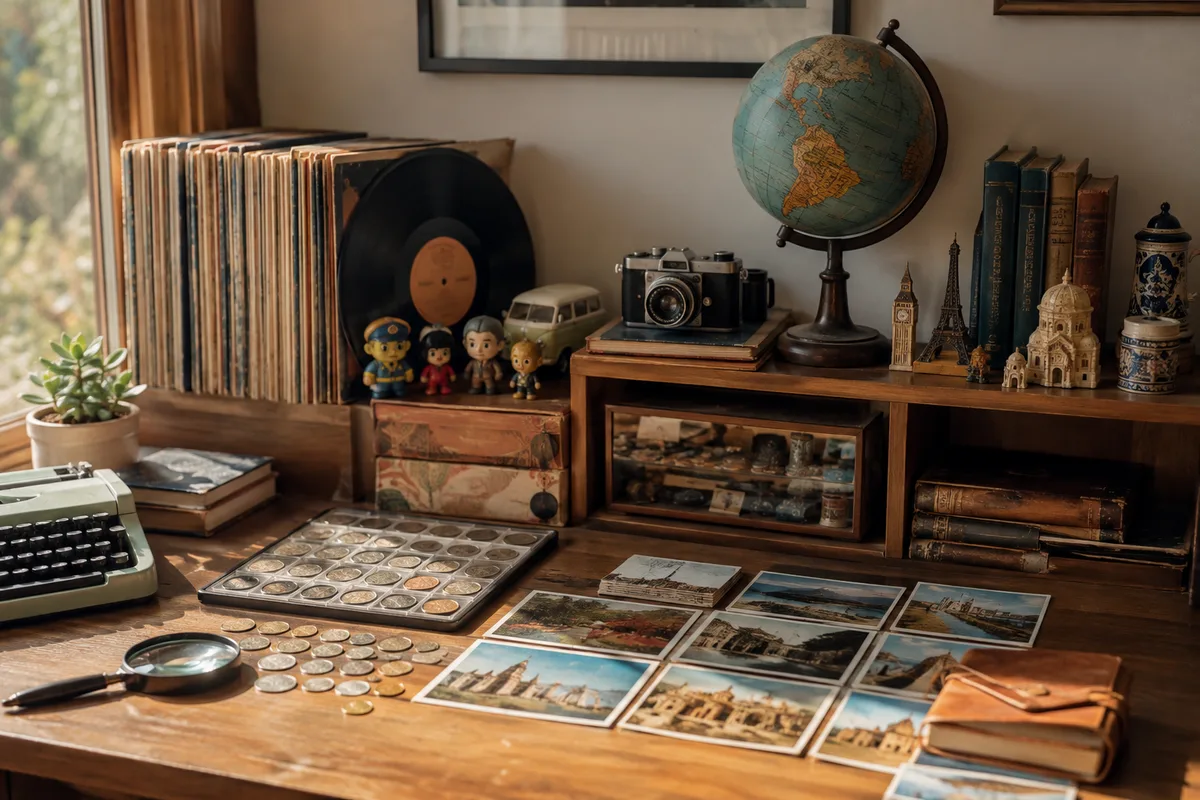
Some collections are less about completing a set and more about preserving a life.
Consider a box containing:
- concert tickets
- postcards
- travel souvenirs
- childhood toys
- old photographs
- letters
- shells from beaches
- objects inherited from family members
Financially, the collection might be worth almost nothing.
Psychologically, it can be irreplaceable.
The systematic review of collecting research identified societal and personal memories as another major motivation behind collecting.
An object can act as a retrieval cue.
A concert ticket is not merely a rectangle of printed paper. It may represent the friend who attended with you, the song you remember most clearly, the city you visited, and the stage of life you were in at the time.
A childhood toy may bring back an entire room.
A souvenir may reconstruct a trip.
A perfume bottle, old book, or piece of clothing can sometimes even carry a sensory cue connected with the past.
Curiworld has examined this broader memory mechanism in why certain smells can suddenly bring back powerful memories. Objects can serve a similar role: they become prompts through which a larger autobiographical story can be reconstructed.
The collection is no longer just a group of things.
It becomes a map of experiences.
Nostalgia Can Turn Ordinary Objects Into Valuable Ones
Why would an adult care deeply about a plastic toy that originally cost a few dollars?
Because market value and psychological value are different things.
A vintage lunchbox, game cartridge, trading card, or toy may represent childhood far more powerfully than its material composition would suggest.
For someone who owned—or desperately wanted—the object decades earlier, acquiring it later can reconnect the present self with an earlier version of the self.
This is why nostalgic collecting often focuses on apparently ordinary consumer goods.
The collector may not care about plastic.
They care about what the plastic represents.
An object can symbolize:
- childhood freedom
- a favorite television show
- time spent with siblings
- a parent or grandparent
- a school period
- an earlier technology
- a cultural moment that no longer exists
Collecting can therefore become a form of personal timekeeping.
Instead of storing memories only mentally, people give some of them physical anchors.
Organizing a Collection Can Feel Satisfying Too
Collectors do not merely acquire objects.
They classify them.
Coins may be organized by country and year.
Books by author.
Records by genre.
Cards by series.
Rocks by mineral type.
Stamps by region.
That classification creates order.
A chaotic group of objects becomes a system with boundaries and rules.
The collector learns what belongs, what does not, which variations matter, what counts as rare, and how different items relate to one another.
For some people, that structure is a major part of the pleasure.
Knowledge gradually increases alongside the collection.
A casual collector of watches may begin learning about movements, manufacturers, reference numbers, production periods, materials, and design history.
A fossil collector may learn geology.
A coin collector encounters history, economics, politics, and metallurgy.
A book collector may learn printing history, bindings, editions, publishers, and provenance.
The physical collection becomes an organized representation of knowledge.
Collectors Often Become Experts Without Planning To
This is one of the less obvious benefits of collecting.
Repeated decisions require discrimination.
At first, two objects may look nearly identical.
After years in the hobby, an experienced collector may immediately notice:
That logo belongs to a later production run.
That color was used only briefly.
That edition has the wrong binding.
That signature does not look authentic.
That model was manufactured in a different country.
Collections create reasons to pay close attention.
Research becomes useful because knowledge improves the hunt.
Over time, what began as possession can develop into expertise.
This helps explain why collectors often enjoy talking about the history and differences among their objects as much as they enjoy displaying them.
The collection is partly physical inventory and partly accumulated knowledge.
Collecting Can Create Community
A hobby practiced alone can become surprisingly social.
Collectors trade.
They compare.
They teach newcomers.
They attend conventions.
They discuss rare versions online.
They compete in auctions.
They show discoveries to other enthusiasts.
They help identify unusual items.
They sometimes lend or donate objects for exhibitions.
The systematic review of collecting research identified social membership as one motivational theme and cooperation and competition as another.
These forces can operate simultaneously.
Two collectors may compete fiercely for the same rare object while also sharing information, advice, and enthusiasm about the hobby.
Communities also create their own language.
Terms that mean nothing to outsiders can communicate precise distinctions among collectors.
Knowledge provides status.
Rare finds attract attention.
Helping another person complete a set can strengthen relationships.
So a collection may connect someone not only to objects but also to other people who understand why those objects matter.
Some People Collect for Legacy
Collections can point backward toward memory, but they can also point forward.
A person may imagine eventually giving a collection to:
- children
- grandchildren
- another collector
- a museum
- an archive
- a university
- a local historical society
The systematic review identified legacy as another recurring collecting motivation.
This makes collections unusual possessions.
A collector may see themselves as a temporary caretaker.
The items existed before them and may continue to exist afterward.
This is especially visible in collections involving historical documents, art, archaeological material, rare books, photographs, scientific specimens, or objects connected with local history.
The collector’s role becomes partly preservational:
Find it.
Research it.
Protect it.
Organize it.
Then eventually pass it on.
What About Collecting for Money?
Financial value matters in some collections.
Art, rare coins, vintage watches, sports memorabilia, trading cards, classic cars, and other collectibles can sell for substantial amounts.
The systematic review therefore identifies financial value as one of the motivations associated with collecting.
But investment and collecting are not identical.
A person who buys an object solely because they expect its market price to rise may behave differently from someone who has spent twenty years building a personally meaningful collection.
Often the motives overlap.
Someone may love watches and also care about resale value.
A card collector may enjoy completing sets while tracking market prices.
A book collector can value literary history and rarity at the same time.
The danger is assuming that because a collectible can increase in price, it will.
Collectibles are markets, not guaranteed investments.
Their prices can change with scarcity, condition, authenticity, fashion, cultural attention, and demand.
For many collectors, emotional value remains much more stable than market value.
Is Collecting the Same as Hoarding?
No.
Having many possessions does not automatically make someone a hoarder, and ordinary collecting should not be casually treated as a mental disorder.
Collections usually have some form of theme, selection criteria, organization, or perceived meaning.
Collectors frequently display, categorize, research, trade, curate, or intentionally preserve their objects.
The simple fact that someone owns hundreds of coins, books, figures, stamps, or records tells you very little by itself.
The more relevant question is whether possession of objects is creating serious distress, unsafe living conditions, loss of usable space, major financial harm, or substantial interference with everyday life.
A large, carefully organized collection can be a functional hobby.
Quantity alone is not the defining issue.
Not Every Collector Thinks of Themselves as a Collector
This may be one of the most useful findings from recent research.
A 2025 study published in the Journal of the Association for Consumer Research examined a representative nationwide sample of 5,069 people across two waves separated by ten years.
The researchers found that about a third of consumers collected something.
Yet relatively few strongly identified themselves as collectors.
That distinction challenges the popular image of collecting.
Research or media stories that focus exclusively on highly committed collectors—the person with 20,000 action figures or a house-sized memorabilia collection—may not describe ordinary collecting very well.
Someone with thirty vinyl records from one genre might have a collection.
So might someone who keeps every ticket from concerts they attend.
So might someone slowly acquiring first editions from a favorite author.
They do not have to build a museum in their living room to qualify.
Why Do People Keep Collecting After the Collection Is “Complete”?
Completion sounds like the obvious endpoint.
Then collectors discover another category.
You collect every standard card in a series.
Now there are alternate editions.
You collect every studio album.
Now there are live recordings.
You collect every coin from one decade.
Another decade begins to look interesting.
This reveals something important about collecting.
The final object is not always the true objective.
Collecting can provide a continuing structure for curiosity.
There is always more to learn, compare, search for, organize, and discuss.
A finished set may deliver satisfaction.
But the process that created the satisfaction can be enjoyable enough that the collector simply builds another goal.
The Collection Is Usually About More Than the Things
From the outside, collecting can seem irrational.
Why own fifty variations of an object when one would perform the same practical function?
Because practical function is often beside the point.
A collection can turn searching into achievement.
It can turn objects into memories.
It can make identity visible.
It can organize knowledge.
It can create friendships and competition.
It can connect someone to childhood or history.
It can preserve something for the future.
And sometimes it can simply make a person happy to see the pieces arranged together.
That is why the psychology of collecting cannot be reduced to greed, shopping, nostalgia, investment, or one supposedly addictive brain chemical.
The objects may be what we can see.
The real collection is often made of goals, stories, knowledge, memories, and meaning.
Sources
Lee, C., Brennan, S., & Wyllie, J. — Consumer Collecting Behaviour: A Systematic Review and Future Research Agenda — International Journal of Consumer Studies (2022)
Read the study on Wiley Online Library
Ryan, W. H., Evers, E. R. K., & Lindenberg, S. M. — There Is a Potential Collector in Every Consumer — Journal of the Association for Consumer Research (2025)







Join the discussion