Why Do We See Faces in Clouds, Walls and Everyday Objects?
Faces seem to appear in clouds, walls, cars and even food. The phenomenon is called face pareidolia, and it reveals how quickly our brains search for familiar patterns.

A pair of windows becomes eyes. A door handle turns into a mouth. Two dark patches in a cloud suddenly look like a face staring back at you.
Nothing in the object has actually changed. Your brain has simply done something it is exceptionally good at: finding a face before it has fully decided what it is looking at.
This familiar experience is called face pareidolia—the perception of a face in a pattern or object that does not contain a real face. It happens in clouds, electrical outlets, cars, tree trunks, rocks, buildings, food, shadows and countless other ordinary things.
Far from being a strange visual mistake, pareidolia offers a revealing glimpse into how quickly the human brain interprets an uncertain world.
What Is Face Pareidolia?
Pareidolia is the tendency to perceive a recognizable form in ambiguous visual information.
Faces are such a common version of the phenomenon that researchers study face pareidolia as a category of its own.
You may recognize it when:
- two windows and a doorway make a building look surprised,
- headlights and a grille make a car seem angry,
- knots in a tree resemble eyes and a mouth,
- marks on toast appear to form a human face,
- or shifting clouds briefly create a recognizable expression.
The important point is that you usually know the object is not actually a face.
You can see both interpretations at once: that is a power socket—and it looks like it is smiling.
That makes pareidolia different from simply being confused about what an object is. The illusion can remain compelling even while you fully understand its cause.
The brain produces other strange familiarity effects too; one of the best-known is déjà vu and why it happens.
Your Brain Is Extremely Sensitive to Faces
Human faces carry an enormous amount of socially useful information.
From a brief glance, we can often estimate where someone is looking, recognize familiar people and interpret expressions. Because faces matter so much in everyday social life, the visual system processes them with remarkable speed.
That speed comes with a trade-off.
A system designed to notice potentially important patterns quickly may occasionally produce a false positive—detecting a face-like arrangement where no face exists.
Neuroscience provides an unusually clear demonstration of this.
In a 2020 Nature Communications study, researchers used both functional MRI and magnetoencephalography to investigate how the brain responds to real faces, ordinary objects and objects containing illusory faces.
They found that pareidolia images initially produced activity in face-selective visual areas. During the first few hundred milliseconds, the brain represented those objects more like real faces than comparable objects without face-like patterns.
But that response did not last.
Within roughly 250 milliseconds, the brain’s representation shifted toward the object’s actual identity.
In simple terms, the visual system appears to do something remarkably close to:
Face? Maybe. Check again. No—it’s an object.
That rapid correction helps explain why pareidolia can feel immediate even when you instantly understand that the “face” is only a pattern.
Why Do Two Dots and a Line Suddenly Become a Face?
A realistic portrait is not required to trigger face perception.
Sometimes the visual ingredients are astonishingly simple.
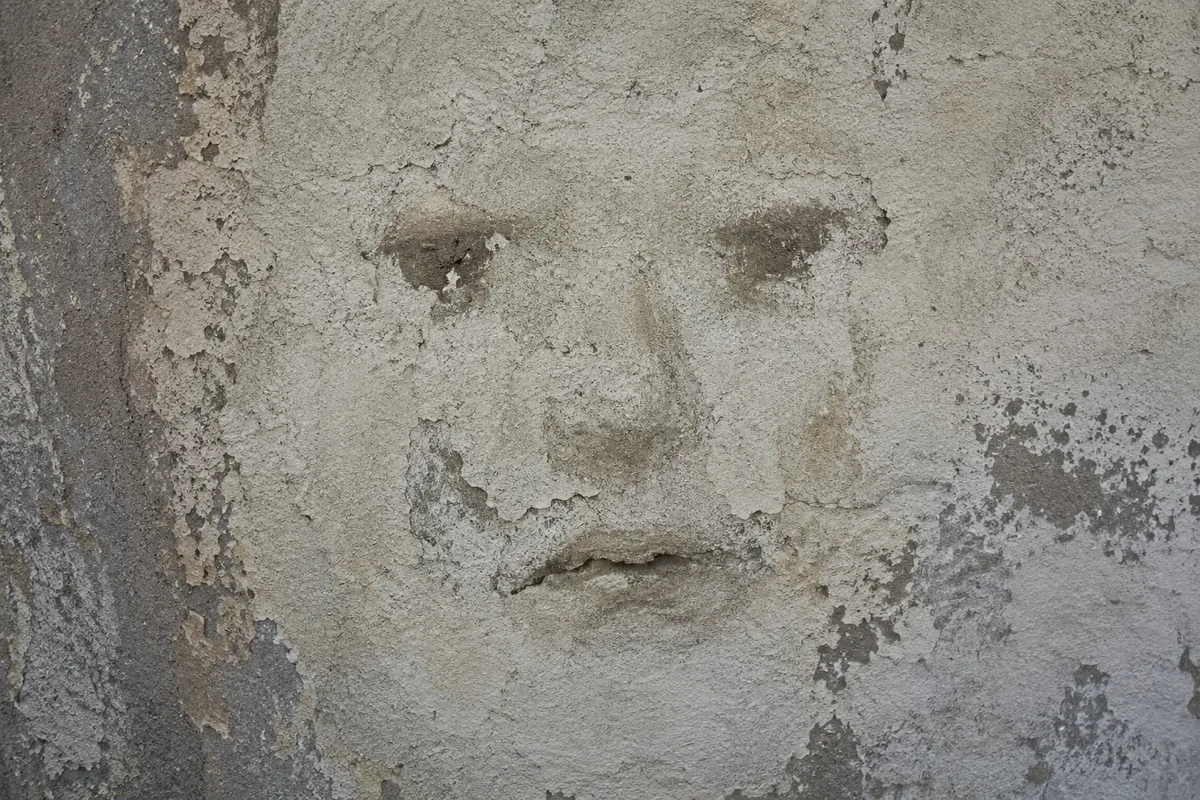
Two similarly positioned shapes can resemble eyes. A horizontal mark beneath them can resemble a mouth. Add approximate vertical symmetry—the left and right sides looking somewhat alike—and the pattern becomes even more face-like.
A 2026 study published in Royal Society Open Science explored how little visual information may be necessary.
Researchers showed participants both face-like everyday objects and abstract visual noise. When vertical symmetry was introduced into otherwise ambiguous patterns, participants became more likely to perceive faces.
The experiments also showed something stranger: people did not merely detect a face. They frequently attributed characteristics such as age, gender or emotion to something that contained no actual person at all.
The brain can therefore go beyond saying there is a face here.
It may immediately begin asking, What kind of face is it?
Why Faces Rather Than Random Other Objects?
People can certainly see animals, figures, maps and recognizable shapes in ambiguous patterns. A cloud may look like a dragon, a ship or a rabbit.
But faces have an unusual advantage.
Our visual system encounters faces constantly, and specialized areas of the visual cortex respond strongly to facial information. Detecting a face also has immediate social relevance in a way that detecting an accidental resemblance to a chair usually does not.
This may encourage the visual system to operate with a relatively sensitive threshold.
Imagine two possible errors.
One is briefly thinking an object contains a face when it does not.
The other is failing to notice an actual face.
A highly sensitive detection system will inevitably produce some false alarms. Pareidolia may be one visible consequence of that sensitivity.
It is therefore more useful to think of face pareidolia not as the brain failing to see correctly, but as an extremely efficient recognition system occasionally being too eager.
Why Do Cars Seem to Have Personalities?
Once you notice face pareidolia, cars become difficult to ignore.
Headlights resemble eyes. The grille becomes a mouth. The shape of the hood can make the “expression” look cheerful, aggressive, sleepy or surprised.
The same effect appears in houses, appliances and electronic devices.
This reveals another fascinating feature of perception: once the brain detects the basic geometry of a face, it can begin interpreting social information from it.
A curved line may look like a smile. Slanted “eyes” may make an object seem angry. Large circular shapes can produce an innocent or surprised expression.
Of course, the washing machine is not disappointed in you.
Yet the expression can feel instantly obvious.
The 2026 research on pareidolia is particularly interesting here because participants assigned traits and emotions even to faces perceived in abstract visual noise. The social interpretation did not require a real face—or even a meaningful object—to begin.
Why Can One Person See a Face That Someone Else Cannot?
Pareidolia is not perfectly consistent between people.
You might immediately see a face in a patch of peeling paint while the person next to you sees nothing unusual until you point out the “eyes.”
This is partly because ambiguous images leave room for interpretation.
Perception does not work like a camera recording the world pixel by pixel. The brain combines incoming visual information with patterns it already knows.
The brain’s sensitivity to social cues is not limited to face-like patterns in objects. See why we can sometimes feel as though someone is watching us for a related example of how gaze, context and expectation shape perception.
Once someone says, “Look, there are the eyes and that’s the mouth,” the pattern can suddenly become difficult to unsee.
Attention matters as well.
If you are deliberately searching for faces in clouds, you are likely to notice more face-like configurations than if you are simply watching the weather.
Lighting, contrast, angle, distance and symmetry can all alter whether the necessary pattern stands out.
Sometimes moving a few steps completely destroys the illusion.
Is Pareidolia the Same as Apophenia?
They are related, but they are not exactly the same idea.
Apophenia broadly refers to perceiving meaningful connections or patterns in information that may be unrelated or random.
Pareidolia usually refers more specifically to perceiving a familiar image or pattern in ambiguous sensory information.
Face pareidolia is narrower still: the familiar pattern being detected is a face.
So seeing a face in a cloud is a classic example of pareidolia. The term does not need to be turned into a diagnosis or treated as evidence that something is wrong.
Seeing occasional faces in ordinary objects is a widespread perceptual experience.
Can Animals Experience Pareidolia Too?
Humans may not be alone in making this particular visual error.
Research discussed in the 2020 Nature Communications study notes evidence that rhesus macaques respond to face-like objects in ways suggesting that they, too, may experience a form of face pareidolia.
That is an intriguing clue.
It raises the possibility that the tendency is connected to fundamental aspects of primate face-detection systems rather than depending entirely on human language, culture or imagination.
Researchers are still investigating exactly which visual features trigger these responses and how much the mechanisms overlap across species.
Why Do Clouds Work So Well?
Clouds are almost perfect material for pareidolia.
They contain edges, shadows, curved shapes and constantly changing patterns without a fixed interpretation. Your brain receives enough structure to search for something familiar but not enough to force one definitive answer.
A cloud can therefore become a face for a few seconds and dissolve into meaningless vapor almost immediately afterward.
Walls, marble, wood grain and stains work for similar reasons.
Their patterns contain accidental combinations of contrast, spacing and symmetry. Occasionally, those combinations happen to match the rough template the visual system uses to detect faces.
The face is not hidden inside the cloud.
It exists in the interaction between the cloud’s shape and the brain interpreting it.
The Face Is Real to Your Perception—even When It Is Not Really There
Perhaps the most interesting thing about pareidolia is how little effort it requires.
You usually do not decide to turn an electrical outlet into a surprised face. The impression simply appears.
Research suggests that this is because the visual system begins categorizing face-like information extremely quickly. For a brief moment, an accidental arrangement of shapes can enter some of the same perceptual machinery used for actual faces before the brain settles on the object’s true identity.
That is why a house can look worried, a pepper can appear horrified and a cloud can seem to smile.
The world is not secretly filled with faces.
But the human brain is so prepared to find them that sometimes two dots and a line are all it needs.
Sources
Wardle, Susan G., et al. — Rapid and Dynamic Processing of Face Pareidolia in the Human Brain — Nature Communications
https://doi.org/10.1038/s41467-020-18325-8
Peterson, Lindsay M., et al. — Facing Your Expectations: Perceived Characteristics of Illusory Faces in Symmetrical Visual Noise — Royal Society Open Science
https://doi.org/10.1098/rsos.250570







Join the discussion