Why Do Jeans Have That Tiny Pocket? The Real Story Behind It
The tiny pocket inside your jeans was originally designed to hold a pocket watch. The feature dates back to early riveted jeans and survives today long after its original purpose faded.

That tiny pocket tucked inside the front right pocket of your jeans was not designed for coins, keys, or decoration. It originally had a very specific job: holding a pocket watch.
Known historically as a watch pocket, the small compartment dates back to the earliest riveted jeans of the 1870s. Pocket watches were a familiar accessory at the time, and the design gave wearers a dedicated place to keep one close at hand.
More than 150 years later, most of us check the time on a phone or wristwatch instead. Yet the pocket remains, making it one of those rare clothing details whose original purpose disappeared while the design survived.
It Was Originally a Watch Pocket
Levi Strauss & Co. traces the little pocket back to the earliest blue jeans.
On May 20, 1873, Levi Strauss and tailor Jacob Davis received a U.S. patent for their method of reinforcing vulnerable areas of work pants with metal rivets. Those early garments were called waist overalls, rather than jeans.
Among their features was a small pocket positioned at the front of the pants specifically for a pocket watch.
That made considerably more sense in the late nineteenth century than it might today.
Before wristwatches became the convenient everyday standard, men commonly carried watches in pockets, often attached to a chain or fob. A separate small compartment offered an obvious advantage: a valuable timepiece did not have to share space with whatever else a person was carrying.
The pocket therefore was not an ornamental flourish added later to make denim look distinctive. It began as a functional part of the garment.
The Tiny Pocket Is Not Actually the “Fifth Pocket”
Here is where denim history becomes a little counterintuitive.
People frequently refer to the tiny compartment as the fifth pocket because modern classic jeans usually have five pockets:
- two large front pockets,
- two back pockets,
- and the small watch pocket.
But historically, that tiny pocket was not the fifth one.
The earliest Levi Strauss riveted waist overalls from 1873 had four pockets: two regular front pockets, the small watch pocket, and only one back pocket.
The second back pocket did not arrive until 1901.
That means the additional back pocket—not the tiny watch pocket—was technically the fifth pocket added to the classic design.
It is a small distinction, but it reveals something interesting about familiar objects: the way we describe them today does not always match the order in which their features appeared.
Why Did a Pocket Watch Need Its Own Pocket?
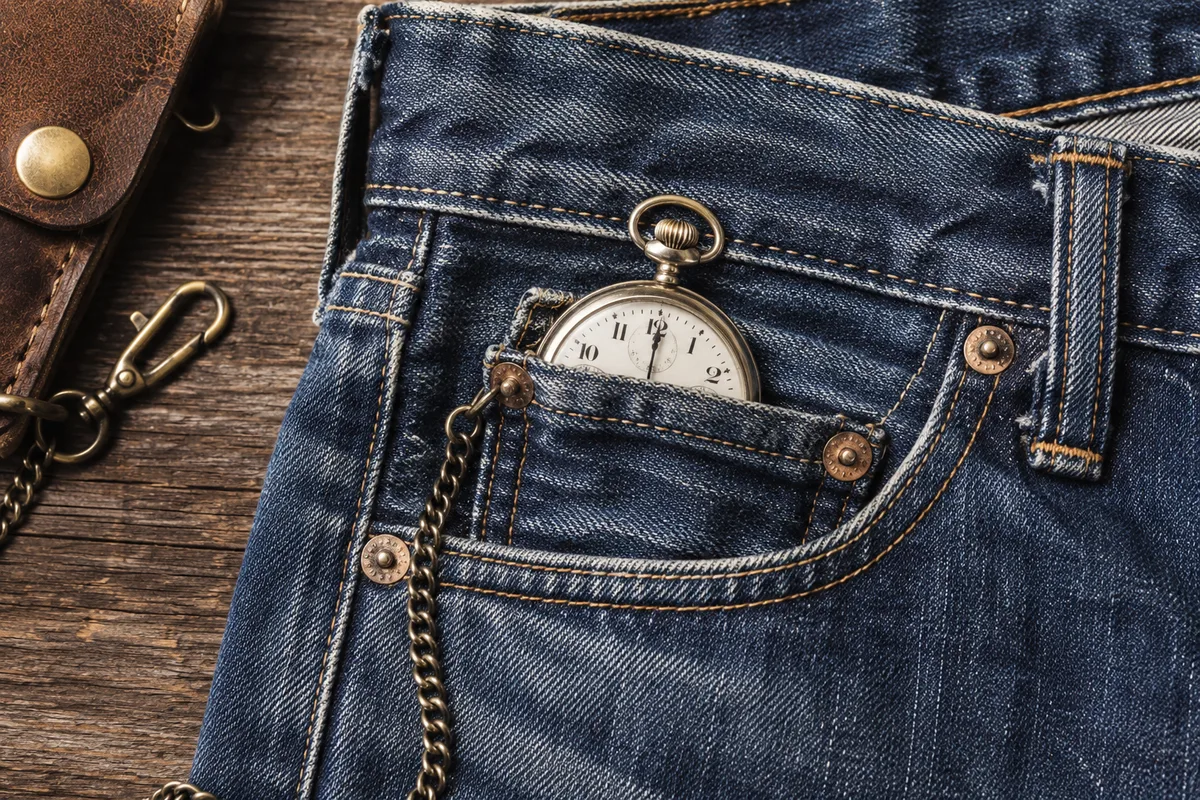
A nineteenth-century pocket watch was quite different from glancing at the lock screen of a smartphone.
It was a physical object that had to be carried throughout the day. Pocket watches could also be meaningful and relatively valuable possessions. The Smithsonian notes that during much of the nineteenth century, men’s pocket watches were commonly worn in clothing and could serve as markers of fashion and status.
For someone wearing sturdy work pants, a dedicated pocket was a sensible solution.
The small size helped keep the watch contained rather than allowing it to move freely inside a larger pocket. Its position near the waistband also made the watch relatively easy to reach.
The design reflected the objects people actually carried at the time.
Modern clothing still does something similar. Phone pockets, headphone compartments, card slots, and specialized athletic pockets all exist because everyday objects influence the way garments are designed.
The watch pocket is simply an older version of the same idea.
So Why Is It Sometimes Called a Coin Pocket?
As pocket watches faded from everyday use, the original function of the compartment became less obvious.
The name changed with its use.
Today, the small compartment is often called a coin pocket, and even Levi’s contemporary denim terminology acknowledges that name while identifying its historical origin as the watch pocket.
Coins happen to fit well inside it, but they were not the reason the pocket was originally created.
That distinction explains why both names can be correct in different contexts:
Watch pocket describes its historical purpose.
Coin pocket describes one of its familiar modern uses.
Why Do Jeans Still Have the Pocket?
This may be the more interesting question.
Technology changed. Pocket watches largely gave way to wristwatches, and wristwatches now compete with smartphones and smartwatches.
Yet the pocket stayed.
One reason is that classic jeans developed a highly recognizable visual language. Rivets, contrasting stitching, back-pocket shapes, metal buttons, denim fabric, and the small front pocket all became associated with what traditional jeans are supposed to look like.
Once a practical feature becomes part of an iconic design, it does not necessarily disappear when its original purpose does.
The pocket also never became completely useless. Its size makes it suitable for tiny objects that might otherwise disappear inside a larger pocket.
Depending on the cut and dimensions of the jeans, people now use it for things such as:
- coins,
- a small key,
- folded cash,
- a ring,
- guitar picks,
- or other compact items.
There is no single official modern use. The dimensions also vary between manufacturers and styles.
In other words, the pocket survived partly because jeans survived.
Jeans Carry More History Than Their Appearance Suggests
The watch pocket is not the only old engineering detail still visible on modern denim.
The copper rivets found around many jean pockets are another reminder of the garment’s workwear origins. Jacob Davis and Levi Strauss used rivets to strengthen areas that were prone to tearing under stress, helping create the durable trousers that eventually evolved into modern blue jeans.
Denim itself produces other everyday curiosities. For example, getting blue jeans wet can make them appear dramatically darker even though the dye has not suddenly changed. Curiworld’s guide to why wet clothes look darker than dry clothes explains the optical effect behind that familiar change.
These details are easy to overlook because jeans are now so ordinary. But their construction still contains traces of the environment in which they developed.
A 150-Year-Old Feature Hiding in Plain Sight
The tiny pocket on your jeans is essentially a piece of nineteenth-century design still traveling around in twenty-first-century clothing.
It began as a practical place for a pocket watch, appeared on the earliest riveted jeans, survived the arrival of the second back pocket, and remained long after people stopped carrying pocket watches every day.
So the next time that oddly small pocket seems too tiny to be useful, remember that it was never designed around your phone, earbuds, or loose change.
It was designed around an entirely different way of telling time.
Sources
Levi Strauss & Co. — The Story Behind the Official Fifth Pocket
View source
Smithsonian National Museum of American History — Revolution on Your Wrist
View source








Join the discussion