Why Do Some Books Have Deckled Edges? It’s Not Always Damage
Deckled edges are the rough, uneven edges seen on some book pages. They began as a natural result of traditional papermaking and are now sometimes recreated deliberately for style.
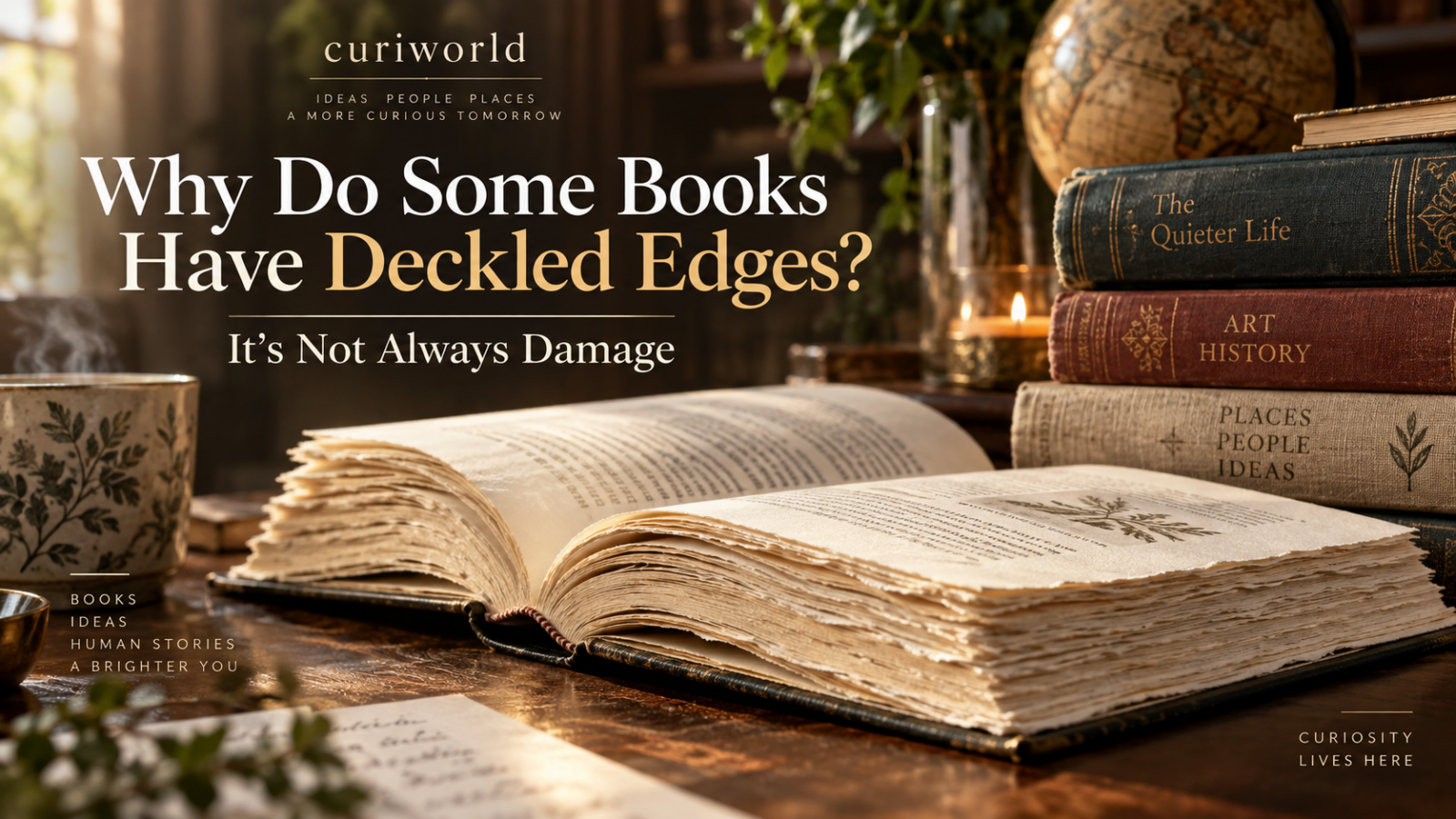
Open some hardcover books and the page block looks perfectly smooth. Open another and the outer edges seem rough, uneven, almost torn.
It can look like a manufacturing mistake.
Often, it is the opposite.
Those irregular page edges are commonly called deckled edges, and they may be a deliberate design choice inspired by the way handmade paper was traditionally produced. In genuinely handmade paper, the uneven edge forms naturally during sheet making. In many modern books, however, the same appearance is recreated mechanically for style.
The important part is that not every rough edge means the book has been damaged.
What Is a Deckled Edge?
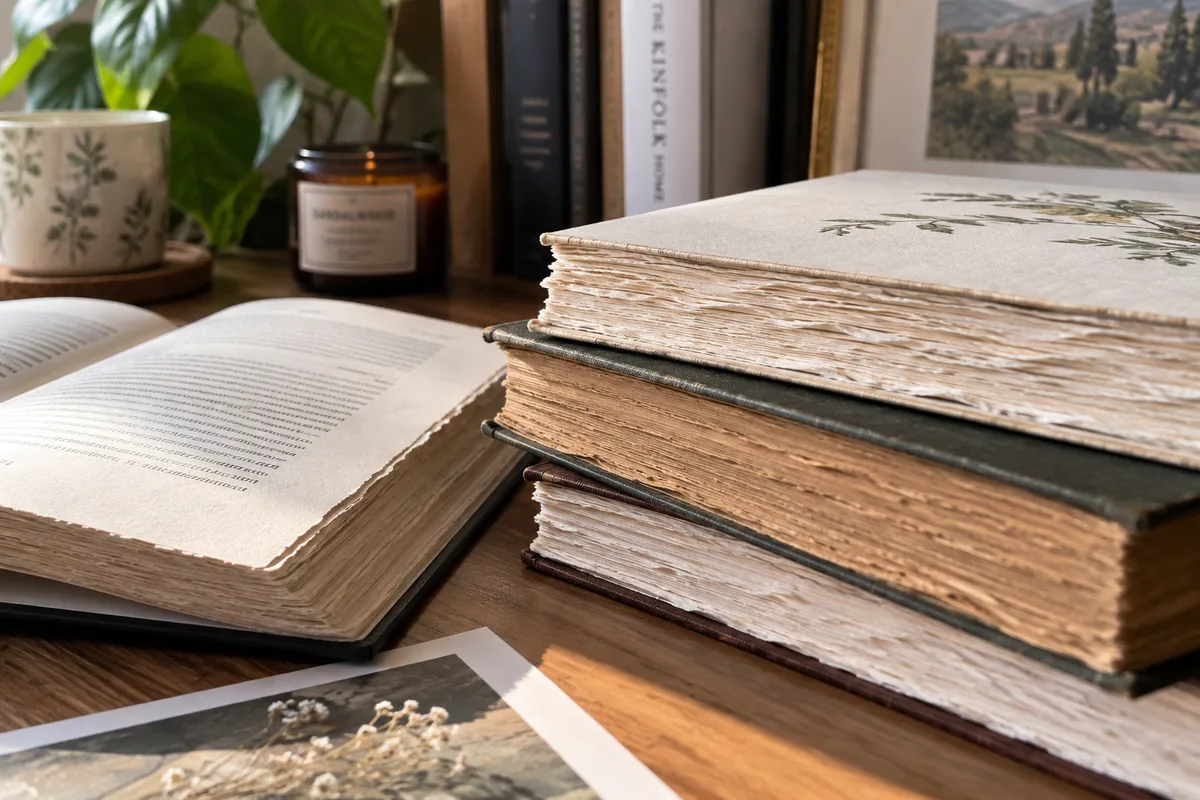
A deckled edge is the soft, irregular, feather-like edge found along a sheet of paper.
The term comes from the deckle, a removable frame used in traditional hand papermaking.
When a papermaker lifts a mold from a vat of water and suspended fibers, the deckle helps contain the wet pulp and define the approximate dimensions of the sheet. Near the boundary of the frame, fibers do not settle into a perfectly straight machine-cut line.
The result is a naturally uneven edge.
Book-conservation terminology describes a true deckle edge as the feathered edge created where paper stock meets the deckle during sheet formation.
That is very different from a page that has been accidentally ripped.
Handmade Paper Did Not Begin With Perfectly Straight Edges
Modern readers are used to industrial paper that arrives in uniform sheets with sharply trimmed sides.
Traditional handmade paper looked different.
In European hand papermaking, a rectangular mold covered with a fine surface was paired with a wooden deckle. The mold and deckle were dipped into a vat containing diluted pulp.
As water drained away, fibers remained behind and formed a sheet.
The deckle controlled the general outline of the paper, but the fibers at its boundaries created a softer, irregular edge rather than a perfectly straight one.
A sheet made this way could naturally have deckled edges on several sides.
So historically, the rough edge was not added afterward as decoration.
It was simply part of how the paper came into existence.
Old Bookmakers Often Tried to Remove Deckled Edges
Here is the part that surprises many readers.
Today, deckled edges are sometimes marketed as elegant, traditional, or premium.
Historically, printers and binders did not always feel that way.
According to the classic conservation reference Bookbinding and the Conservation of Books, early printers commonly regarded the deckle edge as something to trim away.
There were practical reasons.
Rough edges could:
- collect dust more easily,
- make pages slightly harder to turn,
- create an uneven text block,
- and make the finished book look less uniform.
Books were therefore often cut down during binding to produce cleaner edges.
That also means an old book retaining visible deckle can sometimes reveal something about how much the pages were—or were not—trimmed during its history.
Why Collectors Eventually Started to Value Them
Over time, attitudes changed.
Collectors became interested in deckled edges partly because their survival could indicate that a book had not been excessively trimmed, sometimes called cropping.
That mattered with older books because repeated rebinding could reduce the dimensions of the pages.
A surviving irregular edge could preserve evidence of the original sheet.
By the late nineteenth century, the rough look also became fashionable in its own right.
Books printed on handmade or handmade-style papers were sometimes intentionally left untrimmed so the deckled edge remained visible.
What had once been considered an inconvenience gradually became a visual signal of craftsmanship and tradition.
Modern Deckled Edges Are Often Simulated
This is where the story becomes more interesting.
A book published today can have deckled edges even when the paper was made entirely by machine.
Modern manufacturers can create an imitation deckle using specialized cutting, tearing, water, air, or other mechanical finishing methods.
The conservation dictionary distinguishes between a natural deckle formed during papermaking and an imitation deckle created later on a finished sheet.
So the irregular edge on a modern novel does not necessarily mean its pages were individually handmade.
Often, the roughness is simply part of the book’s visual design.
That is not fake in the sense of being a defect. It is closer to a stylistic finish.
Why Would a Publisher Choose Rough Page Edges on Purpose?
Deckled edges change how a book feels before you even start reading it.
They can give a modern edition a sense of:
- age,
- craftsmanship,
- literary tradition,
- handmade production,
- or collector-oriented design.
That can be especially effective with historical fiction, literary editions, classics, fantasy novels, or special hardcovers where the physical object is part of the appeal.
A perfectly smooth edge looks industrial and precise.
A deckled edge looks less uniform and more tactile.
Neither is inherently better.
They simply create different impressions.
Are Deckled Pages Harder to Turn?
Sometimes, slightly.
Because the fore edge is not perfectly flat, individual pages do not line up in one smooth vertical plane.
That can make flipping rapidly through a book less convenient.
Some readers love the tactile feeling. Others find it annoying, especially when trying to locate a page quickly.
This is one reason deckled edges remain largely an aesthetic choice in modern commercial publishing rather than the default for every book.
Functionally, trimmed edges are easier to manufacture consistently and easier to handle.
Deckled Edge vs. Uncut Pages: They Are Not the Same Thing
These terms are often mixed together.
A deckled edge refers to the irregular boundary of the paper itself.
An uncut or unopened book, historically, can refer to folded sheets whose folds were not fully cut apart after printing and binding.
That is a different phenomenon.
A book can have deckled edges while all of its pages open normally.
Likewise, an older book can have unopened folds without possessing dramatic deckled edges.
The distinction matters because someone unfamiliar with historic books may assume both are forms of damage.
They are not.
How Can You Tell a Deckled Edge From Actual Damage?
A deckled edge usually has a consistent visual character across many pages.
The irregularity may vary from sheet to sheet, but it tends to look intentional and repetitive throughout the book.
Actual damage is more likely to appear as:
- one or a few isolated tears,
- missing corners,
- deep cuts extending into the page,
- crushed fibers from impact,
- water distortion,
- or edges that clearly interrupt printed text.
A newly purchased hardcover with a uniformly rough fore edge is probably designed that way.
A single page torn halfway toward the binding is not a deckle.
Why Do Some Deckled Books Look More Uneven Than Others?
Because there is no single standard deckle pattern.
Natural handmade paper depends on the way pulp fibers settle during formation.
Simulated modern edges depend on the manufacturing method chosen by the publisher or printer.
Some books have very subtle variation.
Others have pronounced, almost torn-looking edges.
The paper itself matters too. Thick, textured stock produces a different visual effect from thin, smooth paper.
So two books can both be described as deckled while looking quite different on a shelf.
Does a Deckled Edge Mean the Book Is More Expensive?
Not automatically.
Historically handmade paper could require considerably more labor than mass-produced paper, and specialty editions may use costly materials and finishing.
But modern deckled edges can also be produced at industrial scale.
A rough edge by itself does not prove:
- the paper is handmade,
- the book is rare,
- the binding is higher quality,
- or the edition is valuable.
It is one physical feature among many.
Collectors looking at an older book would consider the edition, paper, binding, condition, provenance, printing history, and whether the edge is original—not just whether the pages look uneven.
The Rough Edge Is Part of the History of Paper
Deckled edges are a good example of how a manufacturing limitation can become a design language.
The irregular edge began as a natural result of forming paper by hand.
Printers often removed it.
Collectors later saw value in preserving it.
Publishers eventually began recreating the same look intentionally.
That is why a modern book can arrive from the bookstore with pages that look almost torn while being completely new and undamaged.
The edge is not necessarily a flaw.
Sometimes it is a small visual reminder of how books were made long before paper became perfectly uniform.
If the material side of books interests you, Curiworld also explores why old books develop their distinctive smell as paper and binding materials age.
Sources
Bookbinding and the Conservation of Books — “Deckle Edge”
University of Iowa — European Papermaking Techniques 1300–1800






Join the discussion