Why Do Old Books Smell So Good? The Chemistry Behind That Familiar Scent
Old books can smell like vanilla, wood, coffee, or chocolate. The reason lies in the surprising chemistry released as paper slowly ages.
Open an old book and, before you read a single word, you may notice something else: the smell.
It can be warm, woody, slightly sweet, dusty, vanilla-like, or even faintly reminiscent of coffee and chocolate. For many readers, that scent is almost as appealing as the book itself.
The surprising part is that there is no single chemical called “old-book smell.” What reaches your nose is a changing mixture of volatile organic compounds, or VOCs, released as paper and other materials slowly age.
In other words, that familiar bookstore or library scent is partly the chemistry of a book changing over time.
An Old Book Is Slowly Changing at the Molecular Level
Paper may look stable, but chemically it is not frozen in time.
Most paper contains cellulose, a long-chain organic polymer derived from plant material. Depending on when and how the paper was manufactured, it may also contain varying amounts of lignin, sizing agents, fillers, coatings, inks, adhesives, and other substances.
Over decades, reactions involving oxygen, moisture, acids, light, and heat gradually alter these materials.
Some large molecules break into smaller compounds. A portion of those products can evaporate easily enough to enter the surrounding air. Those airborne molecules are the VOCs you detect when you open an aging book.
Research published in Environmental Science and Pollution Research has shown that books of different ages can produce measurably different VOC profiles. Researchers were even able to distinguish groups of very old, old, and modern books using their gaseous chemical markers.
So an old book does not merely have a smell.
In a chemical sense, it is continuously producing one.
Where Do the Vanilla, Sweet, and Woody Notes Come From?
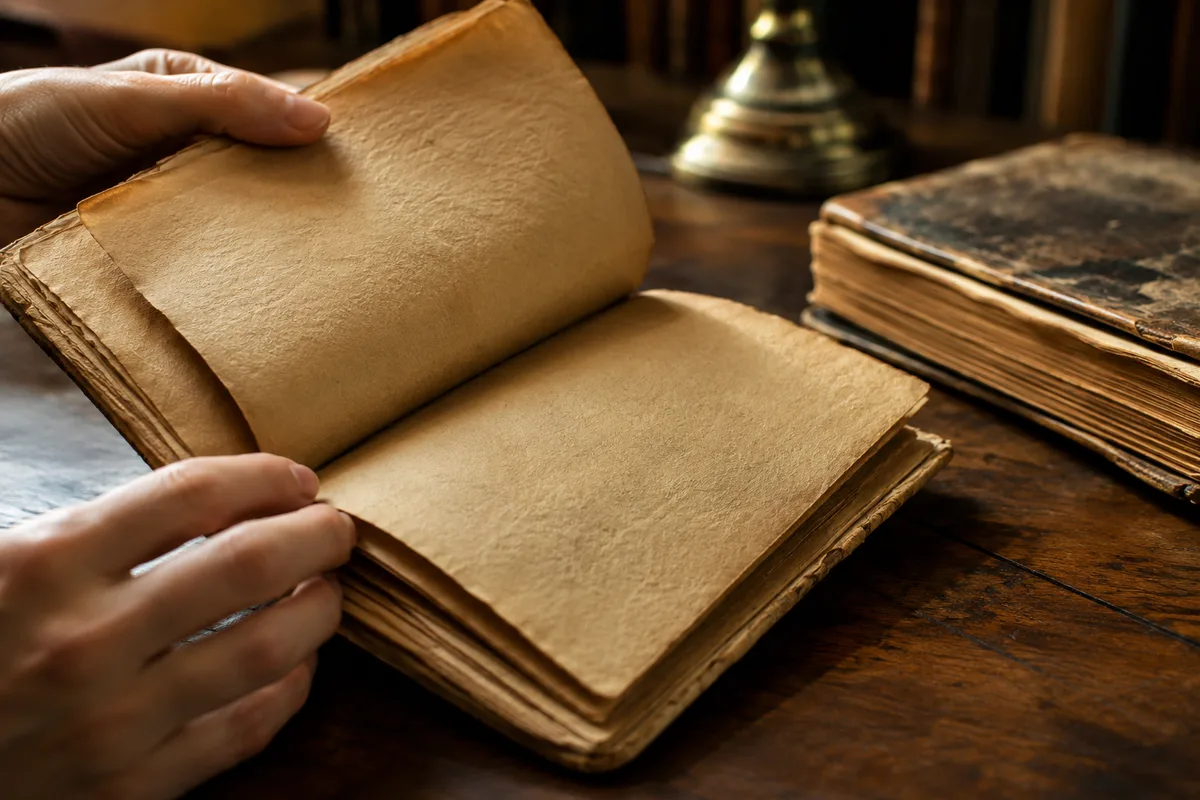
The characteristic scent is created by many compounds interacting at once rather than by one dominant ingredient.
Two of the most important starting materials are cellulose and lignin.
Cellulose forms much of the structural framework of paper. As it degrades, it can produce compounds including furfural and other volatile molecules.
Lignin is another major component of wood. It is especially relevant to many papers manufactured from wood pulp. As lignin changes chemically with age, compounds associated with its degradation can include vanillin and benzaldehyde.
Those names offer a clue to why aging paper can smell surprisingly pleasant.
Vanillin is closely associated with the familiar aroma of vanilla, while benzaldehyde has an almond-like aroma. Furfural and related compounds can contribute sweet or bread-like impressions.
But an old book is not simply releasing natural vanilla perfume.
Its aroma is a complex mixture that may also include acids, alcohols, aldehydes, ethers, and many other volatile compounds. Their concentrations depend on the original paper, manufacturing process, storage conditions, and degree of deterioration.
That is why two books printed decades apart — or even two books of similar age — may smell noticeably different.
Old Books Can Share Aroma Chemistry With Coffee and Chocolate
One of the most intriguing studies of historic-book odor went beyond laboratory instruments and asked people what old books actually smelled like to them.
Researchers Cecilia Bembibre and Matija Strlič presented historic-book odor samples to visitors at Birmingham Museum and Art Gallery. Participants frequently used descriptions associated with chocolate, cocoa, coffee, wood, and burnt aromas.
That connection is not as strange as it sounds.
Historic paper, coffee, and chocolate can contain some of the same or related volatile compounds. The researchers noted overlapping substances such as furfural, aldehydes, vanillin, and other VOCs in their aroma profiles.
This does not mean your nineteenth-century book contains chocolate.
It means very different materials can release some of the same molecules, allowing the brain to recognize similarities between their smells.
Why Does the Smell Feel So Good?
Chemistry explains what reaches the nose. It does not completely explain why someone enjoys it.
That part is more personal.
A scent can become associated with particular places, people, or periods of life. Someone who spent childhood afternoons in a library, collected secondhand novels as a teenager, or remembers a grandparent’s bookshelf may experience an old-book aroma very differently from someone without those associations.
Curiworld has explored this connection more deeply in why certain smells can bring back powerful memories. Odors can act as unusually effective cues for autobiographical memories and the emotions connected with them.
Old books have another advantage: their aroma often includes notes we already recognize as pleasant — woody, sweet, vanilla-like, or reminiscent of roasted foods.
Chemistry and memory can therefore reinforce each other.
The molecules create the scent.
Your history helps decide what the scent means.
Does Every Old Book Smell the Same?
Not even close.
The phrase “old-book smell” makes it sound as though every aging volume eventually develops the same fragrance, but each book has its own material history.
Its aroma can be influenced by:
- the fibers used to make the paper
- how much lignin the paper contains
- the acidity of the paper
- inks and printing materials
- adhesives and binding materials
- leather, cloth, or board covers
- temperature and humidity during storage
- exposure to light and air
- smoke, perfumes, cooking odors, or other environmental contaminants
- microorganisms associated with damp conditions
A paperback from the 1970s, a nineteenth-century novel, and a centuries-old rag-paper volume are chemically different objects. Their VOC mixtures should not be expected to match.
Modern research reinforces this point. A 2024 study found substantial differences between the VOC patterns emitted by old and new books: older volumes in the study produced profiles dominated more heavily by alcohols and ethers, while newer books showed a different balance involving ketones and aldehydes.
Age matters, but so does everything that happened to the book along the way.
A Pleasant “Old” Smell Is Not the Same as a Musty Smell
There is also an important distinction between the normal aroma of aging paper and the strong mustiness associated with damp storage.
A book can smell old without being moldy.
Persistent dampness creates very different conditions. Microbial growth and moisture-damaged materials can add odors that are not simply part of ordinary paper aging.
That matters because the nostalgic smell people enjoy in an old bookstore should not be treated as evidence that every old or musty book is in good condition.
For collectors and libraries, smell can actually be a clue that deserves attention rather than merely appreciation.
Scientists Can “Sniff” Books Without Damaging Them
The chemistry behind old-book smell has a practical use.
Traditionally, assessing the deterioration of historic paper could require removing or testing physical material. Researchers have increasingly investigated VOC analysis as a non-destructive way to learn about a book’s condition.
Instead of cutting into a valuable page, scientists can sample molecules released into the air around the object and analyze the resulting chemical profile.
That profile can contain clues about cellulose deterioration, lignin degradation, acidity, and other changes taking place within the paper.
This approach is sometimes described as material degradomics: studying the chemical products released as materials deteriorate.
It turns something librarians and book lovers have noticed for generations — the smell of an old volume — into measurable scientific information.
The Smell of a Book Is Part of Its History
An old book’s scent is not just accumulated dust.
It is partly the result of decades or centuries of molecular change: cellulose breaking down, lignin transforming, volatile compounds escaping into the air, and the materials of the book interacting with the environment around them.
That is why the aroma can contain hints that remind us of vanilla, wood, bread, coffee, or chocolate.
It also explains why the scent can feel unusually powerful. The chemistry belongs to the book, but the pleasure may belong just as much to the reader — to libraries visited, stories discovered, and memories attached to physical pages.
An old book, in that sense, carries two histories.
One is printed in ink.
The other is quietly drifting into the air.
Sources
Stylianou, M., Barlet, C., Andreou, C. & Agapiou, A. — “Assessment of Volatile Emissions by Aging Books” — Environmental Science and Pollution Research (2024). PubMed record
Bembibre, C. & Strlič, M. — “Smell of Heritage: A Framework for the Identification, Analysis and Archival of Historic Odours” — Heritage Science (2017). Open-access study







Join the discussion