The Psychology Behind Viral Memes
Why can a simple image become an internet phenomenon? Emotion, identity, inside jokes and social connection help explain why some memes are almost impossible not to share.
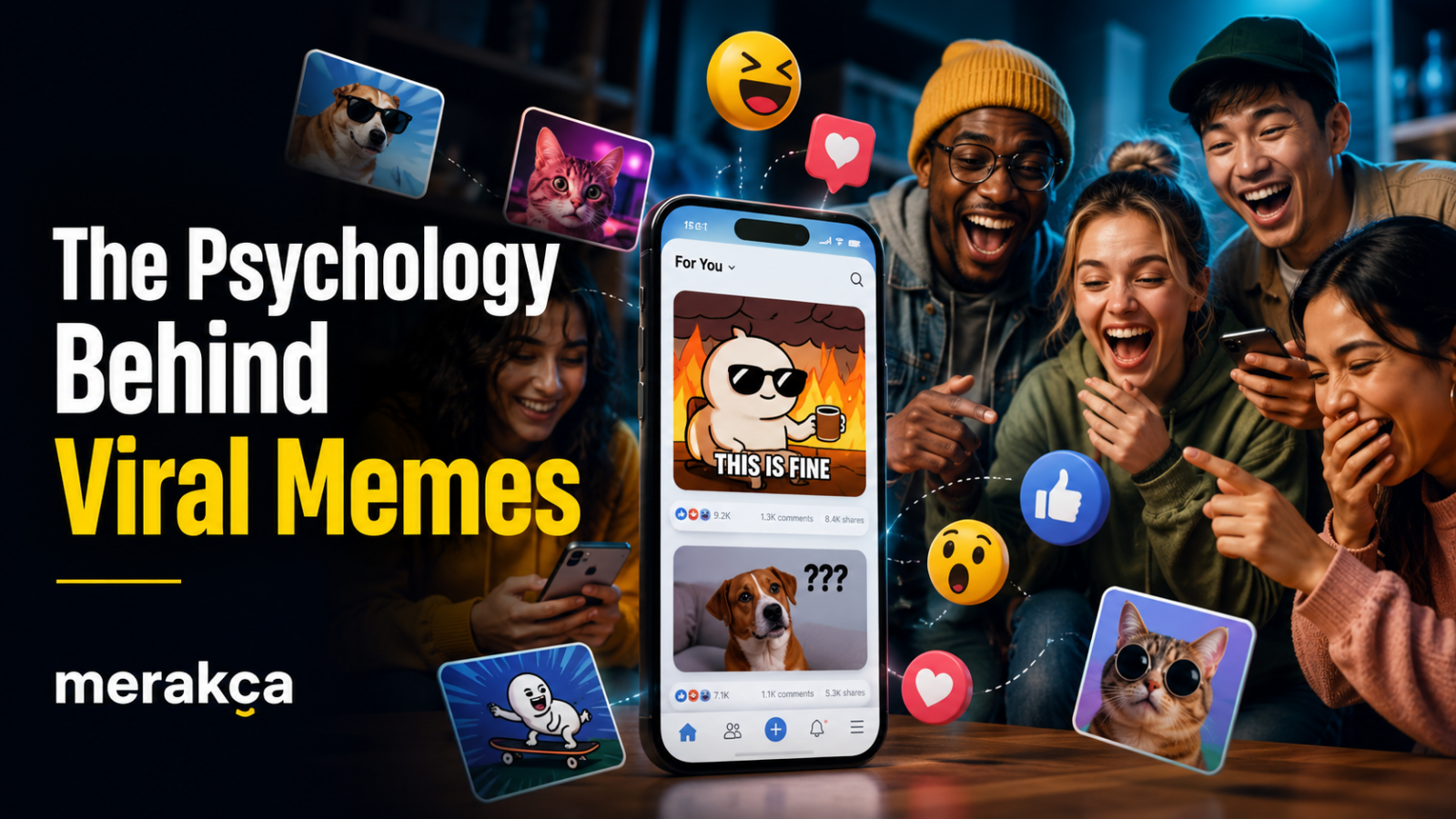
A meme appears in your group chat. Within seconds, three people react, someone forwards it to another chat, and one friend says, “This is literally you.”
The image itself may be ordinary. The caption might contain fewer than ten words. Yet somehow it communicates a joke, an emotion, a social observation and an inside reference all at once.
That efficiency is part of what makes memes so powerful.
Viral memes do more than make people laugh. They can express identity, signal belonging, maintain friendships and turn complicated experiences into instantly recognizable social shorthand. Their success is not controlled by a single psychological trick, but several forces repeatedly appear when people decide that a piece of content is worth passing on.
A Good Meme Compresses a Big Idea Into a Small Package
One of the strangest qualities of internet memes is how much meaning they can carry with so little explanation.
Imagine a familiar reaction image paired with:
“Me opening my email after ignoring it for three days.”
You do not need a backstory. You probably do not need to know who originally created the image. If you recognize the situation, your brain fills in most of the missing context.
That gives memes an unusual communication advantage.
A successful meme often takes a familiar emotion or experience—procrastination, embarrassment, dating, work stress, friendship, sleep deprivation—and reduces it to an instantly recognizable scene.
The reader does some of the work.
And that can make understanding the joke feel almost immediate.
Emotion Helps Content Travel
People do not share everything they enjoy.
A post can be interesting enough to read and still not feel worth sending to another person. Viral content usually creates an additional impulse:
Someone else needs to see this.
Research on online sharing suggests that emotion plays an important role in creating that impulse.
In a widely cited study published in the Journal of Marketing Research, Jonah Berger and Katherine Milkman examined which kinds of New York Times articles were more likely to be heavily shared. Their research was not specifically about memes, so it should not be treated as a formula for meme virality. But it revealed an important pattern: content associated with higher-arousal emotions such as awe, anger and anxiety was more likely to spread than content associated with lower-arousal emotions such as sadness.
For memes, the activating emotion is often laughter, surprise, disbelief or the sudden shock of recognition.
That moment of “this is painfully accurate” can be more shareable than something that is merely pleasant.
The Best Memes Often Feel Personal
Some memes become irresistible because they seem strangely specific.
A meme about avoiding one awkward phone call.
A joke about pretending you understand the restaurant bill while someone calculates how to split it.
A reaction image for seeing a message and deliberately deciding to answer it “later.”
When a meme describes something you recognize in yourself, sharing it becomes more than distributing entertainment.
It can become a tiny piece of self-expression.
Instead of writing:
“I always do this.”
You send the meme.
Instead of explaining:
“This is exactly how I feel when this happens.”
You send the meme.
The person receiving it understands both the joke and something about you.
That ability to communicate identity without writing an explanation helps explain why memes fit so naturally into friendships and group chats.
Curiworld’s group-chat personality quiz even includes the “Meme Dealer”—the friend who somehow always has the perfect reaction image ready for the situation.
That character feels familiar because meme sharing has become its own recognizable form of social behavior.
Memes Can Act Like Digital Inside Jokes

Some memes are funny to millions of people.
Others are hilarious to exactly four.
That is not a failure.
A meme does not always need the largest possible audience. Sometimes its value comes from being understood by a very particular group.
Friends may repeatedly send each other variations of the same image. Couples can develop meme references that make little sense outside the relationship. Online communities create jokes built around games, television shows, professions, hobbies or events that outsiders would barely recognize.
Understanding the reference becomes part of the experience.
A 2026 peer-reviewed study from researchers at Aarhus University examined everyday meme sharing among young adults and found that participants used memes in ways connected with identity, relationships and what the researchers describe as digital intimacy.
The study was small—two focus groups involving 14 university students in Denmark—so its findings should not be generalized to everyone who uses memes. Still, it provides an interesting window into something easily overlooked: sending a meme can be a lightweight way of maintaining closeness.
Sometimes “I saw this and thought of you” does not need to be written.
The meme already says it.
Familiarity Makes a Meme Faster to Understand
Internet culture constantly recycles formats.
The same facial expression, movie frame, cartoon character or screenshot may survive through hundreds of unrelated jokes.
That repetition might seem like it should make memes boring.
Instead, familiarity can become useful.
Once people recognize a format, much of the setup has already been established. The creator only needs to change one part of it.
The audience knows the visual language.
Think of it like hearing the opening of a joke format you already understand. Your mind knows roughly where the setup is going, which allows the new twist to arrive faster.
That creates one of the most effective combinations in meme culture:
a familiar structure with an unexpected variation.
Too familiar, and the meme feels stale.
Too unfamiliar, and people may not understand it.
The sweet spot often lies somewhere between recognition and surprise.
Sharing a Meme Also Says Something About the Sender
People rarely share content in a social vacuum.
There is usually an imagined audience.
You send one meme to your closest friend.
Another goes to your coworkers.
A third stays safely inside your camera roll because explaining why you find it funny would create more problems than the joke is worth.
That selection matters.
Every share contains an implicit prediction:
“They will understand this.”
“They will find this funny.”
“This reminds me of them.”
“This is something our group talks about.”
Sharing therefore becomes a small social decision. People are not merely judging the meme itself; they are judging the relationship between the meme and the person receiving it.
The funniest meme in the world is useless if you send it to someone who has no idea what it means.
Context can be as important as content.
Timing Can Turn an Ordinary Meme Into the Perfect Meme
The right meme delivered five minutes after something happens can feel brilliant.
The same meme two weeks later may feel ancient.
Internet humor is unusually sensitive to timing because memes frequently react to shared moments: a sporting event, celebrity appearance, television episode, new technology, awkward interview, cultural trend or another meme.
Early versions benefit from novelty.
Then imitation begins.
People modify the format, remix it, exaggerate it and combine it with other references. Eventually the joke can become so common that using it sincerely becomes embarrassing.
Sometimes the meme then receives a second life precisely because it is outdated.
People begin using it ironically.
Internet culture has effectively turned the expiration date of a joke into another joke.
Algorithms Can Amplify a Meme, but People Still Give It Meaning
Platforms clearly matter to virality.
Recommendation systems can expose content to audiences far beyond the creator’s original followers. A meme that performs well can move rapidly between feeds, accounts and communities.
But distribution alone cannot explain why people keep forwarding a particular meme.
A platform can show someone a post.
It cannot guarantee that they will think of a friend and send it.
That distinction is useful because virality is often described as though it were purely an algorithmic event.
Algorithms can amplify attention.
Human behavior supplies the reactions, interpretations and relationships that make a meme socially meaningful.
Our broader habits around feeds and notifications also affect what reaches our attention; Curiworld’s look at what happens when you step away from social media for 30 days explores that environment from a different psychological angle.
Why Do Some Memes Fail?
There is no reliable recipe that guarantees virality.
If one existed, every marketing department on Earth would already be using it.
A meme can fail because the reference is too obscure, the joke requires too much explanation, the format has already been exhausted or the audience simply does not identify strongly enough with the situation.
Trying too hard can also work against the format.
Memes often succeed because they feel effortless.
The funniest ones rarely appear to be explaining why they are funny.
They create a small recognition gap and allow the audience to close it.
That participation is part of the reward.
Viral Memes Are Tiny Social Messages
The psychology behind viral memes becomes much clearer once memes are treated as communication rather than disposable internet jokes.
They can trigger emotion, compress shared experiences, express identity and strengthen a sense of belonging. Familiar formats make complex jokes quick to decode, while new twists prevent them from becoming completely predictable.
Most importantly, sharing changes the meaning.
A meme sitting on a feed is content.
The same meme sent directly to a friend can become an inside joke, a reaction, an opinion, a memory or simply a way of saying, “I know exactly who will understand this.”
That may be the most important psychological ingredient of meme culture.
The internet creates the audience.
People create the connection.
Sources
Berger, Jonah & Milkman, Katherine L. — “What Makes Online Content Viral?” — Journal of Marketing Research, 2012. View the study
Balleby, Lasse; Toft-Nielsen, Claus; Hougaard, Tina Thode — “Digital Intimacy: How Everyday Meme Sharing Shapes Identity and Relationships” — Popular Communication, 2026. Aarhus University research record







Join the discussion