Why Are Oddly Satisfying Videos So Hard to Stop Watching?
A spotless visual loop, a perfect fit, a clean transformation—oddly satisfying videos seem simple, but psychology helps explain why they are so difficult to stop watching.
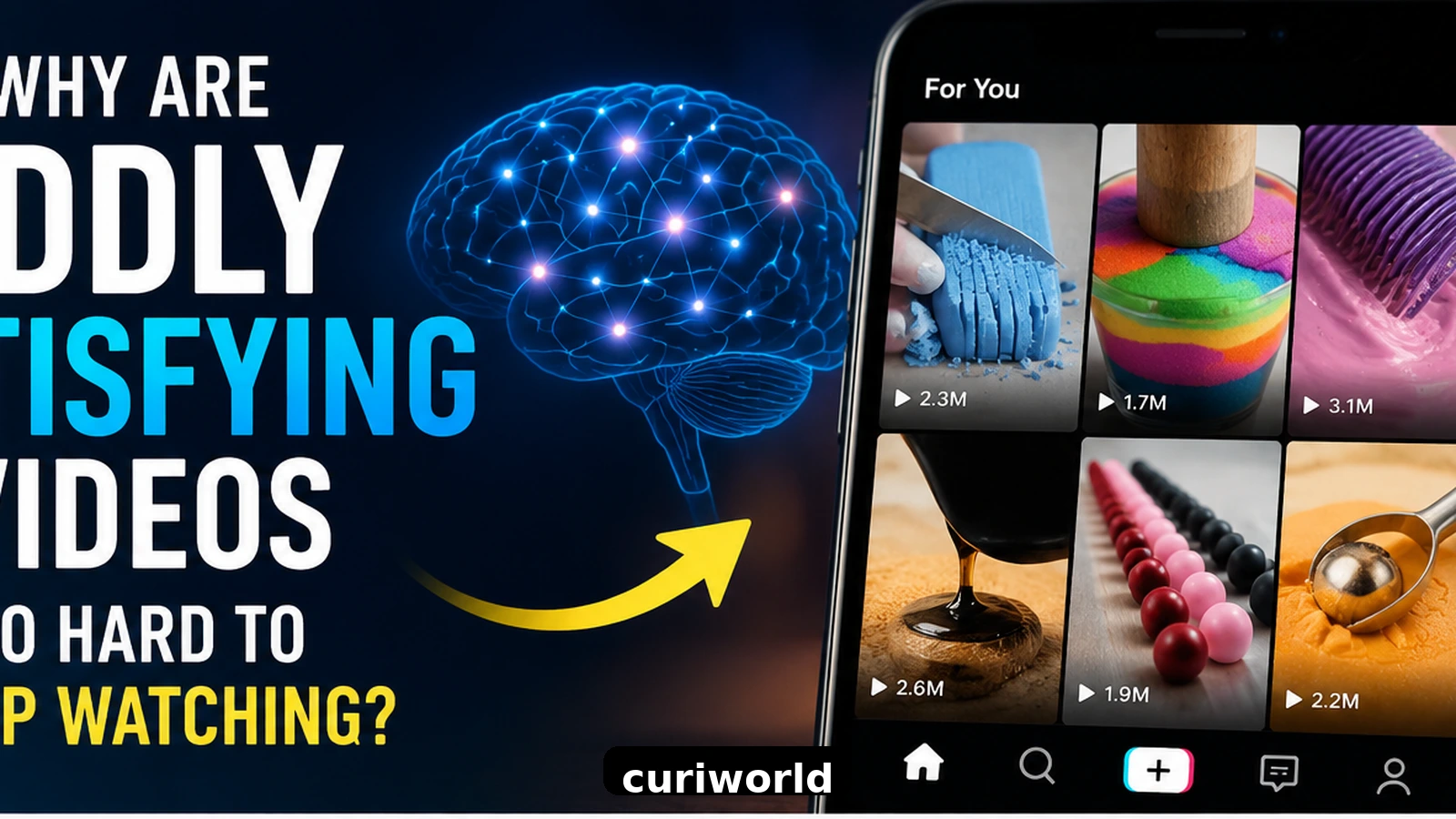
A knife glides cleanly through soap. Paint spreads in a perfectly even layer. Hundreds of tiny objects fall into flawless alignment. Nothing important is happening, yet somehow it feels impossible to look away.
Oddly satisfying videos occupy a strange corner of the internet. They are often short, repetitive, and almost plotless, but they hold attention with surprising force. The reason is not that they contain some secret trick. It is that they combine several things the brain tends to enjoy: predictability, sensory smoothness, tiny moments of completion, and low-effort reward.
That combination makes them easy to start, easy to keep watching, and oddly difficult to stop.
They Feel Good Because the Brain Likes Smooth Processing
One of the clearest explanations comes from a psychological idea known as processing fluency.
In simple terms, people tend to respond more positively to things that are easy for the mind to process. When shapes are neat, patterns are clear, movement is smooth, and outcomes are visually coherent, the experience can feel more pleasant than something messy or mentally demanding.
Oddly satisfying videos are built around that effect.
A straight line is drawn perfectly. A stack fits together exactly. A messy surface becomes clean. The viewer does not have to work hard to understand what is happening. The visual information is organized, legible, and often rhythmically repetitive. That creates a small but real sense of ease.
The pleasure is not always dramatic. Sometimes it is almost too subtle to notice. But that is part of the appeal. These videos often feel soothing precisely because they reduce friction rather than create excitement.
Tiny Moments of Completion Keep Pulling You Forward

Many oddly satisfying clips revolve around one satisfying outcome: the thing gets finished.
A surface is scraped clean. Slime is mixed until the texture looks uniform. Objects click into place. A cake is frosted smoothly from edge to edge. Each video promises a mini-resolution.
That matters because the brain is highly sensitive to unfinished versus finished states. A visually incomplete action can create a mild sense of tension, while completion brings a small sense of relief. It is one reason so many people feel compelled to wait until the end of the clip, even if they know exactly what is coming.
That same pull toward closure is related to why unresolved tasks can stay mentally active. Curiworld explored a similar idea in Why Do Unfinished Tasks Stay in Your Head?. Oddly satisfying videos are not the same phenomenon, but they tap into a related desire: the pleasure of seeing something resolved.
The trick is that one completed clip immediately sets up the next.
They Deliver Reward Without Asking Much From You
A thriller demands attention. A tutorial asks you to learn. A long article expects concentration. Oddly satisfying videos ask for almost nothing.
That low barrier matters.
They offer a quick sensory reward without much cognitive effort. You do not need background knowledge, emotional investment, or even sound in many cases. The clip works in a few seconds, often with no language at all.
This makes the experience extremely accessible. It can slot into moments when the brain is tired, bored, overstimulated, or unwilling to focus deeply. Instead of asking for effort, the video gives the viewer a rapid feeling of order, rhythm, or resolution.
That makes it especially sticky on platforms built around endless feeds. If each clip gives you a tiny payoff and the next one starts instantly, stopping begins to feel less natural than continuing.
Repetition Can Be Calming, Not Boring
At first glance, repetitive content should seem dull. In practice, repetition often has the opposite effect.
Repetitive motion can be calming because it reduces uncertainty. When the viewer can predict the next movement, the experience becomes less mentally taxing. That is one reason looped visuals, symmetrical actions, and rhythmic sounds can feel so soothing.
There is also an overlap here with ASMR, although the two are not identical. Some oddly satisfying videos include soft sounds, crisp textures, or repetitive sensory cues that resemble ASMR triggers. Research on ASMR suggests that, for people who respond to it, this kind of content can be associated with pleasant feelings and measurable physiological changes linked to calm attention.
Not every satisfying video is ASMR, and not every viewer experiences tingles or deep relaxation. Still, the overlap helps explain why these videos can feel more regulating than random entertainment.
They do not merely show something nice. They often create a sensory environment that feels controlled, neat, and reassuring.
They Turn Disorder Into Order
A major source of satisfaction is transformation.
Before-and-after structure is everywhere in this genre: dirty becomes clean, scattered becomes organized, rough becomes smooth, uneven becomes precise. Even when the viewer has no personal stake in the task, there is pleasure in watching disorder give way to order.
That effect is powerful because it is immediately legible. The brain does not need a long explanation to register improvement. It can see it.
This is especially effective in a chaotic online environment. Social feeds are noisy, fragmented, and attention-hungry. Against that backdrop, a clip showing a single clean transformation can feel almost restorative. For a few seconds, at least, the world makes visual sense.
That may be one reason these videos thrive online. They offer a tiny experience of control inside a digital space that usually feels crowded and overstimulating.
Short Platforms Make Them Even Harder to Leave
The content itself matters, but platform design matters too.
Oddly satisfying videos are usually short. They autoplay. They loop cleanly. They arrive in a feed where another similar clip is always one swipe away. The result is a pattern of viewing built on micro-reward, fast transition, and almost no stopping friction.
You do not need to make a big decision to watch more. You simply remain where you are.
This is different from being deeply absorbed in a two-hour film. The grip is lighter, but in some ways more persistent. A long movie asks for commitment. A satisfying video asks for “just one more.”
That “just one more” structure is one of the most powerful habits the modern internet produces.
Why Do Some People Love Them More Than Others?
Not everyone finds the same videos satisfying.
Some people respond strongly to visual symmetry. Others care more about texture, sound, or the feeling of completion. Some are soothed by repetitive clips, while others get bored almost immediately. Personal history, sensory preferences, mood, and context all seem to matter.
A person who is stressed may find these clips calming. Someone procrastinating may find them irresistible for less flattering reasons. A tired viewer may prefer content that offers reward without effort. Another viewer may simply enjoy craftsmanship and precision.
So there is no single universal mechanism.
That is worth remembering, because people often talk about oddly satisfying videos as if they work like a guaranteed brain hack. The reality is more modest and more interesting: they combine several psychological features that many people find pleasant, especially in the right moment.
When Does “Satisfying” Turn Into Mindless Scrolling?
Watching a few satisfying clips is not a problem. For many people, it is just harmless entertainment.
The issue begins when the videos become a default escape from boredom, stress, or mental effort. Because they are easy, pleasant, and endless, they can slide into passive overconsumption. You may open one clip for a quick break and realize twenty minutes disappeared.
That does not mean the videos are uniquely dangerous. It means they fit extremely well with the larger logic of short-form platforms: low effort in, quick reward out, repeat.
If that pattern starts leaving you more distracted than refreshed, the problem may be less the videos themselves and more the way the feed keeps removing natural stopping points.
The Real Reason They Are So Hard to Stop Watching
Oddly satisfying videos work because they stack small pleasures on top of one another.
They are visually fluent. They often feature neat patterns and predictable motion. They promise completion. They sometimes overlap with calming ASMR-like cues. They transform disorder into order. And they arrive in a platform environment designed to make the next clip effortless to start.
None of those ingredients is overwhelming on its own.
Together, they create exactly the kind of low-friction, low-effort reward the internet is exceptionally good at delivering.
That is why these videos can feel so compelling. They do not demand much from the viewer, but they keep handing back tiny moments of relief, order, and payoff.
And when the next one is already loading, stopping can feel like interrupting a process the brain was enjoying just a little too much.
Sources
PMC — Loop and Enjoy: A Scoping Review of the Research on Processing Fluency






Join the discussion