Why Do Familiar Places Sometimes Suddenly Feel Strange?
A familiar room or street can suddenly feel oddly unfamiliar. Psychology explains how jamais vu and temporary changes in familiarity can create the eerie sensation.
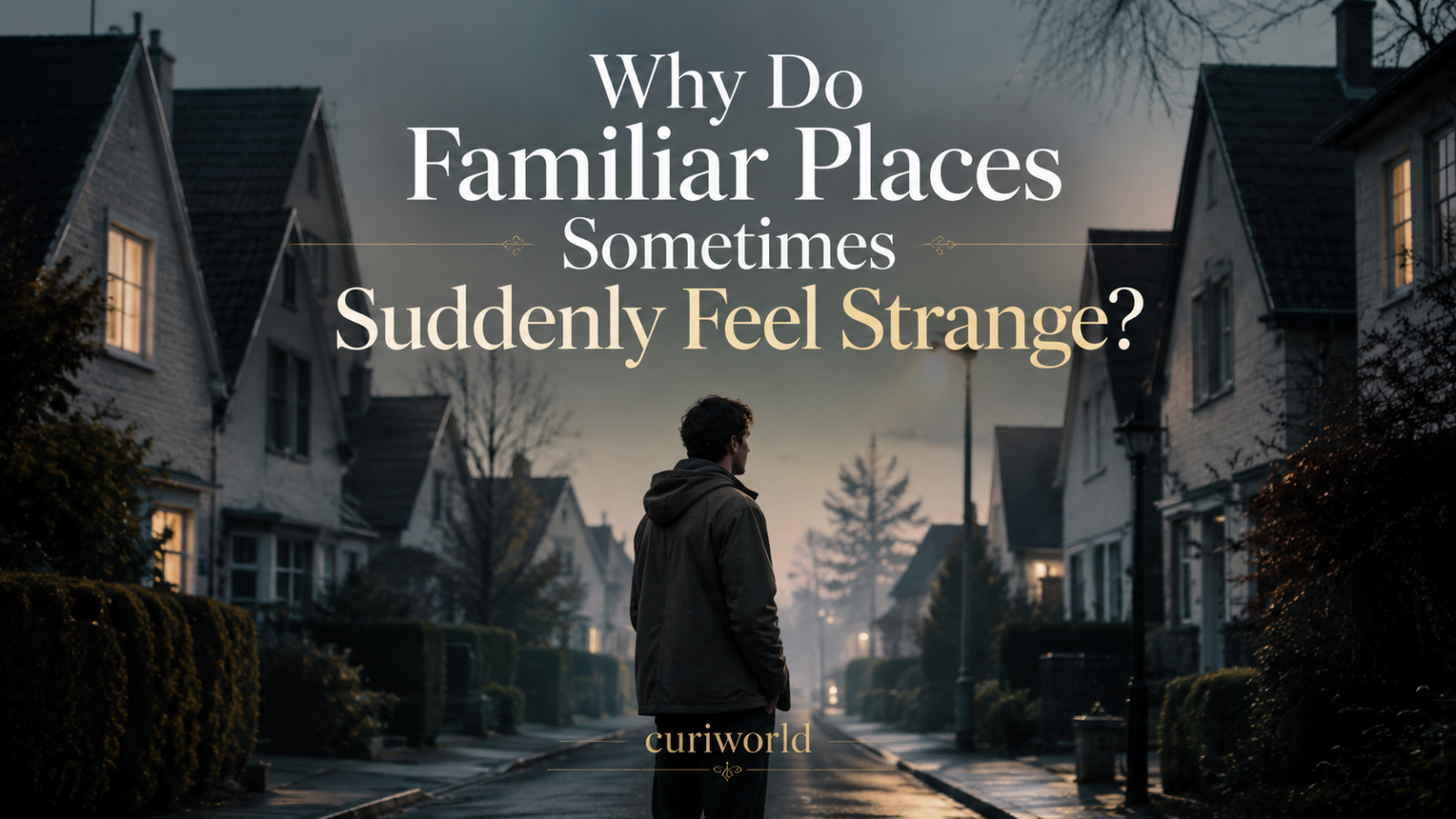
You walk into your own kitchen, turn onto a street you have used hundreds of times, or look across a room you know perfectly well—and for a few seconds, something feels wrong.
Nothing has actually changed. You know where you are. You can name the objects around you. Yet the place suddenly seems oddly unfamiliar, almost as if you were seeing it for the first time.
There is a name for one version of this experience: jamais vu, French for “never seen.” Often described as the opposite of déjà vu, it happens when something you know is familiar temporarily fails to feel familiar.
That distinction—between knowing and feeling—is the key to understanding why an ordinary place can suddenly seem strange.
Familiarity Is a Feeling, Not Just a Fact
Recognizing a place involves more than retrieving a fact from memory.
When you enter your home, you usually do not consciously think, “I have seen this hallway before.” Recognition happens automatically. The shape of the space, the position of furniture, the lighting, sounds, smells, and countless small details combine into an immediate sense of familiarity.
Most of the time, two things line up perfectly:
You know the place, and it feels familiar.
Jamais vu appears when those processes briefly fall out of sync.
You may still know perfectly well that you are standing in your bedroom or walking through your neighborhood, but the usual emotional sense of recognition is temporarily missing.
Researchers studying jamais vu describe it as a situation in which something objectively familiar becomes subjectively unfamiliar. The phenomenon can involve words, faces, places, and even well-practiced actions.
That is what makes the experience so unsettling. Your knowledge says one thing while your immediate perception seems to say another.
The Opposite of Déjà Vu

Déjà vu is much more famous.
If that reverse sense of familiarity interests you, our guide explains what déjà vu is and why it happens.
With déjà vu, a new situation somehow feels as though it has happened before.
Jamais vu reverses the mismatch.
For the opposite experience—when a genuinely new situation suddenly feels familiar—see what déjà vu is and why it happens.
A familiar situation suddenly feels new.
You might enter a building you visit every day and momentarily wonder why it looks different. A friend’s face may briefly seem unusual even though you have no difficulty identifying them. A common word can become so visually strange that you start questioning whether it is spelled correctly.
The last example is particularly useful because scientists have managed to reproduce something similar in laboratory experiments.
Researchers asked participants to repeatedly write familiar words. After enough repetition, many participants reported that the word began to look peculiar, unfamiliar, or somehow wrong.
In the study, strange sensations often emerged after roughly 30 repetitions or about a minute of continuous writing. The researchers interpreted this temporary “word alienation” as an experimentally induced form of jamais vu.
If you have ever written a simple word several times and suddenly thought, “That can’t possibly be how it’s spelled,” you have encountered a close relative of the same effect.
Too Much Familiarity Can Make Something Feel Unfamiliar
This sounds contradictory.
Shouldn’t seeing something repeatedly make it feel more familiar?
Usually, yes.
But extreme repetition can temporarily disrupt normal processing.
Imagine saying the word “door” aloud 40 times. Eventually, the sound may detach from its meaning. It stops behaving like a normal word and starts sounding like a collection of strange noises.
The word itself has not changed.
Your processing of it has.
Researchers sometimes discuss this alongside semantic satiation, in which repeated exposure temporarily weakens the normal connection between a familiar word and its meaning.
Jamais vu may involve a related disruption in the feeling of familiarity.
This does not mean your home has to be repeated 30 times before it suddenly looks strange. Real-world experiences are far more complicated than laboratory word-repetition tasks.
But the experiment demonstrates something important: familiarity is not permanently attached to an object or place. It is something the brain continuously produces.
And occasionally, that process behaves unexpectedly.
A Small Change Can Make a Familiar Scene Look Different
Places are especially interesting because our recognition of them depends on a large collection of cues.
Consider your living room.
You normally see it from certain angles, under familiar lighting, with objects arranged in predictable positions. You probably move through it without consciously studying any of those details.
Now imagine entering it in the middle of the night with an unfamiliar light switched on.
The furniture casts different shadows. The room’s proportions seem slightly altered. Familiar objects stand out in unusual ways.
You still know it is your living room, but it may briefly look like a different place.
A similar effect can happen when you enter a familiar street from an unusual direction, visit a workplace when it is completely empty, or see a childhood location after many years.
The physical place has not necessarily changed much.
The context in which your brain is processing it has.
Sometimes that small disruption is enough to make the automatic feeling of familiarity hesitate.
Attention Can Suddenly Reveal What Routine Usually Hides
There is another strange feature of very familiar environments: we often stop looking at them closely.
Think about the front door of your home.
Could you immediately describe the exact shape of the handle, the number of panels, every scratch, and the position of every mark?
Probably not.
Familiarity allows the brain to operate efficiently. Instead of repeatedly analyzing every feature of a known environment, we rely heavily on expectations.
That efficiency is useful, but it also means that intentionally inspecting a familiar place can produce an unexpectedly strange experience.
You suddenly notice the proportions of a hallway.
You stare at a staircase and realize how unusual its geometry actually is.
You look at the outside of your house instead of simply recognizing it as “home.”
For a moment, you are no longer experiencing the place through the usual shortcut of familiarity. You are examining it almost as a new observer might.
The result can feel surprisingly alien.
Fatigue and Stress Can Change the Experience
Not every episode of unfamiliarity is classic jamais vu.
Feeling tired, stressed, anxious, or mentally overloaded can change how surroundings are experienced.
A related phenomenon called derealization involves a sense of detachment from the external world. People experiencing it may describe their surroundings as dreamlike, artificial, distant, foggy, or somehow unreal.
Temporary experiences of derealization are not necessarily evidence of a disorder. Merck Manual notes that transient feelings of depersonalization or derealization are relatively common and can occur during severe fatigue, sleep deprivation, intense stress, or other circumstances.
This is different from a brief moment of jamais vu.
With jamais vu, the central oddity is often:
“I know this place, but suddenly it doesn’t feel familiar.”
With derealization, the experience may be broader:
“Everything around me feels unreal or distant.”
The sensations can overlap, but they are not interchangeable terms.
Knowing Where You Are Is an Important Difference
One of the most striking things about a typical jamais vu experience is that you usually retain insight.
You know the kitchen is your kitchen.
You know the street is the one you walk every day.
The sensation feels strange precisely because it conflicts with what you know to be true.
That is very different from genuinely becoming disoriented and being unable to identify where you are.
The same distinction matters with derealization. People experiencing derealization generally recognize that their surroundings only feel unreal; they do not necessarily believe that reality itself has actually changed.
That preserved awareness is one reason a fleeting strange feeling can be fascinating rather than dangerous.
It is your brain noticing a mismatch in its own experience.
Why Looking at Something for Too Long Can Make It Weird
You can sometimes produce a miniature version of the effect deliberately.
Pick a familiar object—a key, a mug, or even your own written name—and examine it longer than you normally would.
Do not merely recognize it.
Study its shape.
Look at the spaces between letters. Notice tiny asymmetries. Ignore what the object is for and focus only on what it physically looks like.
After a while, something very ordinary can begin to seem surprisingly odd.
The same can happen with faces.
If you stare too long at a familiar face, including your own reflection, individual features can begin to dominate your perception instead of blending into the effortless whole you normally recognize.
Ordinary perception works partly because we do not constantly inspect familiar things this way.
We recognize them and move on.
Is It Something to Worry About?
An occasional fleeting feeling that a familiar place suddenly looks strange is not, by itself, enough to establish that anything is wrong.
Jamais vu is a recognized memory phenomenon, and temporary changes in the sense of familiarity can occur without becoming a clinical problem.
Frequency, duration, and accompanying symptoms matter.
A very different situation exists if episodes are persistent, repeatedly distressing, or accompanied by significant confusion, memory problems, loss of awareness, seizures, substance effects, or difficulty functioning normally.
Persistent or recurrent derealization that causes substantial distress also deserves professional evaluation rather than being dismissed as ordinary jamais vu. Merck Manual notes that clinicians consider other possible medical and psychiatric causes when evaluating persistent depersonalization or derealization symptoms.
The strange sensation itself is therefore less informative than the larger pattern in which it occurs.
Your Brain Is Constantly Rebuilding “Familiar”
We tend to imagine familiarity as something stored permanently inside a memory.
You have seen your house thousands of times, therefore your house is familiar.
But the experience is more dynamic than that.
Every time you encounter a familiar place, your brain combines current sensory information with memory and expectation to produce the effortless feeling that says:
I know this place.
Most of the time, that system works so smoothly that you never notice it.
Jamais vu gives you a rare glimpse of what happens when the feeling briefly fails to arrive.
The room is still the same room.
The street is still the same street.
Your memories have not necessarily disappeared.
For a few strange seconds, however, one of the brain’s most ordinary achievements—making the known world feel known—becomes visible precisely because it stops working as expected.
And that may be why the experience feels so eerie.
Nothing around you has become unfamiliar.
For a moment, familiarity itself has.
Sources
Moulin, C. J. A., Bell, N., Turunen, M., Baharin, A., & O’Connor, A. R. — “The the the the induction of jamais vu in the laboratory: word alienation and semantic satiation” — Memory (2021).
PubMed record
Merck Manual — “Depersonalization/Derealization Disorder” — Reviewed June 2025, updated January 2026.
Merck Manual







Join the discussion