Why Does Your Phone Battery Drain Faster in Cold Weather?
Cold weather can make a phone shut down while charge still remains. The reason has more to do with battery chemistry and voltage than disappearing energy.
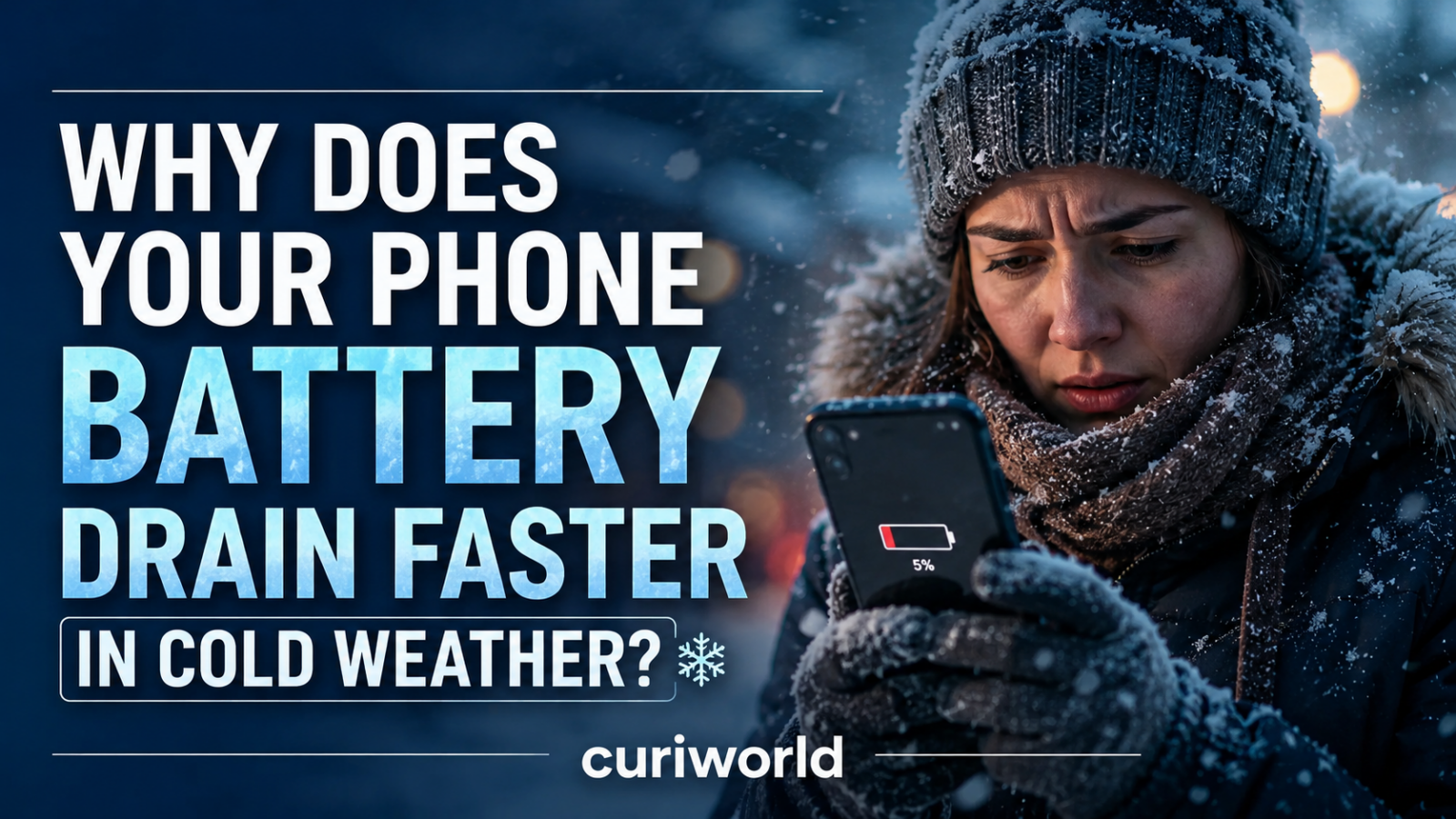
Your phone says 40% battery when you leave the house. After spending some time outside on a freezing day, the percentage starts falling much faster than expected—or the phone suddenly switches off even though it appeared to have plenty of charge left.
The battery has not necessarily used all of that energy.
Cold temperatures make lithium-ion batteries less efficient at delivering power. Chemical reactions slow down, internal resistance increases, and the battery’s voltage can fall more sharply when the phone needs energy. In very cold conditions, the device may even shut down before all of its stored energy can be used.
The surprising part is that much of this effect can be temporary.
What Cold Weather Does Inside Your Phone Battery
Most modern smartphones use lithium-ion batteries. They are lightweight, rechargeable, and capable of storing a large amount of energy in a relatively small space.
To supply power, lithium ions move through the battery between its electrodes while electrons travel through the phone’s electrical circuit.
Temperature affects how easily those processes happen.
When a lithium-ion battery becomes cold, movement inside the cell slows. The electrolyte becomes less effective at transporting lithium ions, electrochemical reactions become slower, and the battery’s internal resistance rises.
Think of it as trying to move through thickening traffic. The energy is still present, but moving it where it needs to go becomes more difficult.
The phone, meanwhile, continues asking for power to run the display, processor, cellular connection, GPS, camera, and other components.
That mismatch is what creates many familiar winter battery problems.
Your Battery May Not Be Empty
This is one of the most misunderstood parts of cold-weather battery drain.
A phone shutting down does not always mean the battery has reached zero stored energy.
Electronic devices require their batteries to maintain a minimum voltage. As a cold lithium-ion battery’s internal resistance rises, its voltage can drop more dramatically whenever the phone demands power.
If the voltage falls below the level needed for reliable operation, the phone may reduce performance or shut itself down.
This explains a strange experience many people have had:
Your phone shows 20% battery outside.
It suddenly powers off.
You bring it indoors.
After it warms up, it turns on again and still shows some remaining charge.
The phone did not recharge itself while sitting in your pocket. Instead, warming the battery reduced some of the temporary resistance that had prevented it from delivering its stored energy effectively.
If battery drain also happens at normal indoor temperatures, use our broader checklist for what can make a phone battery drain unusually fast.
Why the Battery Percentage Can Drop So Quickly
The percentage displayed on your phone is an estimate of its remaining state of charge.
It is not the same as looking through a transparent fuel tank and seeing exactly how much liquid remains.
A smartphone’s battery-management system estimates available charge using several measurements and models, including voltage, current, temperature, and the known behavior of the battery.
Cold temperatures can make that estimation more difficult because battery voltage behaves differently under load.
Imagine two phones that both display 25%.
One is sitting indoors at a comfortable temperature. The other has been outside in freezing air.
The warm battery may be able to supply the power required to record video or run navigation without difficulty. The cold battery may experience a much larger voltage drop when asked to perform the same task.
To the user, it can look as though the remaining battery disappeared in seconds.
In reality, the phone may simply have reached a point where the cold battery could no longer deliver enough power safely.
Why Older Phones Often Struggle More
Battery age makes the problem more noticeable.
Lithium-ion batteries gradually lose capacity as they go through charging cycles and chemical aging. Their internal resistance can also increase over time.
Cold weather temporarily increases resistance too.
An older battery is therefore starting from a less favorable position.
A newer phone with a healthy battery may function normally during a winter walk, while an older version of the same model may lose performance or shut down much sooner.
This is why unexpectedly severe cold-weather behavior can sometimes reveal an aging battery.
If your phone frequently shuts down with significant charge remaining—even in temperatures that are not especially extreme—it may be worth checking the device’s battery-health information.
If the battery also drains unusually quickly at normal indoor temperatures, the problem may be broader than cold-weather chemistry. See what can cause fast phone battery drain.
Some Tasks Put More Pressure on a Cold Battery
Your phone does not use power at a constant rate.
Certain activities demand considerably more energy than others, especially for short bursts.
Examples include:
- Recording video
- Taking many photos
- Gaming
- Using GPS navigation
- Running the screen at maximum brightness
- Making video calls
- Using mobile data in areas with weak reception
- Running processor-intensive apps
A cold battery already has more difficulty supplying current.
When the processor, camera, screen, or cellular radio suddenly asks for more power, voltage can drop further.
That is why a freezing phone may appear perfectly fine while sitting idle and then suddenly shut down when you open the camera.
The camera did not necessarily consume the remaining battery in a few seconds. It may simply have created a power demand that the cold battery could not temporarily meet.
How Cold Is Too Cold for a Smartphone?
There is no single temperature limit that applies to every smartphone.
Manufacturers publish operating-temperature ranges for individual devices, and those specifications are the best reference for a particular phone.
Apple, for example, recommends using iPhone and iPad devices where the ambient temperature is between 32°F and 95°F (0°C and 35°C).
Apple also warns that using an iPhone in very cold conditions outside its operating range may temporarily shorten battery life and can cause the device to turn off.
That does not mean an iPhone will instantly stop working when the temperature reaches 31°F.
The phone’s actual battery temperature matters more than the number on a weather app.
A device kept inside an insulated coat pocket may stay significantly warmer than one attached to a bicycle mount, left on a car dashboard, or held continuously in freezing wind.
Duration matters too. A few minutes of cold exposure is very different from leaving a phone outside for hours.
Does Cold Permanently Damage Your Battery?
Normal short-term cold exposure is usually associated with temporary performance loss rather than the permanent aging more strongly associated with excessive heat.
Once a cold battery returns to a suitable temperature, much of its normal performance can return.
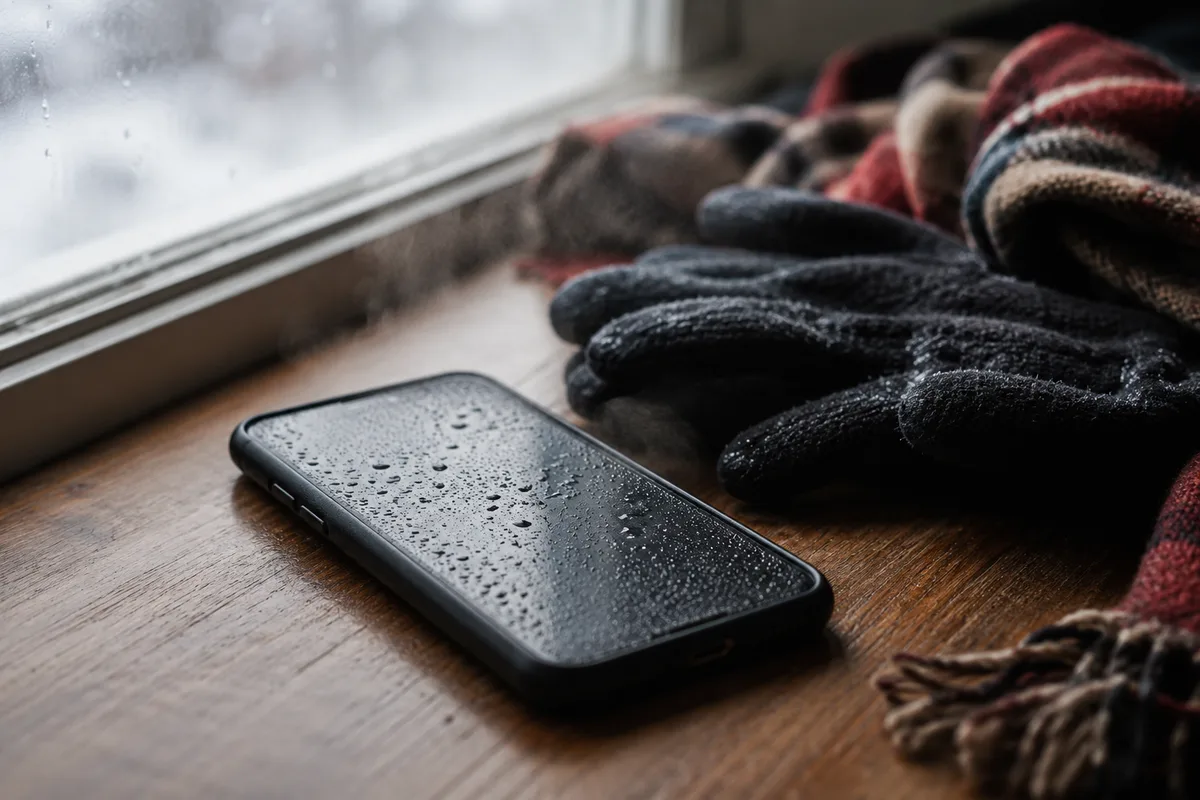
Apple specifically describes reduced battery life caused by very cold conditions as temporary.
Heat is different. High temperatures can accelerate chemical degradation inside lithium-ion cells and permanently reduce their capacity over time.
That does not mean extreme cold should be ignored, especially when charging is involved.
Be More Careful About Charging a Very Cold Phone
Using a cold lithium-ion battery and charging one are not exactly the same problem.
During charging, lithium ions need to move back into the battery’s anode. At sufficiently low temperatures, those reactions become slower.
If a battery is charged under unfavorable low-temperature conditions, lithium may begin depositing on the surface of the anode rather than being stored normally within it. Researchers refer to this process as lithium plating.
Lithium plating can contribute to battery degradation and is one reason modern devices use temperature-monitoring systems to restrict or pause charging under unsuitable conditions.
If your phone has been exposed to freezing temperatures for a long time, the safest approach is simple:
Allow it to warm gradually to its normal operating range before charging.
There is no need to speed the process up with a hair dryer, radiator, heater, or another intense heat source. Rapid heating can create its own problems.
Room temperature is enough.
How to Make Your Phone Last Longer in Cold Weather
You cannot change lithium-ion chemistry, but you can reduce how much cold affects your phone.
Keep it close to your body.
An inside coat pocket usually provides a much warmer environment than an outside pocket, bag, or exposed phone mount.
Start with a healthy charge.
A nearly empty battery has less room for voltage to fall before the phone reaches its shutdown threshold.
Limit unnecessary exposure.
Take your phone out when you need it rather than leaving it continuously exposed to freezing air.
Reduce demanding activities when the phone is very cold.
Long video recording, gaming, maximum brightness, and navigation can place additional stress on a battery that is already struggling to deliver power.
Avoid charging a freezing-cold phone immediately.
Let the device return gradually to an appropriate operating temperature first.
Check battery health if shutdowns happen frequently.
Repeated shutdowns in only mildly cold conditions may indicate that battery aging is making the problem worse.
Why Heat and Cold Are Not the Same Problem
Both temperature extremes are bad environments for batteries, but they affect them differently.
Cold mainly creates an immediate performance problem.
The battery has greater difficulty delivering its stored energy, voltage falls more easily, charging may slow or stop, and the phone can temporarily shut down.
Once the battery warms, much of that lost performance can return.
Excessive heat is more closely associated with permanent chemical aging. Repeated exposure to high temperatures can accelerate battery degradation and reduce how much charge the battery can hold over its lifetime.
So although a freezing winter day may make your phone appear dramatically less reliable, chronic overheating is generally the larger concern for long-term battery health.
Your Phone May Be Cold, Not Truly Empty
A smartphone that shuts down in freezing weather can give the impression that its battery has somehow lost hours of stored energy in minutes.
The reality is more interesting.
Cold slows the electrochemical processes inside a lithium-ion battery and increases its internal resistance. The battery then has more difficulty maintaining the voltage and power your phone needs, particularly during demanding tasks.
If that voltage drops too far, the device may shut itself down while energy still remains inside the battery.
Once the phone warms up, some of that apparently missing capacity can become available again.
So when your phone dies during a snowy walk and mysteriously comes back to life indoors, it has not created new electricity.
The cold simply made the energy it already had much harder to use.
Sources
Apple — If Your iPhone or iPad Gets Too Hot or Too Cold
https://support.apple.com/en-us/118431
Guo et al. — Lithium-Ion Batteries under Low-Temperature Environment: Current Status, Challenges, and Prospects — Materials (2022)
https://pmc.ncbi.nlm.nih.gov/articles/PMC9698970/






Join the discussion