Why Do We Mishear Song Lyrics? The Science of Mondegreens
Misheard lyrics are called mondegreens. They happen because music makes speech ambiguous and the brain uses language, memory and expectation to fill in what it thinks it heard.
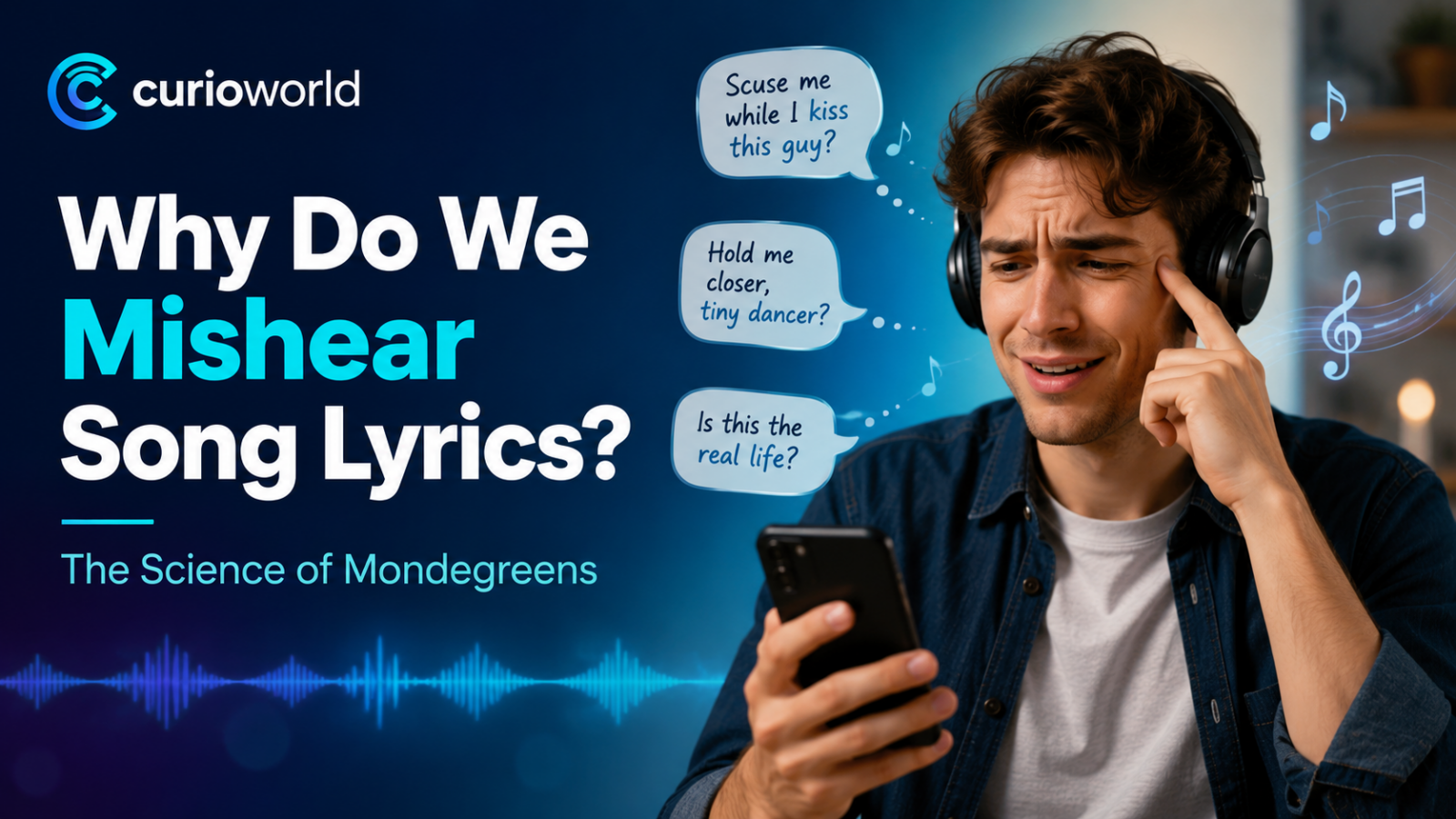
You have listened to a song dozens of times.
You are completely certain you know the lyrics.
Then one day you read the official words and realize:
You have been singing something completely different.
Even stranger, once someone tells you another possible version of the lyric, you may suddenly hear that version every time.
This common auditory illusion has a name:
a mondegreen.
A mondegreen happens when the brain interprets an ambiguous sequence of sounds as words that were never actually sung.
The reason is not simply poor hearing. Songs create unusually difficult conditions for speech perception: pronunciation changes, instruments mask parts of the voice, syllables run together, and your brain has to decide where one word ends and another begins.
When the sound is unclear, the brain fills in the gaps using language, context, expectation and prior knowledge.
Sometimes it guesses wrong.
What Is a Mondegreen?

A mondegreen is a misheard word or phrase, especially in a song or poem, that produces a different interpretation from the original.
Researchers studying the phenomenon describe mondegreens as misperceptions of speech content.
In a PLOS ONE experiment, scientists showed that listeners could actually be pushed toward an alternative interpretation of ambiguous song lyrics simply by being shown that interpretation beforehand. The study demonstrated how strongly expectation and previous knowledge can influence what people believe they hear.
That gives us the first important clue:
Hearing is not completely bottom-up.
Your ears provide the acoustic signal.
Your brain interprets what that signal probably means.
Songs Are Harder to Understand Than Normal Speech
Imagine someone speaking directly to you in a quiet room.
Their voice is relatively clear.
Now change the situation.
Add:
- drums,
- guitars,
- bass,
- background vocals,
- reverb,
- unusual pronunciation,
- stretched vowels,
- compressed consonants,
- and a melody that changes normal speech rhythm.
That is essentially what your brain faces when listening to a song.
Lyrics are speech presented under less-than-ideal conditions.
Research on lyric misperception notes that musical accompaniment and atypical pronunciation can reduce intelligibility.
So the brain has to reconstruct the message from an imperfect signal.
Usually it succeeds.
Sometimes it creates a completely different sentence.
Your Brain Has to Decide Where Words Begin and End
Spoken language does not contain neat little spaces between every word.
On a printed page, this sentence is easy to divide:
THE WORDS HAVE SPACES.
Speech is different.
Sounds flow continuously into one another.
Your brain has learned to identify likely word boundaries using:
- familiar sound patterns,
- grammar,
- vocabulary,
- rhythm,
- and context.
Music can disrupt those normal clues.
A singer may hold one syllable for several beats.
Two words may blend together.
A consonant may disappear beneath an instrument.
The brain may then place the word boundary in the wrong location.
Researchers studying cross-language mondegreens have found that mistaken segmentation of continuous speech is an important part of the phenomenon.
In simple terms:
Your ears receive something ambiguous.
Your brain divides it into words.
It occasionally divides it incorrectly.
The Brain Does Not Wait for Perfect Information
This is a broader feature of perception.
Your brain rarely receives perfect sensory information.
A conversation may happen in:
- traffic,
- a crowded restaurant,
- a windy street,
- or a room full of people.
Yet you usually understand what was said.
That is possible because perception combines the incoming signal with what the brain already knows.
If you hear:
“Please close the d—”
and a loud noise masks the final part, you probably still perceive:
“door.”
Your brain predicts the missing information from context.
Most of the time, that is extremely useful.
A mondegreen is what happens when this predictive system makes a reasonable—but incorrect—guess.
Expectations Can Literally Change What You Hear
One of the most fascinating features of misheard lyrics is what happens after someone tells you the alternative version.
Before:
You hear one phrase.
Someone shows you a different interpretation.
You replay the song.
Suddenly:
you can hear the new phrase clearly.
The audio recording did not change.
Your expectation did.
Experimental research has demonstrated this effect. When participants were shown alternative interpretations of ambiguous song lyrics, that prior information significantly increased the likelihood that they perceived the alternative version.
This is called top-down influence on perception.
Information already in your brain helps determine how incoming sensory information is interpreted.
Once You Hear the Wrong Version, It Can Be Hard to Unhear
This may be the strangest part.
You discover the correct lyric.
You understand exactly what the singer is saying.
Yet the next time the song plays, the incorrect version returns.
Why?
Because the alternative interpretation has now become familiar.
Your brain has created a strong mapping between:
this sound pattern → these words.
The PLOS ONE study found that previous knowledge of an alternative lyric could strongly affect later perception.
Once your brain has found a plausible interpretation of ambiguous audio, it becomes easier to reuse that interpretation.
That is why a mondegreen can survive even after you know it is wrong.
Music Makes Prediction Especially Powerful
The brain is constantly predicting patterns in music.
You learn:
- when the next beat should arrive,
- what melodic direction seems likely,
- where the chorus begins,
- and which phrase comes next.
Curiworld already explores this predictive side of musical memory in Why Do Songs Get Stuck in Your Head?. Familiarity and repeated exposure make musical patterns easier for the brain to reconstruct.
Misheard lyrics involve a different phenomenon, but the same predictive brain is involved.
When the acoustic information is incomplete, the brain does not simply stop.
It searches for the most plausible pattern.
Your Vocabulary Influences What You Hear
Your brain cannot interpret an ambiguous sound using a word it does not know.
That means your language experience matters.
The PLOS ONE study found that vocabulary was related to the strength of some lyric misperceptions, suggesting that the interpretations available to a listener influence what ambiguous sounds can become.
This also helps explain why two people can listen to exactly the same line and hear completely different things.
Their brains are working with different:
- vocabularies,
- expectations,
- accents,
- linguistic experiences,
- and memories.
The sound is shared.
The interpretation is personal.
Why Are Foreign-Language Songs Especially Easy to Mishear?
When you do not understand a language fluently, your brain has fewer reliable clues for identifying its word boundaries and sound patterns.
Instead, it may force unfamiliar sounds into patterns from a language you already know.
Researchers sometimes call cross-language versions of this phenomenon soramimi.
A listener hears a phrase in one language but perceives words from another language that sound vaguely similar.
Research on cross-language lyric perception shows that listeners can adapt unfamiliar speech sounds toward the phonological patterns of their own language.
This is not because the foreign singer secretly pronounced your language.
Your brain found the nearest familiar interpretation.
Are Mondegreens a Type of Hallucination?
Not in the way that word is usually understood clinically.
There is an actual external sound.
The mistake is in how an ambiguous real signal is interpreted.
This is closer to an auditory illusion.
Think about a visual illusion.
The image is physically present, but your visual system interprets some aspect of it incorrectly.
A mondegreen works similarly:
real audio + ambiguous information + incorrect interpretation.
The phenomenon is common and, by itself, is not evidence of a hearing or psychiatric disorder.
What Happens in the Brain?
Researchers have also used brain imaging to study lyric misperception.
A 2016 NeuroImage study used induced mondegreens and found activity across a network that included temporal and frontal brain regions as well as areas involved in cognitive control and interpretation.
That fits the broader picture.
Understanding song lyrics is not simply a matter of the ear detecting frequencies.
The brain must combine:
- auditory processing,
- speech recognition,
- language,
- expectations,
- memory,
- and interpretation.
A mondegreen exposes that hidden process because the interpretation becomes visibly—or rather audibly—wrong.
Why Do Misheard Lyrics Often Sound Completely Reasonable?
Because your brain prefers meaningful interpretations.
If an unclear sequence can be interpreted either as:
- meaningless noise,
- or a recognizable phrase,
the recognizable phrase has an advantage.
Language models in the brain use probabilities developed from years of listening and speaking.
Common word combinations are easier to accept.
So the invented lyric may sound completely natural even when it bears little relationship to what the singer intended.
Your brain is essentially solving an auditory puzzle.
It selects the solution that fits the available evidence.
Sometimes the wrong solution fits surprisingly well.
Why Are Mondegreens So Funny?
Part of the humor comes from discovering the gap between confidence and reality.
You may have sung the wrong version for years without questioning it.
Then the real lyric appears and your brain suddenly has two interpretations of the same sound.
Research found that the strength of some induced lyric misperceptions was associated with how amusing participants found them. The authors suggested that resolving perceptual ambiguity may itself contribute to the enjoyment.
The joke is partly the lyric.
But it is also the realization:
“How did my brain hear that?”
Can Reading the Lyrics Fix It?
Often, yes.
Seeing the official lyrics provides powerful top-down information.
Once you know which words to expect, previously unclear sounds can become much easier to understand.
But the old interpretation may not disappear completely.
Because both versions can fit the ambiguous sound reasonably well, your perception may switch between them.
This is why some mondegreens remain entertaining long after the correct lyric is known.
Frequently Asked Questions
What are misheard song lyrics called?
They are commonly called mondegreens, especially when a lyric is heard as a different phrase within the same language.
Why do I hear the wrong lyrics even when I know the real words?
The audio may remain acoustically ambiguous, while the older incorrect interpretation has become familiar. Both expectations can therefore compete when you hear the same passage again.
Why are song lyrics harder to understand than normal speech?
Music changes normal pronunciation and rhythm while instruments and effects can mask speech sounds. This gives the brain less reliable information for identifying words.
Can someone make you hear a different lyric?
Yes. Experiments have shown that presenting listeners with an alternative lyric beforehand can increase the likelihood that they subsequently perceive that interpretation.
Are mondegreens normal?
Yes. Misheard lyrics are a common form of auditory misperception and do not by themselves indicate a medical problem.
Final Thoughts
Misheard lyrics reveal something important about hearing:
The brain does not simply receive sound. It interprets it.
Music gives the brain a difficult signal.
Pronunciation changes.
Instruments mask sounds.
Word boundaries become uncertain.
Your brain combines what it hears with vocabulary, context and expectation.
Most of the time, the reconstruction is remarkably accurate.
Sometimes it invents words the singer never said.
And once your brain decides those words belong there, they can become almost impossible to unhear.
That is the science behind the mondegreen.
Sources
PLOS ONE — Mondegreens and Soramimi as a Method to Induce Misperceptions of Speech Content
PubMed — Neurobiology of Knowledge and Misperception of Lyrics








Join the discussion