Why Do Friendships Fade Even When Nobody Did Anything Wrong?
Friendships can fade without conflict because closeness depends on repeated contact, shared routines, mutual effort and opportunities to stay involved in each other’s lives—not affection alone.
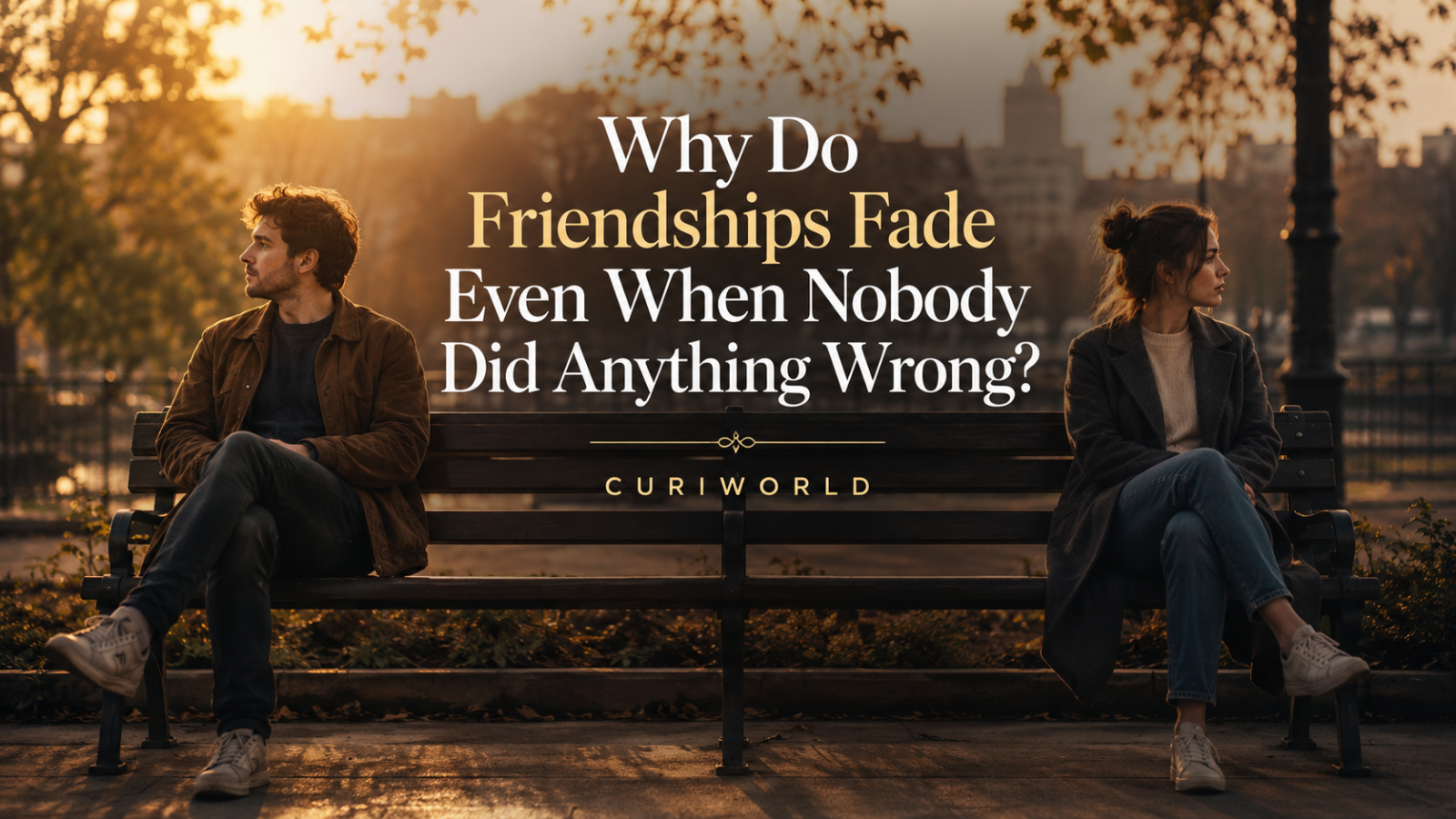
Some friendships end with an argument. Others end so quietly that years later, neither person can explain exactly what happened.
There was no betrayal. No cruel message. No dramatic final conversation. You simply stopped seeing each other as often. Replies became slower. Plans became harder to arrange. One day, a person who once knew almost everything about your life had become someone you occasionally thought about.
Friendships can fade even when nobody did anything wrong because closeness does not depend only on affection. It also depends on repeated contact, shared experiences, mutual effort, compatible routines, and opportunities to remain part of each other’s everyday lives. When those conditions change, a friendship can gradually lose intensity without either person consciously deciding to end it.
That distinction matters. Sometimes nothing went wrong between two friends.
Something changed around them.
A Friendship Can End Without a “Friendship Breakup”
Romantic relationships often have socially recognized endings. Someone says it is over. There may be a conversation, a reason, and a clear moment separating “together” from “apart.”
Friendships frequently work differently.
Research on adult friendship dissolution describes both active and passive routes through which friendships can end. An active ending might involve confrontation or an explicit decision to stop being friends. A passive ending can happen through increasing distance, reduced interaction, or a gradual withdrawal from the relationship.
That helps explain why faded friendships can feel confusing.
There may be no event to remember.
Instead, there is a sequence of tiny changes:
You talk every day.
Then every week.
Then every few weeks.
Eventually, months can pass without either person noticing how much the relationship has changed.
No single missed message ended the friendship. The accumulation of small gaps did.
Many Friendships Are Quietly Supported by Routine

Think about friendships formed at school, university, or work.
You may have spent hours together without making any special effort to do so. You walked to class together, ate lunch at the same place, shared a commute, complained about the same deadlines, or regularly ended up in the same room.
The friendship had infrastructure.
Regular contact happened almost automatically.
This is easy to overlook because we often remember the emotional connection while forgetting the circumstances that made that connection easy to maintain.
Then the context changes.
Graduation arrives. Someone changes jobs. A friend moves across the country. One person begins working nights. Another becomes a parent. The group that once met every Friday starts living in different cities.
The feelings do not necessarily disappear when the routine does.
But the friendship now requires something it did not require before: deliberate maintenance.
A longitudinal study by Sam Roberts and Robin Dunbar followed personal networks across a major transition from school into university or work. The researchers found that friendship quality could decline across the transition and that greater effort—through communication or shared activities—helped reduce that decline.
The lesson is not that every friendship requires constant communication.
It is that affection alone does not always reproduce the experiences that originally created closeness.
“We’re Both Busy” Can Actually Be a Real Explanation
“Life got busy” can sound like an excuse because almost everyone is busy.
Yet changes in time and routine can genuinely reshape friendship.
Adult life often adds competing demands: jobs, partners, children, caregiving, commuting, household responsibilities, health, education, and the practical work of maintaining everyday life.
Friendships are unusual because many are highly voluntary.
You may feel obligated to attend a work meeting or a family event. Seeing a friend is easier to postpone.
Not because the friend matters less.
Because friendship often has fewer external structures forcing the meeting to happen.
A coffee planned for Saturday becomes “next weekend.”
Next weekend becomes “when things calm down.”
Nothing is wrong.
But fewer conversations mean fewer shared stories. Fewer shared stories mean that each person gradually knows less about the other’s current life.
Eventually, catching up requires explanation rather than continuation.
That is when an old friendship can still feel emotionally meaningful while no longer feeling present.
Sometimes What Disappears Is the Shared Version of Your Lives
Two people do not need to become enemies to become less compatible.
At 20, friends may have the same classes, neighborhood, free evenings, interests, and social circle.
At 35, their daily realities may barely overlap.
One may spend weekends with young children.
The other may travel frequently.
One may become deeply interested in a new career.
The other may have moved to another country.
Neither person’s life is wrong. Their lives simply generate fewer natural points of connection.
This is one reason friendship drift can feel so strange: the history remains real even when the present becomes less shared.
You can still love the person you spent your twenties with while realizing that you know very little about their life now.
And sometimes the person you miss is partly the person they were—and partly the person you were when you were together.
New Relationships Compete for Limited Time
Meeting new people does not automatically replace old friends.
But time is finite.
A new job can introduce coworkers you see forty hours a week. Moving can create an entirely new local social circle. A romantic relationship may bring another network of people into your life.
Maintaining new connections requires attention.
Maintaining old connections requires attention too.
Roberts and Dunbar’s research highlights this basic maintenance problem: relationships require investments of time and interaction, while the amount of time available is limited.
That does not mean people coldly rank their friends and remove someone every time a new person arrives.
The process can be much less deliberate.
A nearby friend receives the spontaneous message:
“Want to get coffee?”
A distant friend requires calendars, travel, and advance planning.
Repeated hundreds of times, those small differences can reshape a social network.
Proximity is not the same thing as emotional importance.
It simply creates more opportunities for friendship to keep happening.
Friendship Depends on Small Acts of Reciprocity
A fading friendship can also develop from a surprisingly ordinary pattern.
One person thinks:
“They’ve been busy lately. I don’t want to bother them.”
The other thinks:
“They haven’t messaged in a while. Maybe they’re busy too.”
Neither is angry.
Neither wants the friendship to end.
Both wait.
Silence then begins generating its own momentum.
After a week, sending a message is easy.
After six months, it can feel strangely significant.
After three years, “Hi, how are you?” may feel as if it requires an explanation for the previous three years.
The awkwardness can become one more reason not to reconnect.
Curiworld has explored a related social puzzle in why silence can feel so different depending on the relationship around it. Silence itself carries no single meaning. Context changes how we interpret it.
The same is true of reduced contact.
A delayed reply may mean exhaustion, distraction, a demanding week, changing priorities, reduced interest—or almost nothing at all.
Friendship drift often becomes difficult to interpret precisely because there is no clear message.
Feeling Connected and Maintaining Connection Are Different Things
You can genuinely care about someone you have not spoken to in two years.
You can also feel emotionally close to a memory of a friendship while the current relationship has become weak.
Those are not contradictions.
A useful distinction is between stored affection and active connection.
Stored affection is the warmth that remains because of history: shared trips, private jokes, difficult periods survived together, conversations nobody else remembers.
Active connection is what exists now: current knowledge of each other’s lives, recent interaction, shared experiences, and ongoing mutual involvement.
A friendship can retain enormous stored affection while losing much of its active connection.
This may be why seeing an old friend after years apart can sometimes feel instantly familiar.
Curiworld’s look at why we click with some people so quickly shows how conversational coordination, perceived similarity, and mutual responsiveness can contribute to a sense of connection. Old friends may already possess years of that interpersonal familiarity.
But familiarity does not automatically restore the relationship that once existed.
Both people have continued changing while apart.
Does Fading Mean the Friendship Was Never Real?
No.
A friendship does not have to last forever to have been genuine.
This is one of the more painful assumptions surrounding friendship loss: if two people truly cared about each other, they should somehow remain close permanently.
Human relationships do not necessarily work that way.
A friend may have been exactly the person you needed during university, your first job, a difficult move, a breakup, or a particular period of your life.
Years later, the relationship may become distant.
The later distance does not erase the earlier closeness.
Relationships exist in time. Their value is not measured only by their duration.
Some friendships survive enormous changes.
Others remain closely tied to the circumstances in which they formed.
Both can be real.
Should You Try to Reconnect?
If a friendship faded without serious conflict, reconnecting does not necessarily require a dramatic conversation about why you stopped talking.
Sometimes a simple, specific message is enough.
Instead of vaguely writing, “We should catch up sometime,” mentioning a shared memory or proposing something concrete gives the conversation somewhere to go.
The response also provides information.
Maybe the warmth is still there.
Maybe both people have wanted to reconnect but neither knew how.
Or perhaps the exchange feels pleasant but confirms that your lives have moved in different directions.
Not every old friendship needs to be restored to its previous intensity.
The important question is not simply, “Were we once close?”
It is also, “Is there a friendship here that both of us want to build in the present?”
Those are different questions.
Nothing Went Wrong—But Something Still Changed
We often search for a culprit when a relationship disappears.
Who stopped trying?
Who became distant?
Who changed?
Sometimes those questions have clear answers. Friendships can end because of hurt, neglect, resentment, broken trust, or incompatible behavior.
But not every ending needs a villain.
A friendship can fade because a shared environment disappeared, contact became harder, routines separated, new responsibilities arrived, or two lives slowly stopped overlapping.
Research on adult friendship dissolution makes room for exactly this kind of complexity: endings can emerge through different combinations of situational, personal, and interpersonal factors rather than one dramatic cause.
That may be the most accurate way to understand many old friendships.
Nobody destroyed them.
Nobody necessarily decided to leave.
The conditions that once kept two people continuously present in each other’s lives simply changed—and without enough new experiences to replace the old routine, closeness gradually became history.
The friendship was still real.
It just belonged more strongly to one chapter of life than to the next.
Sources
Roberts, S. B. G. & Dunbar, R. I. M. — Managing Relationship Decay: Network, Gender, and Contextual Effects, Human Nature.
Springer Nature — Read the study
Vieth, G., Rothman, A. J. & Simpson, J. A. — Friendship Loss and Dissolution in Adulthood: A Conceptual Model, Current Opinion in Psychology.
PubMed — View the research record








Join the discussion