Why Do Video Games Use Invisible Walls?
Invisible walls are more than frustrating barriers. They keep players inside designed areas, prevent broken sequences, simplify collision, protect cameras, and help game worlds work behind the scenes.
You can see the mountain.
It does not look especially steep. Your character can jump higher than the rocks in front of it. There is no fence, locked gate, warning sign, or obvious danger.
You walk toward it anyway.
Then your character stops against absolutely nothing.
You have found an invisible wall.
Invisible walls exist because a game world is not the same thing as the playable part of that world. Developers use unseen collision boundaries to keep players inside designed areas, stop them from reaching unsupported locations, protect scripted events, simplify physics and camera behavior, and sometimes reduce the computational cost of complex collision geometry.
The frustrating part is that the best invisible walls are usually the ones players never notice.
An Invisible Wall Is Usually an Invisible Collision Boundary
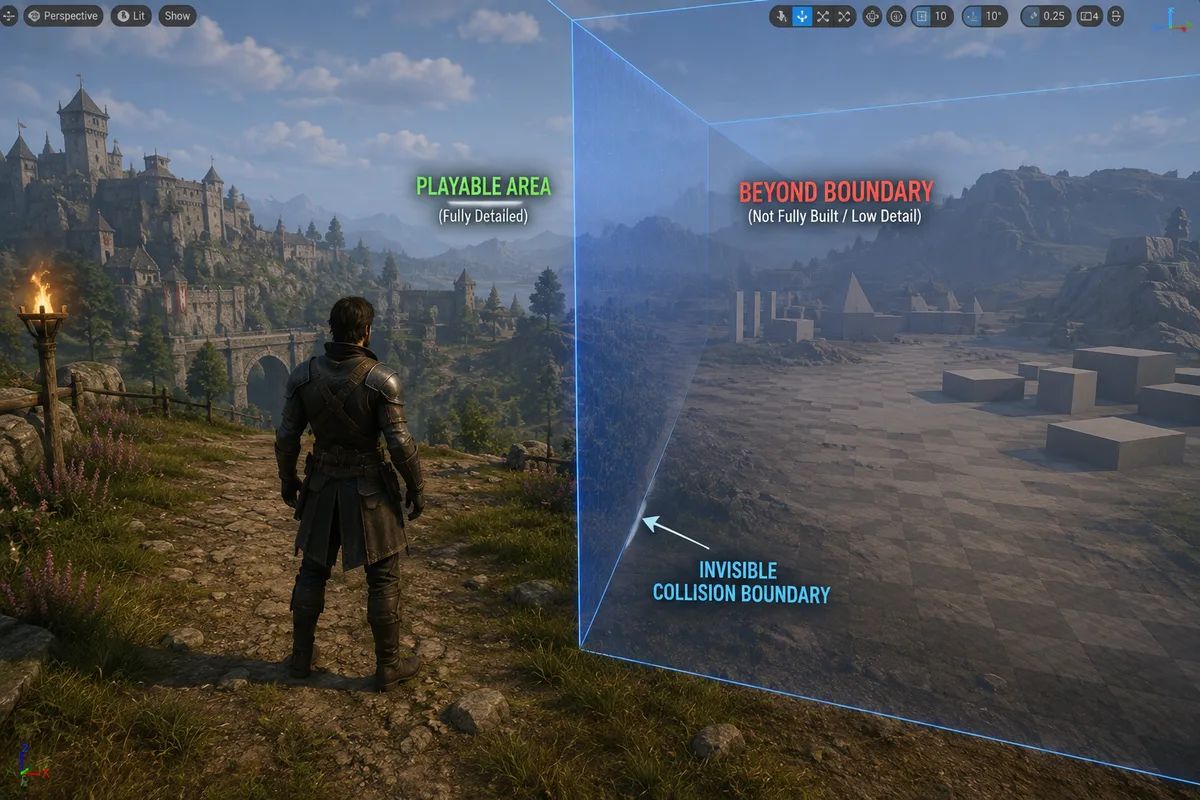
A video game character does not decide whether something is solid by looking at the pixels on the screen.
The game uses collision geometry.
A beautiful stone wall might be represented internally by a much simpler rectangular collision shape. A rocky cliff may have an invisible surface that determines where the character can stand. Developers can also place collision volumes where no visible object exists at all.
Unreal Engine, for example, includes objects called Blocking Volumes specifically for this purpose. They can act as invisible barriers that prevent players from leaving the intended play area.
So when you hit an invisible wall, you are not necessarily encountering a mysterious special effect.
You are often colliding with geometry that exists for the game’s physics system but is intentionally not rendered for you to see.
Games Need a Boundary Between “Visible World” and “Playable World”
Modern games can create enormous landscapes.
That does not mean every mountain, building, island, rooftop, or road visible in the distance is meant to be explored.
A game’s environment often extends visually beyond the space designers expect players to reach.
There are good reasons for this.
A city feels more convincing when streets appear to continue beyond the block where a mission takes place.
A mountain range makes a valley feel like part of a larger world.
A distant skyline can create scale without requiring the developers to build every building as a fully explorable location.
The visible environment therefore performs two jobs.
Part of it is a place.
Part of it is scenery.
An invisible wall can define where one ends and the other begins.
Without some form of boundary, a player might walk directly into terrain that was designed only to be seen from a distance.
Games also expose another technology limitation players quickly notice: why Bluetooth audio can have a noticeable delay.
What Is Actually Beyond an Invisible Wall?
Sometimes surprisingly little.
A game only needs to create enough detail for the places players are expected to see and visit.
An inaccessible building may have a beautiful front facade but no interior.
A mountain viewed from below might look convincing from one angle while appearing unfinished from the other side.
The road beyond a level boundary may simply stop.
Textures can become much simpler.
Objects may lack collision.
Enemies and events may not function there.
Sections of the environment might not even be loaded.
This is not necessarily lazy development.
Building a complete interactive world behind every visible object would consume development time, memory, storage, processing power, testing resources, and artist hours for areas most players would never legitimately reach.
Games create convincing illusions partly by concentrating detail where it matters.
Invisible boundaries help protect that illusion.
They Can Stop Players From Breaking the Level
Players are extremely good at going where designers did not expect them to go.
Give players a stack of boxes and someone will try to climb them.
Give them a jump mechanic and someone will test every railing.
Give them vehicles and someone will attempt to launch one onto a roof.
This experimentation is part of what makes games fun.
It can also destroy carefully designed sequences.
Imagine a level where the player is supposed to:
enter a courtyard → fight enemies → open a gate → trigger a story scene → continue into the next area.
Now imagine the player discovers that jumping from a nearby barrel onto a roof allows them to bypass the courtyard entirely.
The player may enter the next section before the game has triggered something it expects to have happened.
Enemies might not spawn.
A door could remain locked from the wrong side.
Dialogue may play incorrectly.
A mission objective might never update.
In extreme cases, progression can break.
Invisible collision can prevent these unintended shortcuts.
Game developers often call attempts to skip intended parts of a game sequence breaks. Some become celebrated speedrunning techniques. Others create bugs severe enough that developers deliberately block them.
Invisible Walls Make Complex Environments Behave More Predictably
There is another reason that has little to do with restricting exploration.
Realistic-looking environments are messy.
Consider a ruined stone wall.
Visually, it may contain:
cracks, protruding stones, gaps, debris, irregular edges, and tiny ledges.
If the game’s collision system exactly followed every detail, the player’s movement could become irritating.
A character might catch on a tiny piece of geometry.
The camera could jerk against decorative details.
An object rolling along the wall might bounce unpredictably.
Instead, developers can place a smooth invisible collision shape over the complicated visual surface.
To the player, the wall still looks detailed.
To the physics system, it behaves like something much simpler.
Official Unreal Engine documentation specifically notes that Blocking Volumes can smooth over complex collision shapes so players do not become stuck on small edges or holes.
Unity documentation describes the same broader principle: simple collider shapes can be more computationally efficient than complex mesh colliders.
The invisible shape is therefore sometimes not hiding a boundary.
It is making a visible object behave better.
Do Invisible Walls Improve Performance?
Sometimes—but this explanation needs care.
It is common to hear that games use invisible walls simply because rendering everything beyond them would destroy performance.
That is incomplete.
An invisible wall by itself does not automatically stop a game from rendering the landscape behind it.
Rendering, asset streaming, level-of-detail systems, occlusion, physics, AI, and collision are separate systems that can interact but do not all depend on one invisible barrier.
However, invisible or simplified collision geometry can reduce physics complexity.
A detailed mesh may contain thousands of geometric features that would be unnecessary for ordinary player movement. A simple box, capsule, or other primitive collider can be cheaper and more predictable.
Unity’s current documentation explicitly ranks simple primitive colliders such as spheres, capsules, and boxes as more efficient than complex mesh colliders.
So performance can be part of the reason.
It just is not the only reason—and often not the main reason a particular invisible wall exists.
Invisible Walls Can Protect the Camera Too
Sometimes the character is allowed near something that the camera should never enter.
Third-person games are especially vulnerable to this problem.
The player stands near a wall.
The camera sits several feet behind the character.
If the camera passes through the wall, the player may suddenly see:
the empty back side of geometry,
unfinished areas,
objects from impossible angles,
or the inside of a character model.
Game engines therefore support invisible camera collision.
Unreal Engine includes Camera Blocking Volumes, which can stop cameras while allowing other actors to behave differently.
This is why a third-person camera may slide smoothly along a wall even though the character is not actually touching it.
An invisible barrier may be protecting your view rather than your character.
Why Not Just Put a Fence Everywhere?
Because that can make the world look ridiculous.
Suppose a developer needs to prevent players from climbing a mountain.
The obvious solution is to build a physical barrier.
But what should it be?
A concrete wall around an untouched wilderness?
A fence stretching across an ancient battlefield?
A locked gate in the middle of an open desert?
Visible barriers need to make sense inside the fictional world.
Sometimes the environment looks better if the player can see uninterrupted scenery, even though the game still needs a technical boundary.
Invisible walls solve that problem cheaply and cleanly.
But there is a trade-off.
If the landscape strongly suggests that the player should be able to continue, discovering an invisible barrier can immediately remind them that the world is artificial.
That is why designers often try to disguise boundaries rather than leaving completely unexplained walls of air.
Open-World Games Still Have Boundaries
“Open world” does not mean infinite world.
Every open-world game eventually needs an edge.
Designers simply have more ways to hide it.
A boundary might become:
a mountain range,
deep ocean,
a collapsed bridge,
a dangerous radiation zone,
an impassable canyon,
extreme weather,
military restrictions,
or terrain too steep to climb.
These are sometimes called soft boundaries because the game communicates a reason you should not continue rather than abruptly stopping you against empty space.
The technical result can be similar.
You stay inside the playable area.
The difference is how the game explains it.
The Best Invisible Wall Is Often One You Never Test
Good level design can guide players before collision becomes necessary.
A narrow canyon naturally suggests a route.
Lighting can draw attention toward an entrance.
Architecture can frame an important doorway.
Debris can close an unused corridor.
Vegetation can make a slope look inaccessible.
A cliff can communicate danger without a warning message.
These visual signals help players understand where the game wants them to go.
The invisible collision still may be there.
But if the level communicates its boundaries clearly, most players never walk into it.
The wall is technically invisible and psychologically unnecessary.
That is usually a better result.
Why Do Invisible Walls Feel So Annoying?
Players rarely complain about boundaries that make sense.
The frustration appears when the rules seem inconsistent.
Suppose your character has spent the entire game climbing waist-high objects.
Then you encounter a waist-high fence that cannot be crossed.
Nothing about the fence explains the restriction.
The player’s understanding of the game’s rules suddenly stops matching what the game allows.
The problem is not merely lack of freedom.
It is broken expectation.
The same thing happens when an open field appears completely accessible but an invisible line stops the player halfway across it.
The environment says:
“You can go there.”
The collision system says:
“No.”
That contradiction exposes the machinery behind the fictional world.
Some “Invisible Walls” Are Actually Collision Mistakes
Not every invisible obstruction is intentional.
Sometimes collision geometry extends farther than the visible object.
A box collider might be slightly too large.
An old collision volume may remain after artists change the environment.
Two pieces of geometry can overlap incorrectly.
A decorative object may have an unexpected collision shape.
Players experience the result in the same way:
they walk into empty space and stop.
But this is not deliberate level design.
It is a bug.
Developers regularly test levels specifically to find collision problems like these because even a small invisible snag can make movement feel unpolished.
What Happens If Players Get Through One?
Usually, they discover exactly why the wall existed.
Games have a long history of players using glitches, unusual movement techniques, mods, cheats, or developer tools to escape intended boundaries.
Beyond them, the world can become strange very quickly.
You may find:
unfinished landscapes,
floating buildings,
low-resolution objects,
missing textures,
empty terrain,
geometry visible only from one side,
or huge blank spaces.
Sometimes there are even leftovers from development: abandoned sections, testing areas, unused objects, or pieces of earlier level designs.
These discoveries can be fascinating.
But they also reveal a fundamental truth about game worlds.
They are designed from the player’s expected perspective.
They do not need to remain convincing from every possible location.
Are Invisible Walls Bad Game Design?
Not automatically.
An invisible barrier is a tool.
The design quality depends on where and how it is used.
Using invisible collision to smooth movement across a detailed rock wall is unlikely to bother anyone.
Using it to stop a camera clipping through scenery can improve the experience.
Using it quietly at the edge of an area players clearly understand as inaccessible is usually harmless.
Problems appear when a barrier contradicts the game’s own visual language.
If a path looks open, safe, reachable, and consistent with every other traversable path in the game, an unexplained invisible wall feels arbitrary.
The best boundaries therefore do more than stop the player.
They make the player understand why continuing is not possible.
Invisible Walls Reveal How Game Worlds Really Work
Video games create places that can feel enormous, continuous, and alive.
Behind that illusion is a carefully controlled system of geometry, collision, cameras, scripts, AI, streaming, and level boundaries.
An invisible wall is one small part of that system.
Sometimes it keeps you away from unfinished terrain.
Sometimes it prevents you from skipping an important event.
Sometimes it keeps the camera where it belongs.
Sometimes it replaces unnecessarily complicated collision with something smoother and cheaper.
And sometimes it exists because developers simply need to say:
the game ends here.
The clever part is making sure the world itself tells you that before you ever collide with nothing.
Sources
Epic Games — Designer 01: Project Setup and Level Blockout in Unreal Engine
Epic Games Unreal Engine documentation
Unity Technologies — Collider Types and Performance
Unity collider performance documentation









Join the discussion