24 Frames Per Second: How One Number Became the Movie Standard
Movies did not adopt 24 fps because of a limit in human vision. Sound cinema needed one reliable speed—and a 1920s engineering compromise became a visual language.
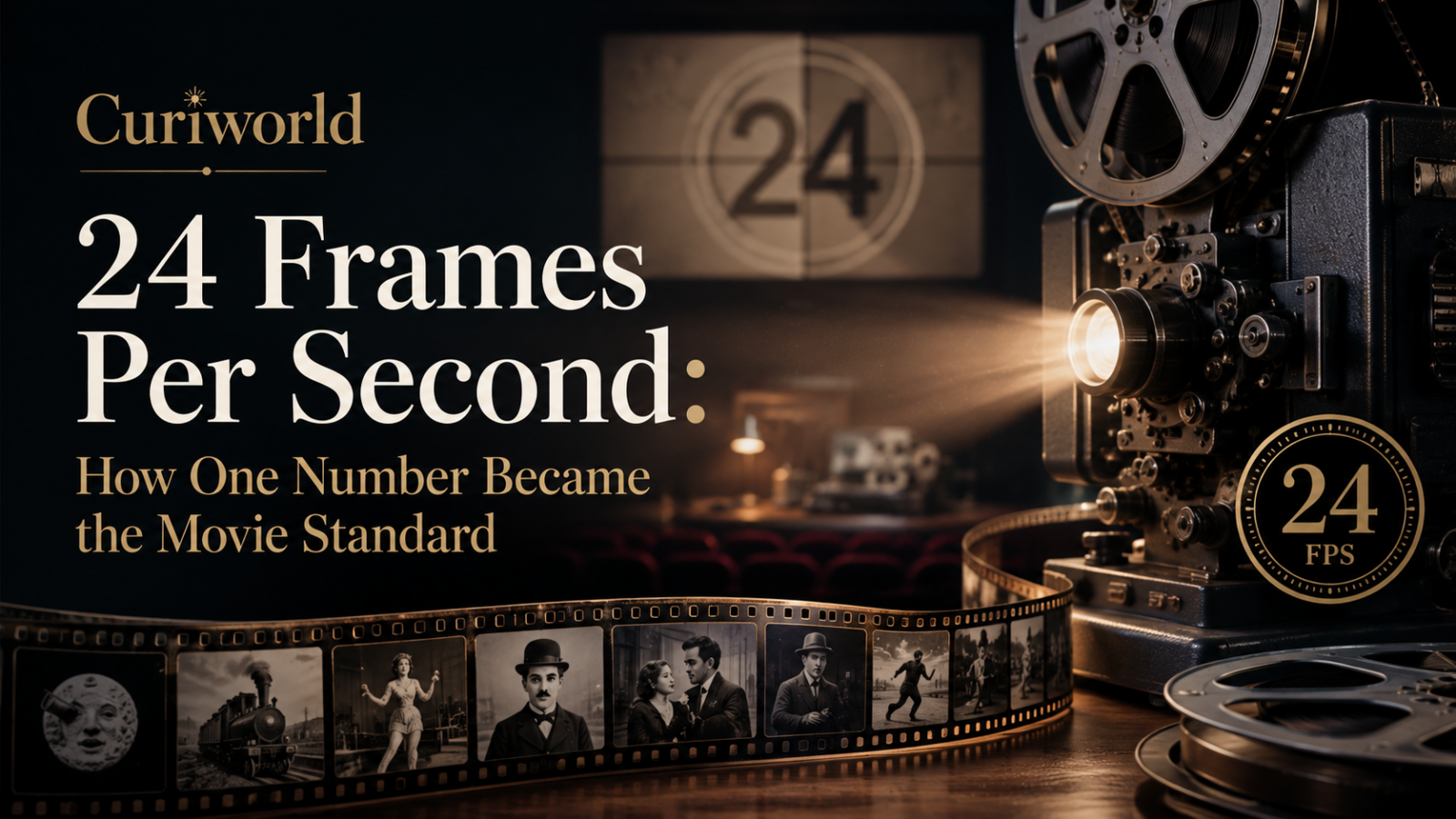
Twenty-four images every second.
That number has defined the visual rhythm of cinema for almost a century. Most theatrical movies are still associated with 24 frames per second, or 24 fps, even though modern cameras and displays can easily operate at much higher frame rates.
It is tempting to assume that 24 was discovered to be the perfect speed for the human eye.
It wasn’t.
Twenty-four frames per second became the movie standard largely because the arrival of synchronized sound forced the film industry to agree on a stable projection speed—and 24 fps was a practical choice that worked with the technology and theater practices of the late 1920s.
The “cinematic look” came later.
Before Sound, Movies Did Not Have One Fixed Speed
Early cinema was much less standardized than modern moviegoing.
Film cameras were often hand-cranked, and projection speeds could vary between productions, theaters, and even individual screenings.
The frequently repeated idea that all silent movies ran at exactly 16 frames per second is therefore misleading.
Some films were photographed at relatively low frame rates. Others were faster. Projectionists could also change playback speed.
This flexibility was possible because there was no synchronized dialogue track that had to remain locked to the picture.
If a silent film was projected slightly faster than it had been photographed, the actors simply moved faster on screen.
Once recorded speech and music had to stay synchronized with the image, that freedom disappeared.
Sound Changed Everything
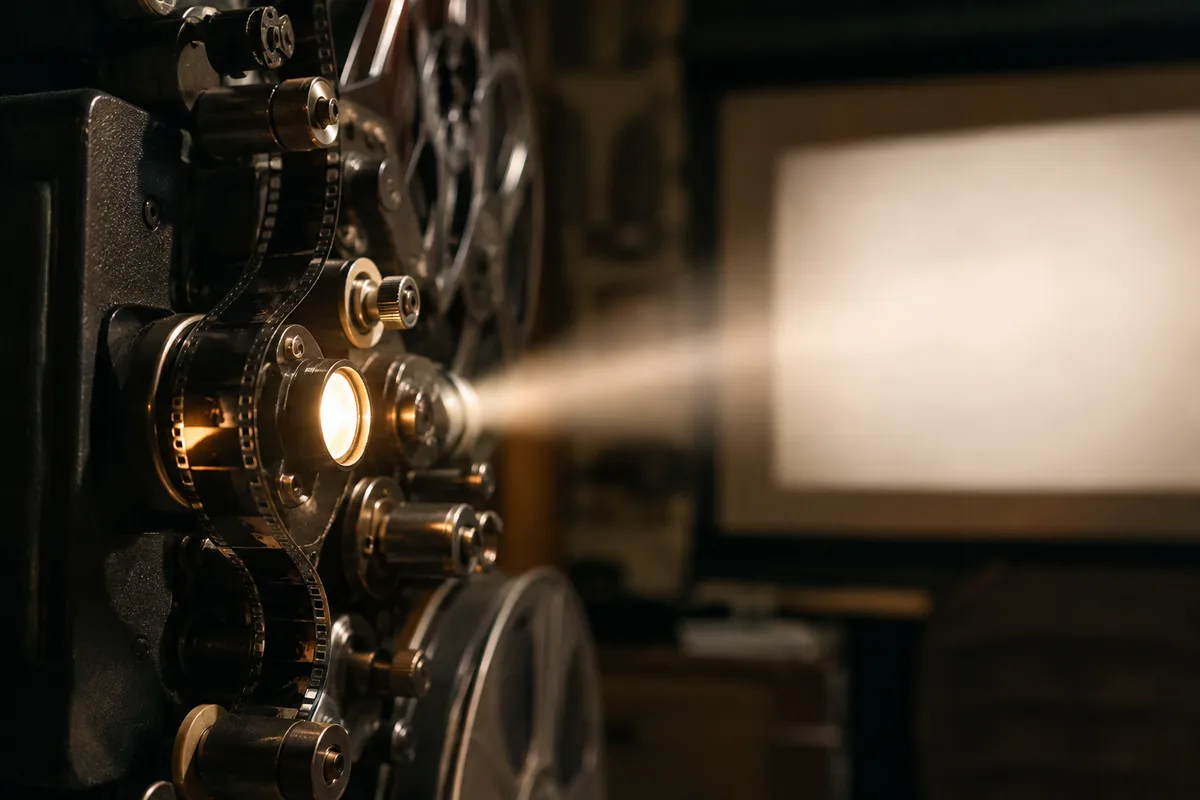
Imagine watching a movie in which the projector gradually speeds up.
In a silent film, the motion becomes faster.
In a sound film, much more goes wrong.
Voices change pitch. Music changes tempo. Synchronization between the actor’s lips and the soundtrack begins to drift.
Sound cinema therefore needed something silent cinema had managed without:
a reliable standard speed.
Western Electric and Bell Labs were among the companies developing synchronized motion-picture sound systems during the 1920s.
Engineer Stanley Watkins later recalled discussions involving Warner Bros. projection staff about how fast films were actually being shown in theaters.
According to Watkins, first-run theaters were commonly running film at around 80 to 90 feet per minute, while some smaller theaters projected even faster.
The engineers settled on 90 feet of 35mm film per minute.
With standard four-perforation 35mm film, that works out to:
24 frames per second.
Why 24 and Not 20, 25, or 30?
There was no mysterious scientific discovery showing that human vision demanded exactly 24 frames every second.
The decision was practical.
A useful sound-film speed had to be:
- fast enough for acceptable sound reproduction
- stable enough for synchronization
- compatible with mechanical camera and projector systems
- reasonably close to speeds theaters were already using
- not so fast that enormous amounts of expensive film were consumed unnecessarily
Higher frame rates would have meant running more film through the camera and projector every second.
That increased film-stock costs, processing costs, print costs, and the physical length of every movie.
Lower speeds saved film but made the technical requirements of early synchronized sound more difficult.
Twenty-four landed in a workable middle ground.
Watkins later described the choice as something reached through both engineering calculations and consultation with working projectionists rather than as a mathematically perfect number.
If you want to see how filmmakers use familiar cinematic conventions to create unfamiliar worlds, explore our sci-fi movies that make you question reality.
“The Human Eye Can Only See 24 FPS” Is a Myth
One of the most persistent explanations for 24 fps is also one of the least accurate.
You may have heard:
“The human eye can only see 24 frames per second.”
Human vision does not work like a camera with a fixed frame rate.
We continuously process changing visual information, and people can absolutely perceive differences between 24, 30, 60, 120, and other frame rates under the right conditions.
If humans literally could not perceive more than 24 fps, high-refresh-rate monitors and displays would provide no visible difference.
They clearly do.
Twenty-four fps works for cinema because sequential still images combined with motion blur can create convincing continuous movement—not because the visual system stops detecting temporal information after the twenty-fourth image.
Why Does 24 FPS Look “Cinematic” Today?
This is where history becomes psychology.
Once 24 fps became established for sound movies, generations of filmmakers used it.
Generations of audiences watched it.
Hollywood dramas, comedies, westerns, science-fiction films, romances, thrillers, and prestige productions all inherited the same basic motion cadence.
Over decades, viewers learned to associate that appearance with movies.
Traditional cinema also commonly uses motion blur associated with shutter settings near a 180-degree shutter angle.
At 24 fps, that corresponds approximately to an exposure of 1/48 second per frame.
Moving objects therefore blur between frames in a characteristic way.
Twenty-four fps plus this familiar motion blur produces the movement we have culturally learned to recognize as cinematic.
That is not proof that 24 is objectively the most beautiful frame rate.
It is partly the result of nearly a century of visual conditioning.
Why Does 60 FPS Look So Different?
Higher frame rates record more moments of motion every second.
That can produce:
- smoother movement
- clearer fast action
- less motion judder
- greater temporal detail
Those qualities can be excellent for sports, gaming, live television, simulation, and some types of filmmaking.
Yet the same smoothness can make a dramatic movie feel unusual to viewers accustomed to 24 fps.
Instead of the familiar slight separation and motion blur associated with traditional cinema, higher-frame-rate footage can sometimes feel more immediate—as if you are looking through a window rather than watching a movie.
This reaction is sometimes described as the “soap opera effect,” although that term also involves television processing such as motion interpolation.
The important point is cultural:
Higher frame rates are not inherently less realistic.
In many ways they show motion more clearly.
They simply do not match the visual language audiences spent decades learning from cinema.
Are Movies Still Actually 24 FPS?
Yes, 24 fps remains deeply embedded in professional cinema.
The Society of Motion Picture and Television Engineers still specifies 24 frames per second as the standard projection frame rate for conventional motion-picture film, while recognizing that other frame rates can be used for particular applications.
Digital filmmaking has made alternative speeds much easier.
You may encounter:
- 23.976 fps
- 24 fps
- 25 fps
- 29.97 or 30 fps
- 48 fps
- 50 fps
- 60 fps
- and much higher rates
Different rates serve different production, television, streaming, slow-motion, and technical requirements.
But if someone asks for the traditional movie frame rate, the answer remains:
24 fps.
What About Movies Shot at 48 FPS?
Filmmakers occasionally challenge the convention.
Peter Jackson’s The Hobbit films, for example, famously experimented with high-frame-rate theatrical presentation at 48 fps.
Other productions have experimented with varying frame rates or high-frame-rate capture.
These experiments demonstrate something important:
There is nothing technologically sacred about 24.
Digital cinema can operate differently.
The difficult part is audience expectation.
A movie filmed and displayed at higher frame rates can look extremely detailed and fluid, but that very clarity may feel unfamiliar when viewers expect the softer motion cadence associated with conventional cinema.
The technical limitation has largely disappeared.
The cultural convention remains.
Why Haven’t We Simply Replaced 24 FPS?
Standards become powerful once an entire ecosystem grows around them.
Cameras, projectors, editing systems, sound workflows, visual-effects pipelines, film archives, theaters, training, and artistic practice all developed around 24 fps.
Modern digital systems are more flexible, but filmmakers also understand the aesthetic language associated with the traditional rate.
There is therefore little reason to abandon it universally.
Twenty-four fps is no longer merely an engineering setting.
It is an artistic option.
A director can choose 24 because its motion feels appropriate for a narrative film, just as another production might choose a higher frame rate because smoother movement serves its purpose better.
An Engineering Compromise Became an Artistic Language
The remarkable thing about 24 fps is not that engineers discovered the perfect number for human vision.
They didn’t.
The movie industry needed synchronized sound to work reliably. The chaotic speeds of silent cinema could no longer continue. Engineers and theater professionals needed one practical standard, and 90 feet of 35mm film per minute—24 frames every second—fit the emerging system.
Then something unexpected happened.
A technical decision became familiar.
Familiarity became convention.
Convention became style.
And after nearly a century of movies, 24 frames per second no longer feels like an engineering compromise from the 1920s.
It feels like cinema.
Sources
British Entertainment History Project — Stanley Watkins: Pioneer of Sound Film Engineering
Society of Motion Picture and Television Engineers — SMPTE 194: Motion-Picture Film Projector Usage





Join the discussion