Why Are Movie Credits So Long? What All Those Jobs Actually Mean
Long movie credits reflect the enormous number of specialized people and companies involved in modern filmmaking. From grips and gaffers to Foley artists and colorists, each role supports a different part of production.
The movie ends. The villain is defeated, the mystery is solved, the screen fades to black—and then hundreds of names begin scrolling upward.
For a large modern production, the credits can feel almost as complicated as the movie itself.
There are familiar titles such as director, producer and editor, but then come the less obvious ones: gaffer, key grip, best boy, script supervisor, Foley artist, first assistant camera, colorist, production coordinator and dozens more.
Those names are not there simply because Hollywood likes long lists. A modern movie is built by many specialized departments, often across several locations, companies and stages of production. Some people work on the film months before the first scene is shot. Others join after the actors have finished and may spend another year creating sound, visual effects, music or the final image.
The credits are essentially a map of everything that had to happen before the movie reached the screen.
Why Have Movie Credits Become So Long?
One major reason is specialization.
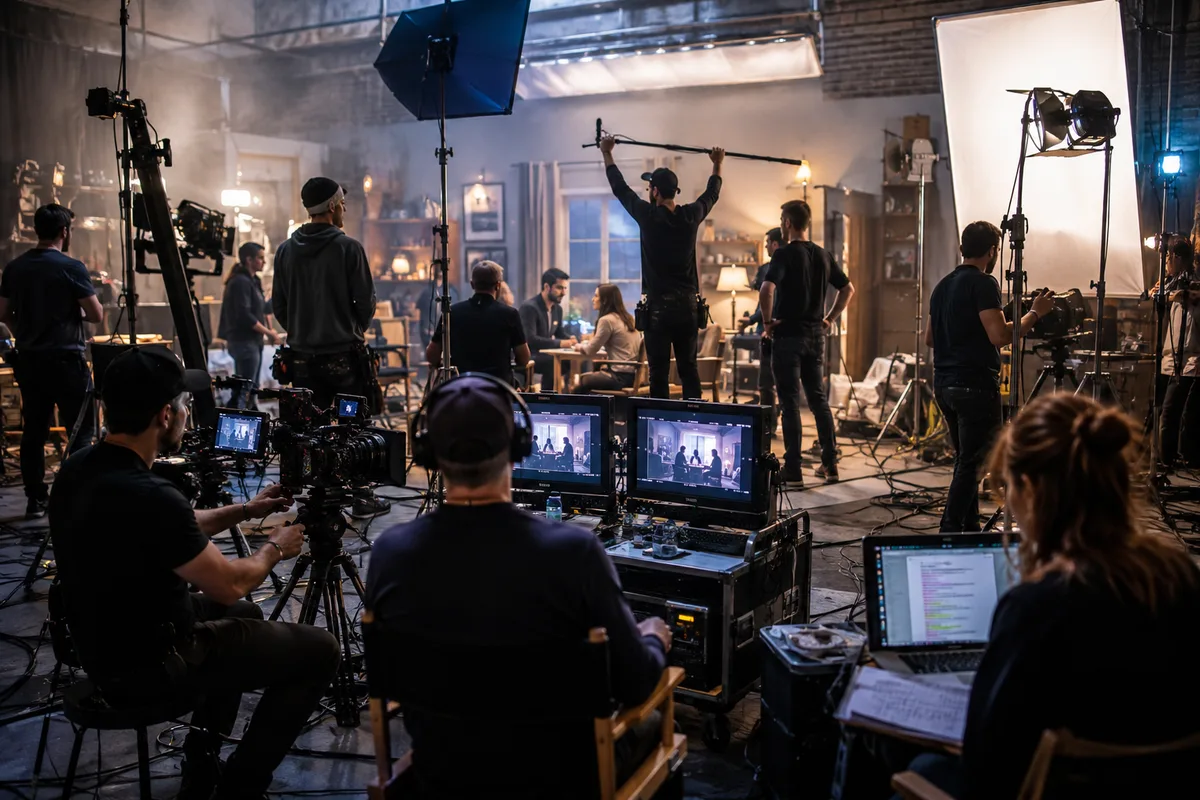
Early films could sometimes be produced by relatively small groups of people. Modern productions can require enormous teams because filmmaking has become increasingly divided into highly specialized jobs.
A single shot might involve people responsible for:
- directing the actors
- operating the camera
- maintaining focus
- moving the camera
- lighting the set
- recording dialogue
- dressing the location
- managing props
- maintaining continuity
- coordinating stunts
- adding visual effects
- editing the image
- editing the sound
- correcting color
And that is before accounting for costumes, hair, makeup, transportation, catering, construction, accounting, insurance, legal work, music licensing, subtitles, publicity and dozens of other tasks.
ScreenSkills, an industry skills organization, divides film and television work into areas including development, production management, craft, technical work and post-production, each containing its own specialized jobs.
Big movies may also use several production units and outside companies. A visual-effects studio in one country might create a digital city while another studio handles creatures and another works on explosions.
All of those contributors can add names to the final crawl.
Credits Are Also Part of the Business of Filmmaking
A screen credit is more than a public thank-you.
For many film professionals, being credited is part of their professional record. It shows what projects they worked on and in what capacity.
Credit can also be governed by employment agreements, contracts and industry guild rules.
The Directors Guild of America, for example, has formal requirements governing certain directorial credits and describes credit as an important part of compensation for employees covered by its agreements.
Not every name in a movie is there because a guild required it, and the exact rules differ between jobs and productions. But this helps explain why credit placement and wording can matter much more inside the film industry than viewers might assume.
Now for the confusing part: what do all those people actually do?
Producer: The Job That Can Mean Several Different Things
“Producer” is one of the broadest titles in filmmaking.
A producer generally helps turn a film from an idea into an actual production. That may involve securing financing, hiring important creative personnel, managing schedules, solving production problems and overseeing the project through completion.
But credits often include several different producer titles.
An executive producer may be heavily involved in financing, business relationships or high-level development.
A line producer focuses more closely on the practical operation of the production, including budgets, schedules and resources.
A co-producer or associate producer may handle specific areas depending on the production.
This is why seeing six or eight producers does not necessarily mean eight people were all doing exactly the same job.
Assistant Director: Not Simply the Director’s Assistant
The title sounds misleading.
An assistant director, or AD, is not usually someone who follows the director around carrying coffee and taking notes.
The assistant directing team helps organize the physical process of shooting.
The first assistant director plays a major role in scheduling the day’s filming, coordinating departments and helping keep the set working efficiently and safely.
The second assistant director commonly deals with areas such as call sheets, cast logistics and coordination.
On a large production there may be additional assistant directors as well.
The director concentrates heavily on creative decisions and performances. The AD department helps create the conditions that allow those decisions to be filmed.
Director of Photography: The Person Shaping How the Movie Looks
The director of photography—often abbreviated as DP or DoP—is responsible for much of the photographic look of the film.
Working closely with the director, the DP helps determine how scenes should be framed, lit and photographed.
Questions such as these often involve the cinematography team:
Should the camera move?
How bright should the scene be?
Should the background appear sharp or blurred?
Should the image feel warm, cold, soft, harsh or natural?
Which lenses and camera setups best produce the desired result?
Even basic technical conventions have long histories. If you enjoy the hidden engineering decisions behind movies, Curiworld’s explanation of why movies use 24 frames per second shows how a technical compromise from early sound cinema became one of filmmaking’s most familiar standards.
Camera Operator: The Person Actually Operating the Camera
The director of photography does not necessarily operate every camera personally.
That job can belong to a camera operator, who physically controls the camera during a shot while following the visual plan developed with the director and DP.
Large productions may use several cameras simultaneously.
That means multiple operators and camera teams may appear in the credits.
First Assistant Camera: The Focus Puller
This job is easy to underestimate until you realize how precise modern cinematography can be.
The first assistant camera, commonly called the 1st AC or focus puller, is responsible for keeping the correct part of the image in focus.
Imagine an actor walking toward the camera while the lens is using an extremely shallow depth of field.
The acceptable focus zone might be tiny.
The focus puller has to change focus smoothly while the actor moves—sometimes without relying on autofocus.
When it works perfectly, the audience never notices.
When it fails, almost everyone does.
What Is a Gaffer?
The gaffer is the head of the electrical lighting department.
The gaffer works closely with the director of photography to create the lighting required for each scene.
That can mean deciding how lights should be positioned, what equipment is required and how a lighting plan can be executed safely and efficiently.
Want moonlight through a bedroom window even though the scene is being filmed in the afternoon?
Want a face softly illuminated while everything behind the actor falls into darkness?
The cinematographer may design the photographic idea, while the gaffer and lighting crew help make it physically possible.
What Is a Grip?
A grip works primarily with equipment that supports and moves the camera and with the rigging needed to achieve complicated shots.
ScreenSkills describes grips as the people who work out how camera movements requested by the director and director of photography can actually be accomplished.
That might involve:
- dollies
- tracks
- cranes
- jibs
- camera platforms
- mounting systems
- specialized rigs
If a camera smoothly races alongside a moving actor or travels through an unusual location, the grip department may have played a major role.
The key grip leads that department.
And What on Earth Is a Best Boy?
This may be the most famously confusing film credit.
The title has survived from older production terminology and does not mean “the best male employee.”
A best boy is traditionally a senior assistant within either the lighting or grip department.
You may see credits such as:
Best Boy Electric
or
Best Boy Grip.
The job can involve organizing crew, equipment and logistics for the department.
Despite the historical title, the person doing the job does not have to be male.
Production Designer: The Architect of the Movie’s Visual World
Someone has to decide what the physical world of a film should look like.
That responsibility begins largely with the production designer.
The production designer works with the director and other departments to develop the visual environment of the story.
If a movie takes place inside a futuristic spacecraft, a Victorian mansion or an imaginary kingdom, that world does not simply appear when filming begins.
Someone has to decide:
What does the architecture look like?
What colors dominate the environment?
What furniture belongs in the rooms?
How old should everything appear?
How should the spaces support the story?
The production designer oversees that larger visual concept.
Art Director, Set Decorator and Props Are Different Jobs
Several departments then turn that concept into physical reality.
The art director helps manage and execute the production designer’s plans.
The set decorator focuses on the objects and furnishings that create the lived-in appearance of the set.
The props department handles objects actors interact with or that are required during scenes.
A lamp sitting in the background may be set decoration.
A letter that an actor picks up and reads may be a prop.
On complicated productions, those distinctions matter because hundreds or thousands of individual objects need to appear in the right places at the right times.
Script Supervisor: Guardian of Continuity
Movies are rarely filmed in the order in which you watch them.
A conversation lasting two minutes on screen might be assembled from footage recorded hours—or even days—apart.
That creates a problem.
Suppose an actor holds a glass in the right hand during one shot but switches it to the left hand when the camera moves to another angle.
When the editor cuts the shots together, the glass may appear to teleport from one hand to the other.
The script supervisor tracks details such as performances, dialogue, actions and continuity so that shots recorded at different times can still fit together.
It is one of those jobs that audiences mostly notice only when something goes wrong.
Production Sound Mixer and Boom Operator
Recording clear dialogue on a film set is much harder than pointing a microphone at an actor.
The production sound mixer oversees the sound being captured during filming.
The boom operator positions a microphone—often attached to a long boom pole—as close to the performers as possible without allowing it to appear in the shot.
That means following actors, avoiding lights and shadows, reacting to camera movements and remaining completely invisible to the audience.
The microphone hovering just above the frame in behind-the-scenes footage is often being controlled by the boom operator.
Foley Artist: Rebuilding Everyday Sounds
Many sounds you hear in movies were not captured clearly during filming.
Footsteps are a classic example.
A Foley artist recreates synchronized everyday sounds during post-production.
They may reproduce:
- footsteps
- fabric movement
- doors
- objects being handled
- body movements
- small impacts
The goal is not simply to make noise.
The sound has to match the image closely enough that the audience believes it happened naturally during filming.
A character walking across gravel may therefore be accompanied by footsteps recorded days or months later in a completely different building.
Editor: The Person Who Builds the Finished Movie
Filming creates raw material.
The editor turns that material into the movie you actually watch.
One scene may have been filmed repeatedly from several angles.
The editor decides which takes to use, where each shot begins and ends and how scenes flow into one another.
Editing influences:
- pacing
- tension
- comedy
- emotion
- clarity
- performance
Changing a cut by only a few seconds can make a joke funnier, a pause more uncomfortable or an action scene more intense.
Editors are not simply trimming unwanted footage.
They are shaping the final storytelling experience.
What Does a Colorist Do?
After editing, the image still may not look like the finished film.
The colorist adjusts color, brightness and contrast during post-production.
Shots filmed hours apart can have noticeably different lighting conditions.
Color work helps make them feel consistent.
It can also shape mood.
A scene can be made warmer, colder, darker or more stylized depending on the intended look.
The difference is often subtle enough that viewers never consciously notice it, yet it can dramatically affect how polished the finished movie feels.
Why Do Visual Effects Credits Sometimes Seem Endless?
Visual effects are one of the biggest reasons the end credits of modern blockbusters can become enormous.
VFX work is rarely performed by one person—or even one company.
A major film may send different sequences to several specialist studios around the world.
Those teams can include:
- VFX supervisors
- compositors
- animators
- digital artists
- texture artists
- modelers
- lighting artists
- simulation specialists
- matchmove artists
- technical directors
- production coordinators
Even a scene that appears relatively ordinary may contain digital work.
A modern visual effect does not always mean a giant monster or exploding spaceship.
Crews may digitally remove wires, replace skies, extend locations, duplicate crowds, alter backgrounds, combine performances or erase objects that were present during filming.
Hundreds of artists can therefore contribute to what eventually looks like a single effortless shot.
Special Effects and Visual Effects Are Not the Same Thing
The terms are often used interchangeably by audiences, but film crews usually distinguish between them.
Special effects, often called practical effects, are generally physical effects created during production.
These might include:
- mechanical effects
- rain
- smoke
- controlled fire
- breakaway objects
Visual effects, or VFX, are usually created or substantially modified digitally during post-production.
A movie can use both in the same shot.
For example, actors might stand near a practical smoke effect while a digital environment and additional destruction are added later.
Why Are Catering, Drivers and Accountants in the Credits?
Because a film set is also a workplace.
Hundreds of people may need to travel, eat, receive wages, use equipment, obtain permits and work according to a complicated schedule.
That requires people whose jobs may not sound cinematic at all.
Productions need:
drivers;
accountants;
catering crews;
medics;
location staff;
production coordinators;
legal specialists;
security;
construction teams;
and administrative staff.
They may never touch the camera.
The movie could still be impossible to make without them.
Why Are Some Credits Added After the Film Crew?
Eventually the list may move beyond the core production team.
You may see credits for:
music;
songs licensed for the soundtrack;
visual-effects vendors;
equipment providers;
filming locations;
local authorities;
archival material;
special thanks;
distribution;
and technical services.
International releases can create additional work involving subtitles, dubbing, accessibility and different delivery versions.
The final credits therefore reflect much more than what happened while actors were standing in front of a camera.
They represent the entire journey from development to finished movie.
Why Are Opening Credits Much Shorter?
Opening credits usually emphasize a relatively small group of prominent contributors.
That may include the studio, production companies, major actors, producers, writers and director.
The end credits have a different job.
They can acknowledge the much larger workforce behind the production.
That is why a movie can begin with only a handful of names but end with hundreds—or, on particularly large productions, far more.
The Credits Are the Movie Behind the Movie
A finished film can create the illusion that everything happened naturally.
An actor walks through a beautifully lit room.
The camera moves smoothly.
Every object is in the right place.
The dialogue sounds clear.
The colors match.
The music arrives at precisely the right moment.
Nothing about that sequence is accidental.
Behind those few seconds may be a cinematographer, camera operator, focus puller, gaffer, grips, production designer, set decorators, prop crew, sound team, costume department, editor, colorist and dozens of others.
That is why movie credits are so long.
They are not filler after the story.
They are the record of the much larger story required to make it.
Sources
ScreenSkills — Film and TV Drama Job Profiles
Explore film and television production roles
Directors Guild of America — Credits
Read the DGA’s guidance on screen credits





Join the discussion